
Even if you are not in California, laws and policies similar to the more restrictive states may be coming your way. California adds significant restrictions, cost, and time to purchasing a firearm in California. I am going to use numbers based on a recent handgun purchase for examples.
Handguns must be on the “Handguns Certified for Sale” maintained by the California Department of Justice, or meet one of the exemptions such as being Single Shot only, or Single Action only revolver.
Long guns must not have any of the California “Assault Weapon” features. Magazines must be 10 rounds or less, with an exception for some lever action rifles with tube magazines.
So let’s look at buying a handgun, and I am going to provide numbers from a recent purchase, and some of the infringements required in cost, time, and needless paperwork. Law Enforcement officers are exempt from many of California’s gun control laws such as the new firearms needing to be on the safe Handgun Roster.
In addition to the background check fee, sales tax, and Firearm Excise Tax there are several costs that can definitely add up.
You must have a Firearm Safety Certificate (FSC) that is current. This takes $25 and a multiple choice test. Several of the questions on the test ask you to affirm gun control myths.
Costs may include a California compliant lock, lockbox, or safe. California recently made the list far more restrictive. The compliant safe I purchased in 2020 for example is no longer compliant. If you do not have one, or have one that can’t be verified, you will need to purchase a locking device when you pick up the firearm. Some retailers will let you return it immediately, some won’t.
In addition, you may need to pay a transfer fee to the FFL assisting with the transfer. In my part of California the cheapest I could find was $75 per firearm. Others ranged up to $175, and some are $100 for the first firearm, $50 for a second or third firearm. Some charge an additional fee of the FFL who is sending the transfer does not include the California Firearm Shipment Approval form. The distributor used by selling FFL to ship the firearm did not include the form, but I was using an FFL for the transfer that did not charge extra for that. California limits purchases to three firearms in 30 days. Most firearm purchases made online will have this transfer fee. There is one company that works with local gun stores as partners, and you pay a deposit with them, but complete the purchase at the local gun store.
So what does this look like in actuality?
Let’s look at a handgun purchase. A California compliant version is often a little more expensive than the same model in a non-California compliant version. However, I was looking for a specific revolver: Cimarron Arizona Ranger with 5.5” barrel in 45 Colt. It is a clone of the Colt Single Action Army that has most parts made in Italy, but worked on by Cimarron with an action job, and the original Colt style hammer instead of the import safety hammer. MSRP is $743.75. Locally the cheapest I could find it was almost $900.
This firearm is not on the handgun roster, but because it is a Single Action Only revolver, it is exempt from the roster requirement. This can and did lead to some confusion with FFL employees processing the paperwork.
I found it online from an FFL in New Hampshire for $669.99 on Gunbroker with free shipping and no credit card fees. This was enough below the local retailer, that the transfer fee ($75.00) was still coming out ahead. I placed the order on a Friday.
Gunbroker collected sales tax. I had to send a copy of the invoice from Gunbroker to the FFL doing the transfer to avoid paying sales tax again, although that led to confusion later. It turned out it was actually being drop shipped from a distributor in Illinois. It was shipped on Monday, and arrived on Wednesday.
I reached out to the local FFL via email to verify they received it, and heard nothing.
A California Firearm Safety Certificate (FSC) is good for 5 years, and mine expired about a year ago. When originally introduced it was supposed to be good for your lifetime. Then it was only for handguns, and eventually extended to all purchases and transfers. It is not a permit to own, but only a certificate issued by employees at an FFL who have been certified by the state to administer the test. $10 goes to the FFL administering the test, and $15 to the state of California for a total of $25. The test is a multiple choice test that requires you mark several gun control talking points as true. A few questions are worded to be somewhat tricky.
If it expires currently you can continue to own firearms, just not purchase or have any transferred to you. Governor Newsom recently signed SB948 that adds training requirements in addition to the test to obtain an FSC starting in January 1, 2029. SB948 also requires new residents to obtain an FSC before they register their existing firearms with California Department of Justice starting January 1, 2028.
Saturday I went into the FFL, took the FSC test, and missed one question. I had to remember to answer what the state wanted on several of them. I inquired about the status of my firearm, and found out it was in limbo because the California Firearm Shipment Approval paperwork was not included by the shipper. I called the selling FFL, and they said they would work with the distributor on Monday. However, the selling FFL was closed on Mondays. I reached them on Tuesday, and they emailed the paperwork. On Wednesday the transferring FFL called me and left voicemail as I was calling them. They were ready for my part of the paperwork and the start of my 10-day or more wait.
The California waiting period is exactly 10 days or 240 hours at a minimum. If the state runs into any ambiguity on the background check they extend it to at least 30 days. If they extend it, it seems that it always goes to 30 days (720 hours) at least, even if they determined you have passed your background check on day 11. After 30 days if they have not come back with an answer it is listed as “undetermined” and the transferring FFL can transfer it to you, but if they come back later saying you were denied, the FFL is supposed to recover the firearm from you is my understanding. Some FFLs will not transfer on undetermined status because of that.
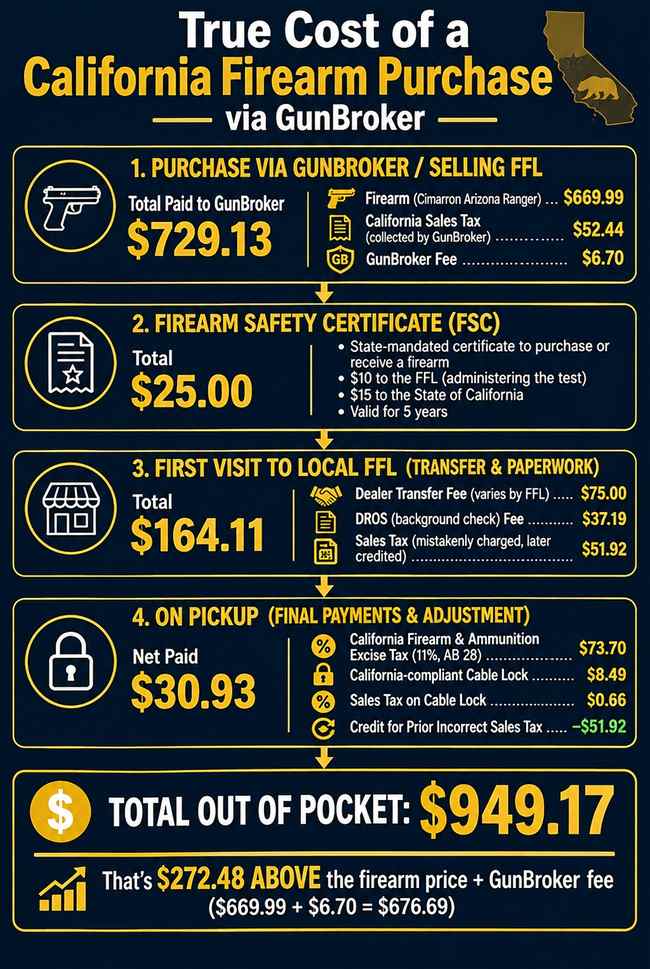
I went in and did the paperwork, and paid $164.11. That included a $75 transfer fee, $37.19 DROS or background check fee, and $51.92 sales tax. I had already paid sales tax through Gunbroker, so they should have charged me $73.70 for the California Firearms Excise Tax (FET). They noticed the error the next day and agreed to pay the difference on pickup.
I received a copy of the DROS and it stated California received the DROS at 3:19 PM and 17 seconds on October 22, 2026. My earliest possible pickup date was November 1, 2026 at 2:19 PM and 17 seconds because of the change from daylight to standard time during the 10 day wait. Exactly 240 hours to the second.
On November 1, 2026, I went in to pick it up, and was told there were additional issues. The gun safe I purchased in 2020 met the state requirements. However, the state changed to a roster of safety devices, and that safe was not listed on the roster. In order to receive the firearm I needed a safety device that was on the roster. The cheapest the FFL had on the safety device roster that was listed as a universal device was $8.49. So on pickup I paid an additional $30.93: $73.70 FET, $8.49 lock, $0.66 sales tax on the lock, and then a credit of $51.92 for the sales tax mistakenly collected.
The actual total ended up being $949.17. That's $272.48 above the purchase price and Gunbroker fee.
In California, buying a gun isn't just a financial transaction; it's an obstacle course designed by politicians who seem intent on making exercising a constitutional right as expensive, inconvenient, and frustrating as possible.