
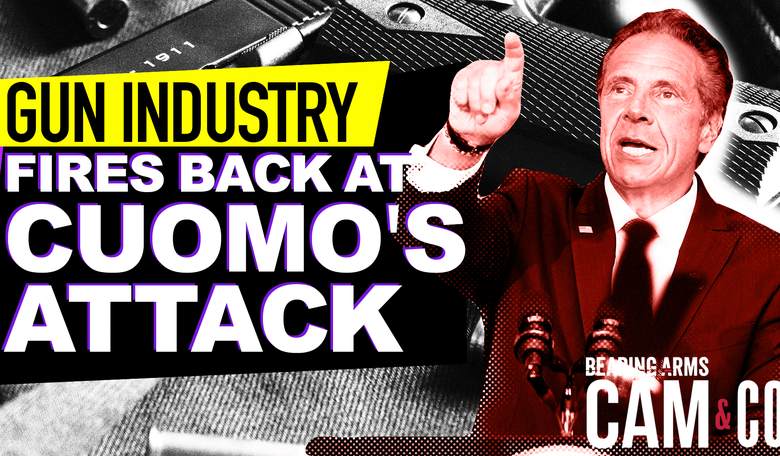
New York Gov. Andrew Cuomo threw down the gauntlet on Tuesday with his announcement that a new state law will allow the state’s anti-gun Attorney General to sue the firearms industry under public nuisance statutes. Now the firearms industry is vowing a legal challenge to that new law, and on today’s Bearing Arms’ Cam & Co the National Shooting Sports Foundation’s Mark Oliva joins the show with a preview of the arguments that the trade group will be bringing to court.
Despite the claims by Cuomo and New York AG Letitia James that the new law will be upheld, Oliva says it’s clear that what the state is doing is clearly in conflict with the Protection of Lawful Commerce in Arms Act. The 2005 law, which was approved by a bipartisan vote in Congress in 2005, prohibits lawsuits against the firearms industry seeking to blame them for the actions of criminals, but that’s exactly the intent of New York’s new attack statute.
In fact, as Oliva points out, Andrew Cuomo himself helped birth the Protection of Lawful Commerce in Arms Act thanks to his embrace of using junk lawsuits to bankrupt the gun industry when he was HUD Secretary during the Clinton administration. Cuomo knew that these lawsuits didn’t have to lead to courtroom victories for anti-gun activists in order to be successful. He actually called for “death by a thousand cuts” for the firearms industry; slowly bleeding dry both gun makers and gun sellers by forcing them to hire attorneys and pay legal fees in litigation that would eventually be tossed out by the courts, but not before first emptying out the bank accounts and draining the capital of these companies.
The other option? Settle with those initiating the lawsuits and agree to a host of demands. That’s what Smith & Wesson did in 2000, acquiescing to a host of demands that gun control groups are still trying to turn into federal law. This is how the Clinton White House described the provisions of the settlement.
- Locking devices. Safety locking devices will be required for handguns and pistols, external locking devices within 60 days and internal locking devices within 24 months.
- Smart guns. Two percent of annual firearms revenues will be dedicated to the development of authorized user technology that can limit a gun�s use to its proper owner. Authorized user technology will be included in all new firearm models within 36 months.
- Large capacity magazines. New firearms will not be able to accept ammunition magazines with a capacity of over 10 rounds. The manufacture of such magazines has been prohibited since 1994.
- Safety testing and standards. All firearms are to be tested by ATF to ensure that they meet performance and safety standards such as drop tests.
- Other safety devices. Within one year, all pistols will have chamber load indictors to show that a pistol is loaded to prevent accidents, and magazine disconnectors will be available to customers within 12 months.
- New sales and distribution controls to help keep guns out of the hands of criminals and help law enforcement crack down on illegal gun traffickers. Under the deal, manufacturers will agree to sell only to authorized dealers and distributors who agree to a code of conduct. The code of conduct imposes new requirements on authorized dealers and distributors.
- Cutting off dealers with disproportionate crime guns. Under the agreement, manufacturers will take action against dealers or distributors who sell disproportionate numbers of guns that turn up in crimes within three years of sale, including termination or suspension against the dealer or distributor.
- Gun shows. Authorized dealers cannot sell at gun shows unless every seller at the gun show conducts background checks.
- Ballistics testing. To help law enforcement trace guns used in crime when only the bullet or casing is recovered, ballistics fingerprints will be provided for all new firearms to ATF/FBI National Integrated Ballistics Identification Network within 6 months if technologically feasible.
- Safety training for purchasers. No sales will be made to dealers who do not require gun purchasers to demonstrate that they can safety handle and store firearms.
- Theft prevention. No sales will be made to dealers who do not implement a security plan to prevent gun theft.
- Weapons attractive to criminals. Authorized dealers and distributors will not sell large capacity ammunition magazines or semiautomatic assault weapons.
- Restrictions on multiple handgun sales. To deter illegal gun trafficking, dealers must agree to new limits on multiple handgun sales. All purchasers of multiple handguns can only take one handgun from the day of sale, the remainder 14 days later.
Eliot Spitzer, who was New York’s Attorney General at the time Cuomo was at HUD, was equally as enamored of the strategy, allegedly warned a Glock executive that unless they followed Smith & Wesson’s lead, “your bankruptcy lawyers will be knocking at your door.”
Smith & Wesson nearly went out of business thanks to the consumer hostility towards the company’s leadership signing off on the agreement, and the brand was ultimately sold to new management a few years later. I don’t think there are any gun manufacturers today that are delusional enough to believe they can keep the support of Second Amendment supporters while bending their knee to the gun control lobby, which tells me that New York’s current move is more about putting the firearms industry out of business than reaching any kind of agreement. Besides, the gun control lobby is trying to get longtime anti-gun activist David Chipman confirmed as ATF director. Why try to broker a settlement when you’ve got your man at the top of the agency overseeing the entire firearms industry?
The New York law is clearly just one of many threats the firearms industry is facing, but Oliva sounds confident that the NSSF’s upcoming legal challenge will be able to overturn the law before Letitia James can wield it as a cudgel against gun makers, gun shops, firearms distributors, and ultimately, the Second Amendment itself. I hope he’s right, and that Cuomo’s death by a thousand cuts strategy dies a quick death at the hands of the federal judiciary.