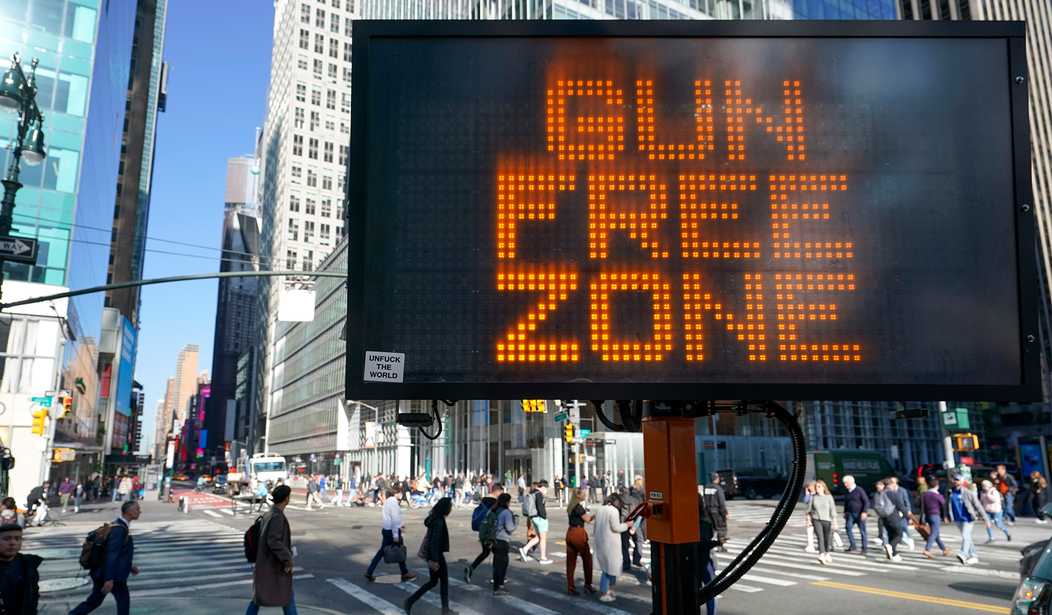
The Supreme Court is already slated to hear oral arguments next month in a case challenging Hawaii's default ban on lawful concealed carry on all private property open to the public, but now the Court is showing its interest in another case dealing with "gun-free zones".
On Wednesday the Court requested the defendants, which include the state of Illinois and Cook County, file a response to the cert petition in Schoenthal v. Raoul. The case is a challenge to the ban on lawful concealed carry on public transportation imposed by both Illinois and the Chicago Transit Authority. While that request doesn't guarantee the justices will ultimately hear the case, it does up the odds considerablly.
Violent crime on Chicago's transit system is, unfortunately, pretty common. Just last month a woman was set on fire on a CTA train, but robberies, assaults, and shootings happen on a regular basis. Despite the frequency of these crimes, both the state of Illinois and the CTA prohibit all weapons from being carried on public transportation, which leaves concealed carry holders in a position where they're not only disarmed while riding the CTA's buses and trains, but before and after they use public transit as well.
Several concealed carry holders sued over the ban and won an injunction in federal district court, but the Seventh Circuit Court of Appeals reversed that decision by, in part, claiming that there's a national tradition of banning guns in "crowded public spaces." The appellate court argued that, even though there were no laws banning possession of firearms on trains in the 19th century, some private railroads did prohibit guns on board, and there were multiple statutes that prohibited the discharge of firearms on or near trains.
The Seventh Circuit further argued that public transportation is government property, and bans there are akin to prohbitions on lawful carry in courthouses, polling places, and other government-owned locations. The appellate court also contended that public transportation may contain “vulnerable populations" like children, an argument that other courts have used to uphold bans on lawful carry in places like museums and libraries.
In their cert petition, the plaintiffs pushed back on that contention, arguing that it is "squarely contrary to this Court’s binding interpretation of the Second Amendment."
As noted several times above, the Second Amendment is not an illogical or unreasoned restriction on the ability of the government to legislate—it embodies a decision of the American people to elevate above other interests the right of the people to defend themselves with arms. Consistent with that understanding of the Amendment, the answer, throughout our nation’s history, to places where “vulnerable populations” can be found, has been to require able-bodied and peaceable citizens to arm themselves for their collective protection. Indeed, given that the relevant type of “danger” to be concerned about here is armed attack (or an attacker bent on violence witha size and strength advantage), it is hard to know what a “vulnerable population” could be except a disarmed one.
The plaintiffs went on to suggest to the Court that Schoenthal offers a better opportunity to flesh out its "sensitive places" doctrine than the Wolford case dealing with Hawaii's default carry ban.
While the decision below in Wolford, discussed repeatedly above, dealt with similar “sensitive place” restrictions to the Illinois law at issue here, the portion of the law that this Court will be considering is not a “sensitive place” restriction. Rather, that case deals with Hawaii’s presumptive ban on carrying firearms in all private property open to the public, but that presumptive ban only has meaning in locations that Hawaii has not deemed sensitive, since in those locations carry is absolutely prohibited, regardless of the wishes of the property owner.
This case therefore would provide a useful companion to Wolford. Indeed, given that Wolford remains the only court of appeals decision to uphold the presumptive ban on carrying on private property, but the Seventh Circuit’s decision below is broadly representative of several court of appeals decisions upholding “sensitive place” restrictions, granting this case in addition to Wolford would ensure that this Court’s guidance on the increasingly important where question in Second Amendment would meaningfully impact the courts of appeals at their greatest point of confusion.
Second Amendment Foundation's Kostas Moros believes the Seventh Circuit's decision in Schoenthal will likely be vacated by SCOTUS, but rather than taking up the case itself the Court will instead remand it back to the appellate court for further review after it issues its opinion in Wolford. Even if that's what the justices decide to do, it would be a much better outcome than simply allowing the Seventh Circuit's decision to stand, but I'm hopeful that the Court will grant cert to Schoenthal early next year.
The Court has scheduled Schoenthal to be discussed at it's January 9 conference, but since the reply briefs from the defendants aren't due until January 16 we probably won't learn whether the justices have decided to hear the case until late next month or early February. Fingers crossed that there are four justices ready to take on this particular "gun-free zone" and provide relief to countless concealed carry holders in places like Chicago, New York City, St. Louis, and other major metropolitan areas where they must disarm themselves before using public transit.