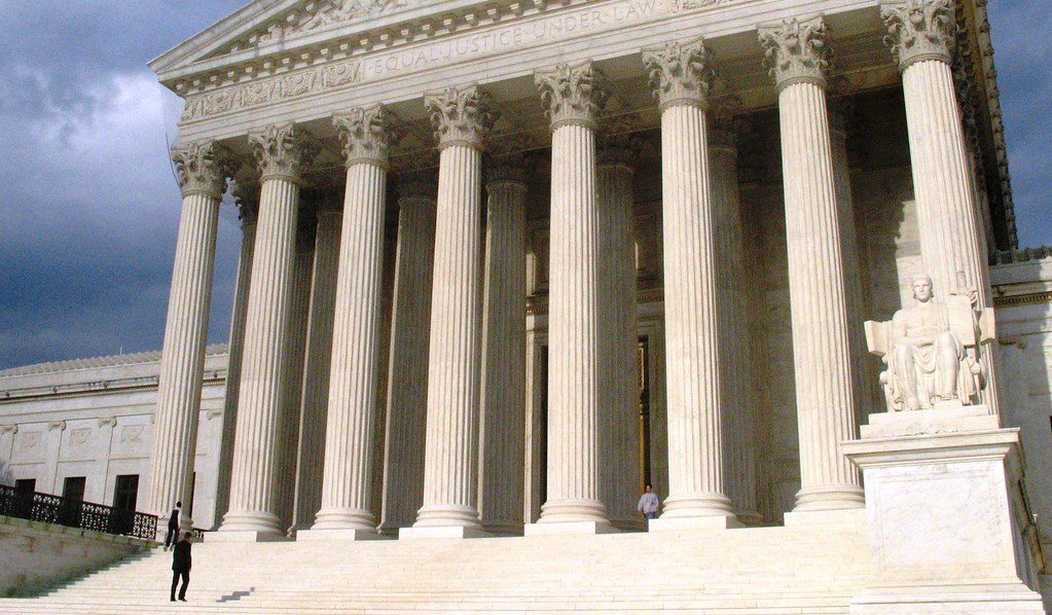
Jonathan Lowy, the former litigator for Brady who's now the head of something called Global Action on Gun Violence, was on the receiving end of a 9-0 Supreme Court decision against his client in Smith & Wesson v. Mexico, where SCOTUS unanimously concluded that the Mexican government's attempt to sue U.S. gunmakers for aiding and abetting cartel violence was not only foreclosed by the Protection of Lawful Commerce in Arms Act, but was based on a number of implausible allegations that Lowy failed to prove.
Lowy gets good money from anti-gun groups like Everytown to tilt at windmills, though, so that embarrassing loss isn't keeping him away from the Supreme Court. Global Action on Gun Violence recently submitted an amicus brief in Wolford v. Lopez arguing that Hawaii's "vampire rule" prohibiting concealed carry on all private property unless property owners explicitly allow it should be upheld because SCOTUS was wrong in Heller when it concluded that the Second Amendment protects and individual right to keep and bear arms.
The Second Amendment uniquely states its“well-regulated militia” purpose in its text, and, for over two centuries, courts faithfully and consistently interpreted it in light of that text and purpose. In modern parlance, it was read, logically, as its author, James Madison, intended; essentially, “Because a well-regulated militia is necessary to the security of a free State, the right of the people to keep and bear arms in state militias shall not be infringed.” The history surrounding the Second Amendment’s drafting and ratification make clear that Madison and the other Framers were animated only by anti-federalist concerns that the new federal government could neuter state military forces.
... The Court in District of Columbia v. Heller replaced Madison’s vision with an ahistorical, atextual reading of the Second Amendment that renders its first half an inconvenient irrelevancy and injects a modern purpose of private, armed self defense with handguns that was nowhere mentioned in the Amendment’s text or history. After Heller, the courts have been required to interpret the Second Amendment essentially (and nonsensically) as:
“Because a well-regulated militia is necessary to the security of a free State, the right of the people (including those who have nothing to do with the militia and may even oppose the state) to possess arms for private self-defense (wholly unrelated to militias) shall not be infringed.” That interpretation is wrong.
Lowy's argument was thoroughly rejected by the majority in Heller, which rightfully noted that the prefatory clause of the Second Amendment doesn't make the right to keep and bear arms contingent on service in the militia. There are dozens of court cases from the 1790s onward that discuss the right to keep and bear arms without a militia context, and even the Supreme Court's decision in Miller doesn't state that the right to keep and bear arms is a collective right to serve in a militia, only that those arms that have a reasonable relationship to the preservation or efficiency of a well-regulated militia are protected by the Second Amendment.
But if the Second Amendment doesn't protect an individual right to keep and bear arms, then Hawaii and other anti-gun states are free to pass whatever gun laws they want, up to and including outright bans on gun ownership.
Lowy doesn't stop there. He also says Bruen was wrongly decided, and the "text, history, and tradtion" test spelled out by the Court is nothing but nonsense as well. Even if SCOTUS wants to view the right to keep and bear arms as an individual right, Lowy argues:
The Second Amendment is not a “super right” that entitles people to bring firearms into the property of other people without permission. The Hawaii statute at issue here seeks to protect that “sacred” right to private property.
I don't think anyone is claiming that the Second Amendment gives people the right to carry onto private property over the objections of the property owner. Instead, the argument is over whether Hawaii's default ban on carrying comports with the text, history, and tradition of the Second Amendment... and it clearly does not. The only laws that Hawaii cited in defense of the law that were viewed favorably by the Ninth Circuit were an 18th century New Jersey law prohibiting carrying firearms onto improved lands and an 1865 Louisiana statute barring the carrying of guns onto private plantations. Neither of those laws suggest a national tradition of banning firearms from all publicly accessible places unless a property owner expressly gave consent beforehand.
The gun control lobby is so well funded that a guy like Lowy can make a good living off of bad arguments like these. I'm not worried in the slightest about the Court adopting his position in Wolford, but it's critically important that gun owners continue to support pro-Second Amendment organizations who provide fact-based rebuttals to Lowy and his allies; not just at SCOTUS but in the lower courts as well, where unfortunately there are some judges who are inclined to buy the baloney Lowy's packaging and selling.
Editor's Note: To celebrate Christmas and ring in 2026, Bearing Arms is matching our biggest sale ever on VIP memberships. Now through January 1, until 11:59 pm PT, receive 74% off a VIP membership using promo code MERRY74!







Join the conversation as a VIP Member