
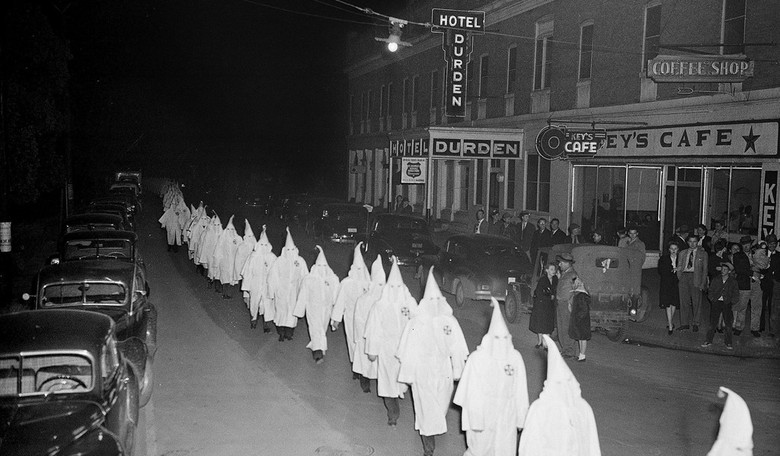
While scholars like Carl Bogus and armchair historians like Malcolm Gladwell like to claim that the Second Amendment is rooted in racism, there's far more evidence for the racist roots of gun control laws. From 17th century prohibitions on slaves possessing firearms in Virginia to an 1825 Florida law that allowed whites to “enter into all Negro houses” and “lawfully seize and take away all such arms, weapons, and ammunition,” early American history is replete with restrictions on the right to keep and bear arms that applied to blacks, Native Americans, and even religious minorities while leaving most white Americans free from those restrictions.
After the Civil War, some gun control laws were written in racially neutral language but were designed or enforced to keep newly freed slaves from exercising their rights. The 1865 Louisiana law that barred people from bringing guns onto the property of plantation owners that was cited by Hawaii in defense of its "vampire rule" in Wolford, for example, didn't single out freed slaves or "Negroes," but it was still a part of the infamous Black Codes designed to restrict the freedom of newly freed slaves and freedmen in the state during Reconstruction.
NRA-ILA's Joseph Greenlee and University of Wyoming law professor George Mocsary explore some of these laws in a new article in the Yale Law Journal. They contend that even though racist gun laws can be found throughout our nation's history, "a historical law does not become an authoritative measure of constitutional meaning simply because it was enacted."
Such enactments cannot be erased from history, but neither should they become affirmative precedents for modern restrictions merely because they existed. Instead, they should serve as “anti-analogues”—counterexamples illustrating the abuses that constitutional guarantees were intended to prevent.
Gun control advocates have argued that the absence of a particular policy in the past isn't always evidence that a modern law isn't a part of the national tradition of gun ownership. Legislators don't always act to the maximum of their constitutional ability, so just because a state didn't ban repeating rifles doesn't mean that they couldn't have done so without violating the Constitution.
Greenlee and Mocsary's argument is a corollary of sorts to that theory: just because lawmakers did adopt a law doesn't mean that it was constitutionally sound at the time or relevant to a modern gun control statute today.
This doesn't apply only to laws steeped in white supremacy. Hawaii also cited the "spirit of Aloha" in defense of its vampire rule, arguing that the traditions of the kingdom of Hawaii did not include a right to keep and bear arms. The Supreme Court rejected that argument, opining that “the Second Amendment has the same meaning in all parts of the United States,” and that that meaning “cannot give way to ‘the spirit of Aloha’ in Hawaii, any more than it can yield to the spirit of the Big Apple (Bruen) or the Windy City (McDonald).”
As Greenlee and Mocsary put it:
The significance of Wolford is not merely that Hawai‘i’s historical argument failed; it is that the argument misunderstands the nature of a written Constitution. Upon entering the Union, a state accepts the constitutional order as it exists; it cannot redefine the scope of a national, preexisting right by pointing to its own historical practices—particularly where those practices reflect a sovereign choice to restrict that right.
Laws like the Black Codes cannot be used to justify modern gun control restrictions, but Greenlee and Mocsary say they "nevertheless are constitutionally significant" because they "exemplify regulations the constitutional order repudiated and therefore can operate as negative evidence against treating relevantly similar modern restrictions as part of a lawful historical tradition."
The relevant question is not whether Black Codes existed but whether enactments adopted as instruments of racial subordination, including specifically the denial of the right to keep and bear arms, can define the lawful scope of a constitutional right that the Reconstruction Amendments were enacted to secure. The majority effectively answered that question by treating Black Codes not as evidence of constitutional tradition, but as evidence of the constitutional evil that Reconstruction repudiated.
Gun control advocates, along with some jurists like Justice Ketanji Brown Jackson, have pushed back against the idea that historical laws should be excluded from constitutional analysis simply because they're offensive by modern standards. Greenlee and Mocsary aren't suggesting those laws should be ignored, however. They're arguing that courts also need to consider whether those restrictions represented abuses of government power that go against the Constitution.
Enactments or practices adopted as instruments of subordination, exclusion, suppression of rights, or other exercises of governmental authority inconsistent with constitutional principles should neither be omitted from the historical record nor treated as self-validating because of their age or mere historical existence. Courts should examine the entire constitutional episode, including an enactment’s design and administration, contemporaneous objections, and subsequent judicial, legislative, or constitutional repudiation. Unless independent evidence shows that the substantive restriction was accepted as lawful apart from the constitutionally objectionable regime or purpose that produced it, the enactment should operate as negative evidence—a counterexample of a practice rejected by the constitutional order—not an affirmative analogue defining constitutional permission.
In other words, just because the government got away with violating people's rights 150 or 200 years ago doesn't mean it has the constitutional authority to do the same thing today.
Imagine a state defending a modern gun restriction by pointing to a law passed after the Civil War that was specifically designed to keep newly freed slaves from possessing firearms. The fact that such a law existed doesn't make it a legitimate part of America's tradition of gun regulation. Quite the opposite, in fact. If that law was eventually rejected because it violated fundamental rights, it should serve as a warning against similar restrictions today, not a justification for imposing them.
Greenlee and Mocsary's argument is solid, and their article is worth reading in its entirety. I don't know that it will persuade the Justice Jacksons of the world about the errors of their own arguments, but it definitely provides some intellectual ammunition to those who believe the constitutional sins of the past should not be used to deprive we the people of our rights today.