
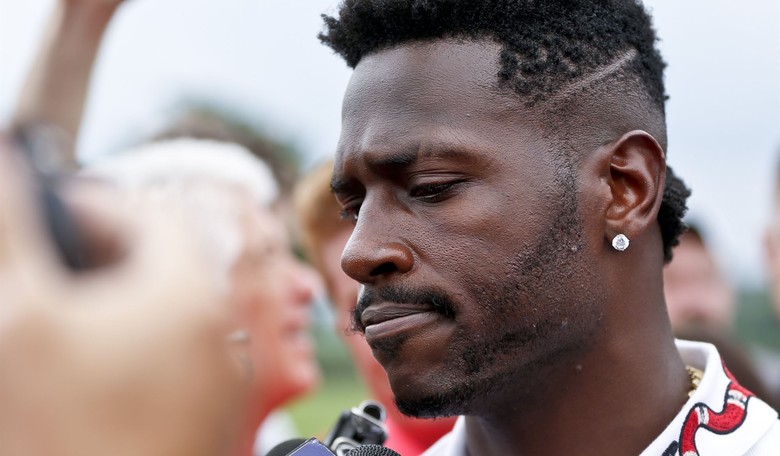
Former NFL wide receiver Antonio Brown is no stranger to controversy, or the criminal justice system. And once again, Brown has managed to avoid a prison sentence after being charged with a very serious crime.
On Friday, Brown pleaded guilty to aggravated assault with a firearm, after originally being charged with attempted murder for a shooting at a celebrity boxing event last year.
A Florida judge sentenced Brown to just three years of probation, and his attorney Mark Eiglarsh told reporters afterward that his client was "extremely grateful" to put the incident behind him.
"My client was facing 30 years in prison with a 20-year minimum mandatory, and he was given an offer he just couldn't refuse," he said. "Probation was too good to turn down, and we're both very excited about the outcome."
The plea to the reduced charge allows the All-Pro wide receiver to not only avoid prison time but criminal conviction.
Brown was charged with attempted murder after investigators alleged that he fired two shots at a man whom Brown claimed was trying to steal his jewelry. Investigators claimed that he took a gun from a security guard and ended up grazing the man he shot at, while Eiglarsh previously told reporters that Brown has a valid carry permit and used his own gun to defend himself from an attack.
He also maintained Brown did not intend to harm anyone.
"I entered a plea of not guilty because it was not proven," Eiglarsh said. "They are not going to be able to prove what they alleged to be an attempted 2nd degree murder, which I strongly believe is a gross overcharge…He didn't attempt to kill anyone."
I'm not knocking Eiglarsh's legal skills here (he did just manage to keep a client away from potentially decades behind bars, after all), but if Brown wasn't attempting to kill his alleged attacker, what were his intentions when he shot at him?
This is actually the second time that Brown has taken a plea for a felony offense and been given the chance to avoid a formal conviction. In 2020, he accepted a no contest plea on a felony burglary with battery charge and two lesser misdemeanor charges, but adjudication was withheld so he was able to avoid becoming a felon.
The same thing appears to have happened with Brown's latest plea deal. So is this a case of celebrity justice?
I initially was leaning towards that conclusion, but after doing some research I'm not convinced.
Brown certainly isn't the only person to get probation after pleading guilty to aggravated assault with a firearm. I found a Florida appellate court decision from 2024 involving a guy named Frederick Bryant who was given two years probation after pleading guilty to the same charge. The trial court withheld adjudication of guilt in his case as well, though he was accused of violating his probation a few months later.
Bryant doesn't appear to be a celebrity of any kind, which suggests that the average Joe can get the same sweetheart deal that Brown received.
But why did prosecutors go from a charge of attempted murder to such a lenient deal? Well, the man who was shot by Brown said back in September that he didn't "wish to participate" in the case, which undoubtedly made prosecutors' job more difficult, particularly if they were relying on his testimony to establish Brown's intent.
Brown also faced a domestic battery charge in Tampa in 2022, but prosecutors dropped the case after the alleged victim recanted part of her original account. The arrest warrant was recalled, and Brown was never prosecuted for the incident.
Given Brown's history of legal troubles, I can understand why some people would be skeptical of yet another plea deal that keeps him out of prison. And the fact that prosecutors lost the cooperation of their key witness certainly raises questions about how much of their original case they could still prove.
But skepticism isn't evidence of wrongdoing, and a defendant shouldn't be punished for charges that prosecutors either dropped or couldn't prove. Brown pleaded guilty to aggravated assault with a firearm, and it's fair to question whether three years of probation is an appropriate punishment for that offense without assuming that something improper happened behind the scenes.
Even if you believe this deal doesn't represent the interests of justice, that doesn't mean that Brown is getting a pass because of his status as one of the better wide receivers of the last 20 years. I'm not even sure it can be argued that Brown's getting a good deal because of his personal wealth. Brown reportedly earned about $88 million during his NFL career, but filed for bankruptcy in 2024, initially reporting approximately $3 million in debts and less than $50,000 in assets.
Now, subsequent bankruptcy proceedings uncovered millions of dollars in Florida real estate, including a mansion that a bankruptcy trustee arranged to sell for $4 million earlier this year. Still, there's no evidence that money alone kept him out of prison.
We see stories of repeat offenders who are part of a catch-and-release criminal justice system every day, and the vast majority of those guys will never get 15 seconds of fame, much less 15 minutes.
Instead of being a case of celebrity justice, I think Brown's latest deal is just a high-profile example of how the courts function much of the time. That's probably the most troubling takeaway: Brown may be famous, but the revolving door of the criminal justice system he's walked through is open to all kinds of defendants, including those most of us have never heard of.