
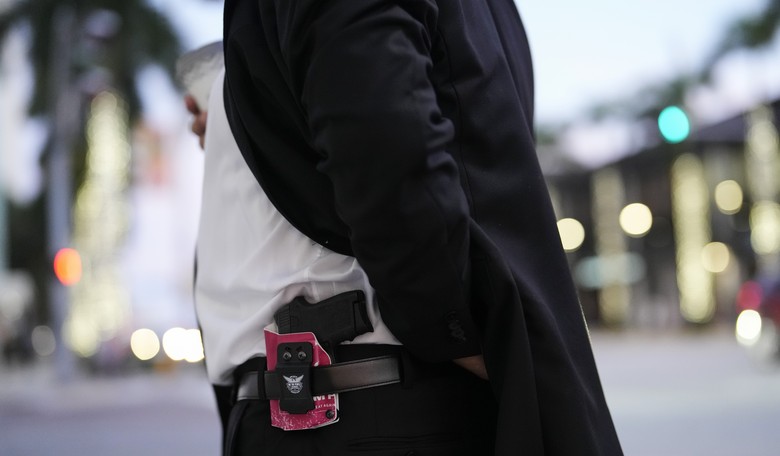
Harmeet K. Dhillon might not be in charge of the Department of Justice (DOJ) Civil Rights Division anymore, but Acting Assistant Attorney General Jesus Osete is picking up where she left off. Osete and the Civil Rights Division's Second Amendment Section have filed a brand new lawsuit against Glendale, California, alleging that its high cost of concealed carry permit fees and enforcement of those fees by the Glendale Police Department amount to a pattern and practice of depriving residents of one of their fundamental civil rights.
The $1,078 Glendale charges applicants is the primary basis for the lawsuit, but as the complaint points out, it's not the only policy in place that violates the right to keep and bear arms.
Additionally, Glendale’s requirement for three reference checks, review of social media, and its requirement for a psychological examination convert its shall-issue scheme into a may-issue one. For instance, a psychological examination is just the type of “constitutionally problematic” requirement because it invites “open-ended discretion[.]”
Glendale also requires applicants to reside in the city, which DOJ says is another no-no.
The new lawsuit focuses more attention, though, on the psych evaluation that every applicant must pay for before they're deemed acceptable to exercise a fundamental right.
Glendale PD Policy § 208.4.1(5) states that all applicants will “undergo psychological testing” as that term is defined in Cal. Pen. Code § 26190. Under state law, “if a psychological assessment on the initial application is required by the licensing authority,” then applicants are “referred to a licensed psychologist acceptable to the licensing authority.” Cal. Pen. Code § 26190. The statute states that psychological testing for renewal applications shall be required “only if there is compelling evidence of a public safety concern to indicate that an assessment is necessary.” Id. However, the City’s policy appears to impose a blanket requirement that all applicants for a renewal license undergo psychological testing. Glendale PD Policy §208.3(i) requires that applicants not have any psychological conditions that make them unsuitable for a CCW License.
As DOJ notes, there's no history or tradition of gun regulation in the United States that compares to a mandatory psychological evaluation before being able to exercise your right to carry. California doesn't even impose that ridiculous requirement on people purchasing firearms, just on those who want to carry a firearm for self-defense.
The cost of that evaluation, which can run as much as $500, serves as another barrier to applicants, but the policy would be equally problematic if it didn't cost applicants a penny. Glendale's permitting process seems to default to applicants being unworthy of approval unless they prove otherwise, when it should be the other way around. If there's anything in someone's background that would serve to disqualify them, that should be evident in a background check. Vetting people's social media, requiring character references, and making them sit for a psych evaluation aren't just unnecessary steps. They're unconstitutional.
While Glendale's policies squarely violate the Second Amendment, the biggest challenge for the DOJ might be proving that it has the authority to bring a pattern and practice lawsuit against the city because of those policies. A federal judge just tossed the DOJ's lawsuit against Montgomery County, Maryland after determining the agency overstepped its bounds when it brought a lawsuit under Section 12601. That doesn't mean that the federal judge assigned to the Glendale lawsuit will come to the same conclusion, but the Second Amendment Section needs to be prepared with a strong argument if the litigation is to survive the city's attempt to get it dismissed with prejudice.