
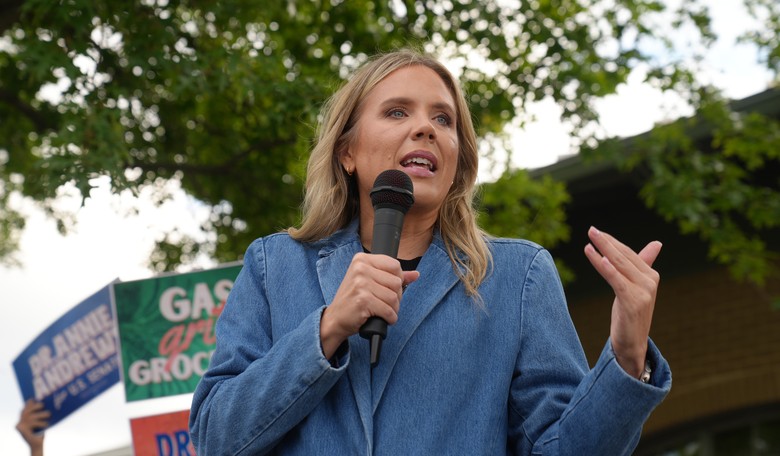
Republicans had a number of challenges in the midterms, but I still think that President Donald Trump's decision to push Darline Graham to run for a full term in the Senate was a huge unforced error, and one that cost the GOP dearly.
Republicans won every other statewide election in South Carolina, but elected Democrat Annie Andrews over Graham in the race to fill the seat left vacant by the death of Lindsay Graham. Appointing Graham's sister to serve as a caretaker for the seat for a few months was one thing, but Graham was decidedly underwhelming as a candidate for Senate, and now Democrat Annie Andrews will be in a position to push her anti-gun views for the next six years.
The Washington Post took a look at how Andrews managed to pull off the victory in ruby-red South Carolina, and part of the reason for her success is that she was able to downplay her anti-Second Amendment extremism on the campaign trail. As the WaPo notes, Andrews' entry into politics came as a volunteer for Moms Demand Action, but you didn't see her sporting any red t-shirts in her campaign ads.
While the GOP nomination was still unsettled that summer, [Democrat consultant AJ] Lenar filmed several TV spots: One showed Andrews putting on her white doctor coat and vowing to go after health insurance companies and lower costs. Another featured Andrews talking about the pain she sees on parents’ faces when they get an unexpected high medical bill. And a third spot, the campaign called its’ “break glass negative” ad to have in reserve for when the Republicans began attacking her on transgender issues.
After the Aug. 25 runoff, Andrews’s campaign went on TV with “White Coat,” taking advantage of a lull in Republican advertising to define their candidate early on — even though they risked running out of money in the final few weeks of the campaign.
“We didn’t know that we had the money to go all the way,” said Brexton Isaacs, who took over managing her campaign that summer.
For about five weeks, Andrews had the TV airwaves largely to herself. A person close to Graham’s campaign, who spoke on the condition of anonymity to disclose private discussions, said the runoff had drained its resources and described the stretch as “five weeks of clear air” for Andrews. The ads burned a positive image of Andrews into voters’ minds, her campaign hoped.
“By the second ad, people were like, ‘If I see this woman’s stethoscope again, I’m going to sell my television,’” Lenar said.
The campaign aimed their ad and endorsement strategy at peeling off independents and Republicans.
That was a tactical error on the part of Graham's campaign. If I'd been advising her, I would have told her to do a tour of the state's gun stores and call out Andrews' anti-gun activism at every stop. Of course, Graham also needed to talk about issues that South Carolina voters found more pressing, but failing to define Andrews as a paid gun control activist was a huge mistake for Graham and her campaign team.
Andrews recruited her Republican dad to take part in a campaign ad, where he assured voters his daughter wasn't "some crazy socialist." She sought out the support of Warren Norman, who's dad Ralph was narrowly defeated by Darline Graham in the GOP Senate primary.
Norman had been turned off by the toxic tone of the Republican primary, and was open to hearing Andrews’s pitch. Over coffee on his front porch, he asked her about transgender athletes in girls’ sports and gun policy. He recalled that she continued to support stronger background checks.
“I remember asking her if she felt like the Democratic Party had gone sort of too far to the crazy left, and she said yes,” Norman said.
Andrews asked him for his endorsement, and Norman said he needed time to think about it. “I’m not saying I can’t get fooled, but she certainly struck me as a very, very genuine person,” he said.
Andrews might have appeared genuine to Warren Norman, but you better believe her anti-Second Amendment positions don't end with "universal" background checks on gun sales. If Andrews believes that the Democrats have gone too far to the crazy left, there's nothing to indicate she thinks the party has gone too far in restricting the right to keep and bear arms.
Andrews has spent years advocating for more restrictions on lawful gun owners, first as a Moms Demand Action volunteer and later as a paid adviser to Everytown for Gun Safety. That history didn't disappear when she traded her gun control talking points for campaign ads about healthcare costs.
Maybe Andrews really does intend to govern from the center, as she repeatedly promised voters. But what does that mean when it comes to the Second Amendment? Will she oppose another attempt to ban commonly owned guns like the AR-15? Will she defend the right to carry, even in states where Democrat lawmakers have tried to turn virtually every public gathering place into a "gun-free zone"? Or will she simply vote with her fellow Democrats whenever gun control legislation comes to the Senate floor?
Those questions that deserve answers, particularly from someone who built her political career advocating for restrictions on gun ownership. Darline Graham failed to press Andrews during the pair's lone debate, and honestly, the South Carolina media didn't exactly grill Andrews on her Second Amendment issues either.
I give Andrews for running a smart campaign. She recognized what South Carolina voters were talking about and focused her message accordingly. But winning an election by talking about healthcare and affordability doesn't give Andrews a mandate to pursue the gun control agenda she spent years promoting.
South Carolina voters expect their new senator to keep her promise to govern from the center. And if Andrews decides that promise doesn't apply to the Second Amendment, the Republicans and independents who helped elect her will have every reason to feel betrayed. Unfortunately, they won't be able to do anything about it for six years, which can seem like a lifetime in politics.