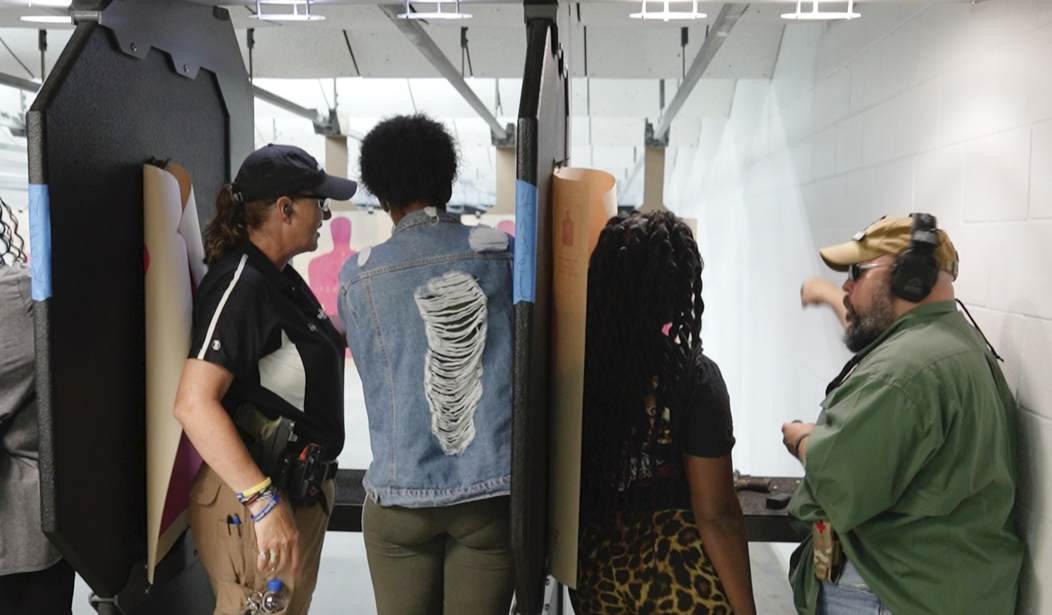
USA Today has partnered with The Trace in the past to push out anti-gun propaganda, but the paper's latest hit piece on the firearms industry and Second Amendment organizations comes courtesy of Kaiser Family Foundation Health News, which claims that guns marketed for personal safety are "fueling a public health crisis in Black communities."
The report, which focuses on "gun violence during the pandemic" alleges (among other things) that "while public officials imposed restrictions intended to prevent covid’s spread, politicians and regulators helped fuel gun sales — and another public health crisis."
As state and local governments shut down schools, advised residents to stay home, and closed gyms, theaters, malls, and other businesses to stop covid’s spread, President Donald Trump kept gun stores open, deeming them essential businesses critical to the functioning of society.
And rightfully so. It wasn't just businesses that were closing. Police chiefs in Philadelphia and other cities told officers to use their discretion and limit arrests, while arrestees were sprung from jails across the country and some inmates released from their prison sentences early in an attempt to reduce the population behind bars and keep COVID from spreading in those confined spaces. Court systems shut down for months, and violent crime skyrocketed during and after the riots and civil unrest sparked by the death of George Floyd in mid-2020.
President Trump wasn't the only person to keep gun stores open. At least one federal judge disagreed with state-level decisions to shut down gun shops on the grounds that it violated the Second Amendment.
Americans were already clamoring to exercise their Second Amendment rights at a time when it seemed like every day brought a new round of chaos, and gun sales boomed throughout 2020. KFF Health News and USA Today contend that was a result of marketing by the gun industry and groups like NRA, but NICS data shows the increase in sales started in mid-January 2020, weeks before any COVID-inspired advertising began.
There were new gun owners of all races, colors, and creeds, which was (and is) a huge problem for the gun control lobby. As Nick Suplina, senior vice president for law and policy at Everytown for Gun Safety, complained to KFF Health News/USA Today, the firearms industry had been marketing to women and minorities for years, but sales in those demographic groups surged during the early days of the pandemic.
“They said, ‘We need to break into new markets,’” Suplina said. “They identified women and people of color. They didn’t have a lot of success until the pandemic, the Black Lives Matter movement, and the death of George Floyd. The marketing says, ‘You deserve the Second Amendment too.’ They are selling the product as an antidote to fear and anxiety.”
‘You deserve the Second Amendment too" are the six words that the gun control lobby can't stand to hear. If gun ownership is largely the domain of white dudes aged 40 and older, it's easier for the anti-gunners to a) demonize that group and b) find allies outside of it. The last thing that the anti-gunners want is for the right to keep and bear arms to be widely embraced in communities that have helped form the base of support for the gun control lobby since the late 1960s.
As a Second Amendment advocate, I'm not just fighting for my right to keep and bear arms. I'm fighting for the rights of people who don't look like me, think like me, and yes, even those who don't vote like me. Suplina and his cohorts, on the other hand, are fighting to keep all of us from exercising this fundamental civil right.
The broader gist of the KFF Health News/USA Today story is that the surge in gun ownership directly led to the surge in violent crime in 2020. The only problem with that assertion is that it simply isn't true. The tens of millions of firearms that were purchased just a few years ago are still around, but the spike in violent crime seen across the nation in 2020 and 2021 has largely subsided to pre-pandemic levels, and 2025 is likely to see the lowest homicide rate since the FBI started keeping track in 1960.
The crime spike was a temporary phenomenon largely driven by a few different factors; the aforementioned closure of courts and "depolicing" efforts in blue states, the shutdown of schools and the corresponding spike in juvenile crime, and an increase in domestic violence incidents coinciding with orders to stay home as much as possible. The stresses that COVID and the government responses to the pandemic placed on mental health didn't help either, but I'd argue that had a lesser impact on crime than the other variables I mentioned.
"Defund the police" isn't really a thing these days, and the court system is back to its usual level of dysfunction. Truancy rates have also largely returned to pre-pandemic levels, and while juvenile crime is still stubbornly high in some cities, it's hard to pin that on an increase in lawful gun sales to adults.
While gun sales have also returned to their pre-pandemic levels, gun ownership itself continues to broaden, which poses an existential crisis for the gun control lobby. Groups like Everytown have responded by claiming they're not actually opposed to the Second Amendment or even offering what they call "gun training," but in stories like this they let the mask slip. They have a fundamental problem with gun ownership itself, and in their view no one deserves the Second Amendment.
Editor's Note: Christmas is coming a little early here at Bearing Arms!
For a limited time, use the promo code MERRY74 for 74% off a VIP, VIP Gold, or VIP Platinum membership when you sign up! It's our way of saying thanks for your support in our mission to bring you the latest Second Amendment news, information, and informed opinion from across the country.










Join the conversation as a VIP Member