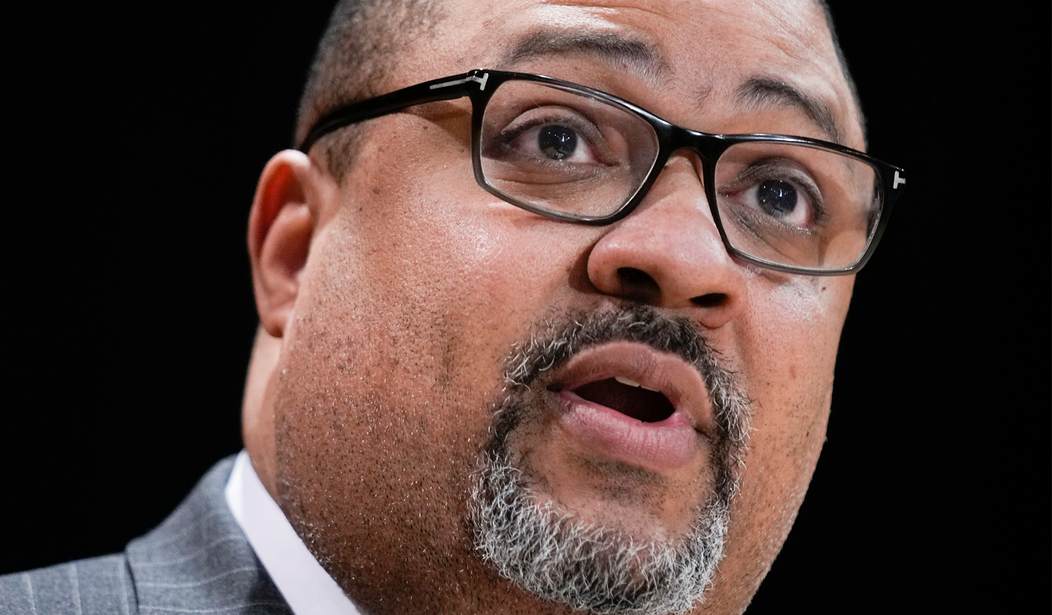
The amicus briefs authored in support of Hawaii's "vampire rule" forbidding lawful concealed carry on all private property without explicit permission from the property owner come from a rogue's gallery of anti-2A voices, including Manhattan District Attorney Alvin Bragg, who's name appears first on the amicus brief submitted by an outfit called Prosecutors Against Gun Violence in Wolford v. Lopez.
The brief makes a number of outlandish claims, starting with the premise that exercising our fundamental right to bear arms is dangerous and disruptive conduct.
This type of property rule has a long historical tradition. During the Founding Era, a business owner’s right to exclude was protected through custom-based default rules that removed any need for an owner to give his customers advanced notice that their implied license to enter his shop or tavern did not entitle them to engage in dangerous or disruptive conduct on the premises. Default rules forbidding certain behaviors within the property are essential to protect the owner’s right to exclude those behaviors because it is often impractical for owners to communicate their preferences to any and all strangers who happen to step inside the premises. And starting in the nineteenth century, criminal trespass laws incorporated custom-based default rules in identifying misconduct that triggers criminal liability when someone lawfully enters a property but then exceeds the scope of his license to be there.
The first problem with Bragg's argument is that, whatever default rules might have existed during the Founding Era, there wasn't any default rule forbidding the bearing of arms in all publicly accessible but privately-owned spaces.
Even today there are laws on the books that criminalize bearing arms in a place where the property owner has notified gun owners that they're not allowed to carry on the premises, but that's not the issue in Wolford. The question is whether the state can impose that default ban with the intent of limiting lawful carry without violating our right to keep and bear arms.
In order to answer that question, the Court is going to look at the text of the Second Amendment as well as the historical tradition of gun ownership, and the justices aren't going to find any evidence of a tradition that bears the slightest resemblance to Hawaii's "vampire rule." That's because bearing arms, in and of itself, has never been seen as dangerous or disruptive behavior by a majority of the American people. Up until the aftermath of the Civil War, any bans on bearing arms were few and far between, and many of the laws that were put in place after the Civil War's conclusion were implemented by southern states with an eye towards keeping the population of freed slaves as disarmed and subjugated as possible.
Bragg argues that "[p]roperly understood, these laws [like Hawaii's vampire rule] draw their historical lineage not from restrictions on gun ownership, but rather from a long tradition under both the common law and criminal law of enforcing private property owners’ preferences."
The problem with Bragg's argument is that we are talking about a restriction on gun possession, which directly implicates our Second Amendment rights. And as SCOTUS has explicitly stated, when deciding whether a modern gun control law is constitutionally sound, courts have to look at both the text of the Second Amendment and the historical tradition of gun ownership, not laws that applied to other facets of life or property ownership.
Even before Bruen, "shall issue" concealed carry or permitless carry was the standard in most U.S. states, and tens of millions of gun owners are regularly carrying in places like grocery stores, shopping malls, restaurants, and other retail establishments with being disruptive or dangerous. In fact, the vast majority of folks will never even realize they're standing next to someone exercising their Second Amendment rights in a concealed fashion.
It's restrictive "gun-free zones" that are actually disruptive and dangerous; disruptive to our right to publicly carry by preventing folks from doing so in a wide variety of locations, and dangerous because these policies don't disarm individuals with evil intentions and a plan to put them into action.
Bragg only has to look at the shootings in Times Square or the violence committed against riders on the "gun-free" buses and trains of the Chicago Transit Authority to see the fundamental flaw in his reasoning, but that would require pulling his head of his rear-end, and it appears he prefers that view to reality.
Editor's Note: To celebrate Christmas and ring in 2026, Bearing Arms is matching our biggest sale ever on VIP memberships. Now through January 1, until 11:59 pm PT, receive 74% off a VIP membership using promo code MERRY74!









Join the conversation as a VIP Member