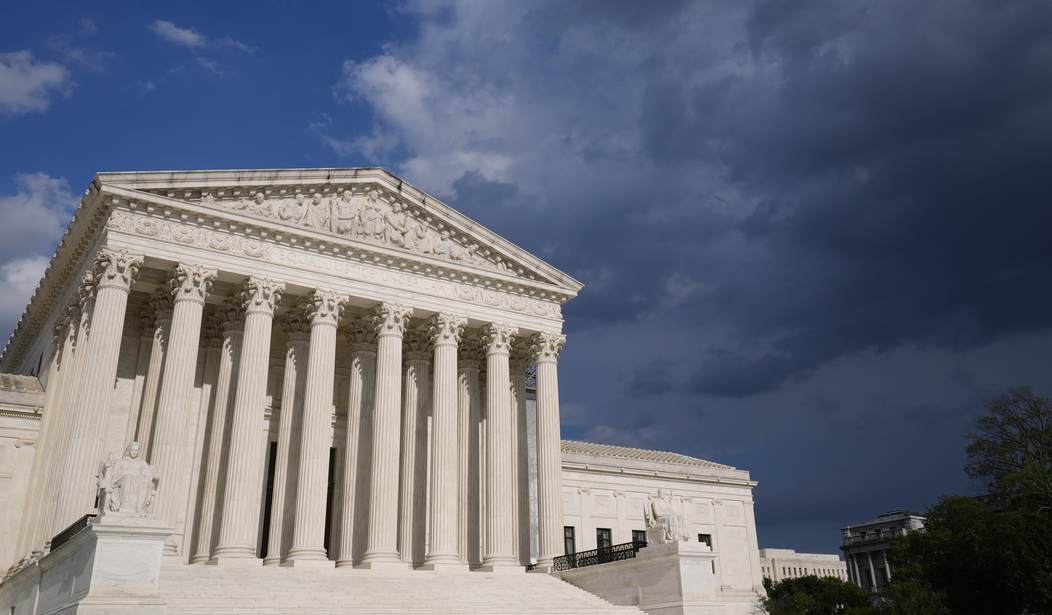
A majority of Supreme Court justices appear ready to strike down Hawaii's "vampire rule" that prohibits lawful concealed carry on all private property unless the property owner expressly gives their consent, though during oral arguments today the three liberal justices seem inclined to uphold the law.
Justice Ketanji Brown Jackson, for instance, repeatedly questioned plaintiffs' attorney Alan Beck and Deputy Solicitor General Sarah Harris (who participated in the oral arguments alongside the plaintiffs) about why this case wasn't simply about property rights, without any Second Amendment implication whatsoever.
When Jackson asked whether this was really a case about property rights, not the Second Amendment, Beck rightfully responded that the law directly implicates their Second Amendment rights, but Jackson argued that while their rights might be "affected," they're not necessarily "implicated."
Justice Neil Gorsuch's line of questioning pushed back against Jackson's contention, noting that the courts don't allow property rights to be defined in a way that infringes on other constitutional rights.
Justice Sonya Sotomayor, meanwhile, appeared ready to completely disregard the Supreme Court's "text, history, and tradition" test by suggesting that Hawaii's "culture" of not carrying firearms in public trumps the national tradition of bearing arms in publicly accessible places. Both Beck and the Harris rebuked that suggestion, pointing out that the Court has specifically discussed a national tradition.
Justice Brett Kavanaugh buttressed that argument in his own question to Harris, wondering if the government wasn't making the issue too complicated by raising questions about pre-textual laws instead of simply looking to see whether Hawaii's "vampire rule" is part of a "deeply rooted tradition," which he defined, in part, as laws that were widely adopted among a number of states.
Several conservative justices raised questions about the level of generality that can be used when looking for historical analogues, which indicates that, whatever SCOTUS ultimately decides about Hawaii's law in question, the opinion will address, to one degree or another, how close any law from the past must be to a current regulation in order to be useful history for judges.
Given the discussion and debate about Hawaii's use of the 1865 Louisiana law that prohibited bringing guns onto plantations without the plantation owner's permission (a law that was part of the state's infamous Black Codes designed to restrict the rights of newly-freed slaves), I'm cautiously optimistic that the Court will not only address the level of generality for historical analogues, but also the relevance of statutes found in history that are unquestionably unconstitutional today.
Justice Jackson argued that those laws must be considered a part of the national tradition, but Harris pushed back on that. In her view, unconstitutional laws are, by their very nature, outliers. And under the Supreme Court's test, outlier laws are not a part of the national tradition of keeping and bearing arms.
Neal Katyal, arguing for Hawaii, echoed Sotomayor's contention that local laws and customs matter more than a national tradition of gun ownership, while still arguing that the national tradition of gun ownership includes the ability of states to flip the default rules.
Gorsuch asked Katyal about relying heavily on the "outlier" Black Code law in defending Hawaii's statute. Katyal called them a shameful part of American history, but argued that the law was presumptively constitutional because Louisiana was re-admitted to the Union with that law still in place. Katyal, however, never really explained why the Louisiana law shouldn't be considered an outlier.
Katyal also got pushback for asserting that the Bruen test requires looking at history when trying to figure out if the Second Amendment is being implicated, as opposed to looking at history when determining whether a law fits within a national tradition. To do otherwise, he said, would be to put the government in the position of having to defend the history of all laws regarding firearms. Kavanaugh and Barrett both disagreed with Katyal, arguing that's exactly what the Court's Second Amendment jurisprudence dictates.
Both Beck and Harris did a great job in tearing apart Hawaii's statute, and while Neal Katyal did his utmost to defend the law I don't see him getting support from any of the more conservative justices. I predict the Court will drive a stake through the heart of Hawaii's "vampire rule" when the Wolford opinion is released, though I'm sure anti-gun lawmakers in the Aloha state are already working on their next scheme to infringe on our right to bear arms.
Editor’s Note: President Trump and Republicans across the country are doing everything they can to protect our Second Amendment rights and right to self-defense.
Help us continue to report on their efforts and legislative successes. Join Bearing Arms VIP and use promo code FIGHT to get 60% off your VIP membership.









Join the conversation as a VIP Member