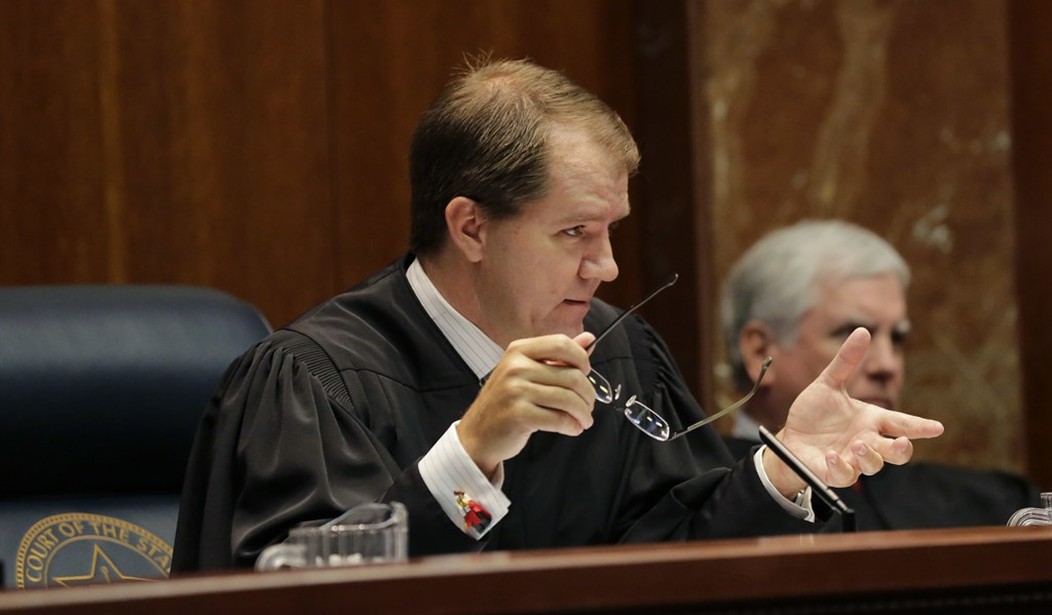
When Texas Supreme Court Justice Don Willett was appointed by President Trump to the Fifth Circuit Court of Appeals in 2018, the social network then known as Twitter lost one of its sharpest and funniest minds as Willett's account went dark (he has since re-emerged on occasion, but only to post about family).
X's loss was gun owners' gain, though, and I'd say the trade-off has been worth it. In his time on the appellate court Willett has been a steady voice in support of an originalist view of the Constitution, including its limits on the power of the executive, legislative, and judicial branches. Most recently that took the form of a concurring opinion in a case called United States v. Hembree. Willett was part of the three-judge panel that threw out the 2018 conviction of Charles Hembree, who was convicted under Section 922(g)(1) for possessing a firearm while an "unlawful" drug user; in this case, methamphetamine.
As in the Hemani case that will be heard by the Supreme Court next month, the Fifth Circuit panel concluded that while there may be a national tradition prohibiting gun owners from possessing arms while intoxicated, that does not extend to prohibiting users of intoxicating substances from possessing a gun while they're sober. In his concurrence Willett went even farther, suggesting that virtually all federal gun laws restricting or prohibiting possession of a firearm in certain circumstances may be beyond the scope of Congress's powers.
Willett begins with a history lesson about why we have a Bill of Rights, and by extension, the Second Amendment.
In September 1787, when “We the People” first glimpsed the document that would become our founding charter, it wasn’t exactly love at first sight. Impressive as it was, the Constitution was incomplete—and conspicuously so. For all its world-shaking ambition, it bore a striking omission: unlike nearly every state constitution,it contained no bill of rights.
How could Madison, Hamilton, Washington, Wilson, Franklin—plus the document’s thirty-four other signatories—have made such a choice? The Federalists answered with a structural defense. A bill of rights, they contended, would be “not only unnecessary . . . but would even be dangerous.” Why? Because while a state constitution operates on the premise that “everything which is not reserved is given,” the federal Constitution rests on the opposite rule: “everything which is not given is reserved.” Congress’s powers, they emphasized, were “few and defined,” and thus incapable of endangering individual liberty. Why, then, “declare that things shall not be done which there is no power to do?” Such declarations, the Federalists warned, would only “furnish . . . a plausible pretense for claiming that power.”
As Willett notes, the anti-Federalists weren't impressed by that argument.
Limited though Congress’s powers might be, they countered, those powers “are as complete, with respect to every object to which they extend, as th[ose] of any state government”—authority enough to draw “[l]ife, liberty, and property . . . under its controul.” And when Congress inevitably stretched its enumerated powers beyond their seams, the people would need something firm to grasp—something “under which we might contend against any assumption of undue power.” What,they asked, was the harm in a belt-and-suspenders Constitution? As PatrickHenry put it, with trademark bluntness: “our rights are reserved.—Why not say so? Is it because it will consume too much paper?”
The anti-Federalists failed to nix ratification of the Constitution, but they were successful in securing a Bill of Rights that lays out the "no-go zones" of the federal government. Which brings us to today, and Willett's belief that "18 U.S.C. § 922(g)(1)—the federal felon-in-possession ban—rests uneasily alongside a bedrock principle: 'Every law enacted by Congress must be based on one or more of its powers enumerated in the Constitution.'"
Given the expansive interpretation of the commerce power, “the natural first place to look is the Interstate Commerce Clause,” which grants Congress the “Power . . . [t]o regulate Commerce . . . among the several States.” Perplexingly, the Supreme Court once declared that this power “is not confined to the regulation of commerce among the states.” More recently, however, the Court has “endeavored to more sharply define and enforce limits on” the commerce power, confining it to “three general categories of regulation.” And “[m]ere possession of a firearm fits uneasily within any of these categories.”
The Fifth Circuit panel didn't need to explore that argument given its prior rulings on the incompatible nature of the Second Amendment and 922(g)(1), but Willett is willing to go there should the opportunity arise.
This case vividly illustrates the Constitution’s deliberate redundancy. Individual liberty is preserved not by any single safeguard, but by “four interlocking mechanisms” working in concert: representative government, separation of powers, federalism, and the Bill of Rights. The Framers trusted none of them to suffice on its own.
Those protections, however, do not run on autopilot. “[E]ach generation must decide whether to honor those structural limits as boundaries to uphold—or to treat them as obstacles to outwit.” When the Bill of Rights halts an aggressive assertion of federal power, it should sharpen our respect for those limits—not lull us into forgetting them.
The Judiciary should heed that lesson as well. In an appropriate case, I remain open to reconsidering whether § 922(g)(1) truly falls within Congress’s enumerated powers. For now, however, I join the majority’s conclusion that § 922(g)(1), as applied here, violates Hembree’s right to keep and bear arms.
There is nothing in the Constitution that explicitly allows Congress to write laws criminalizing gun possession, but there is language stating that the right to keep and bear arms shall not be infringed (presumably, by any branch of the federal government). Willett's faithfulness to federalism is something to be admired, and if there is an opening on the Supreme Court before the end of Donald Trump's second term, the 59-year-old judge would be my first pick to fill the vacancy.