I'm a big fan of our civil liberties, and not just the right to keep and bear arms. I'm also a big believer that our rights belong to the people, not just to specific groups. Once we start slicing and dicing us into various demographic categories and say only some of them get to exercise their rights, we make a mockery of the Constitution and the Bill of Rights.
So when I saw that critics of a Florida bill that defines "domestic terrorist organizations" in the state and creates new penalties to those who provide “material support” or “resources” to them claim the legislation is so broadly written that it could apply to pro-Second Amendment groups, it definitely caught my interest.
On the surface, the bill provides clarity to the definition of domestic terrorism in Florida. While the U.S. State Department has three criteria to designate groups as “Foreign Terrorist Organizations,” Florida currently has no clear criteria or punishments for “Domestic Terrorist Organizations.” HB 1471 seeks to change that by giving control over which organizations are deemed “domestic terrorist organizations” to the Chief of Domestic Security.
However, for many student activists and members of the Muslim community at Florida State University, the bill has drawn criticism for its vagueness, which they say may classify their organizing or community activities as terrorism.
HB 1471 also has specific applications to college students for promoting domestic terrorist organizations. The bill lists potential consequences such as expulsion, ineligibility for fee waivers, and the prohibition of financial aid.
... Concerns have risen in the Muslim community over HB 1471, when in December 2025, Florida Governor Ron DeSantis signed an executive order branding The Council on American-Islamic Relations Florida (CAIR-FL) a “terrorist” organization. CAIR-FL sued DeSantis over this executive order, saying it violated their First Amendment Rights and recently protested at the Florida Capitol about HB 1471 and similar bills.
While not affiliated with CAIR-FL, FSU’s Muslim Student Union (MSU) also voices concerns about the repercussions of a bill like HB 1471 for college students.
“While we are a religious organization and not a political one, and do not claim to represent the views of all of the Muslim students on campus, we believe that Florida HB 1471 is a ‘tool’ that Florida lawmakers are trying to exploit in order to jeopardize the right to free speech,” the MSU said in a statement to the FSView.
The organization shares fears with critics over the bill's vague language.
“[HB 1471] defines vague criteria that anybody can fall under, whether it's environmentalist groups, or Planned Parenthood, or the NRA [National Rifle Association]. They’re all at risk depending on who is in charge of the current administration for labelling groups as terrorists,” the MSU said.
You can find the current version of HB 1471 here. I should note from the start that the bill is ostensibly focused on Islam...and more specifically, Sharia law. The bill includes a legislative finding that, "certain practices inherent to Sharia law—such as non-consensual and child marriages, public stoning or lashings, physical warfare against non-Muslims, discriminatory treatment of women, and amputation of limbs for crimes such as theft—violate the fundamental rights of persons, undermine the peace and order of society, and are deeply incompatible with the United States and Florida Constitutions."
But while the intent of the bill may be to focus on support for Islamic terror groups, the actual definition of a domestic terror organization is much broader. Here are the criteria:
a. The organization is based or operates in this state or the United States.
b. The organization is engaging in terrorist activities that:
(I) Involve acts dangerous to human life that violate state or federal law; or
(II) Are intended to:
A) Intimidate or coerce a civilian population;
(B) Influence the policy of a government by intimidation or coercion; or
(C) Affect the conduct of a government by mass destruction, assassination, or kidnapping.
c. The terrorist activity of the organization is an ongoing threat to the security of this state or the United States.
The only part of that definition that raises alarm bells to me is that an entity could be deemed a domestic terror organization solely for intending to "intimidate or coerce a civilian population" or influence the policy of a government by "intimidation or coercion."
In theory, "intimidation" and "coercion" apply to tactics that go beyond speech protected by the First Amendment. The problem, though, is that those terms aren't defined in HB 1471.
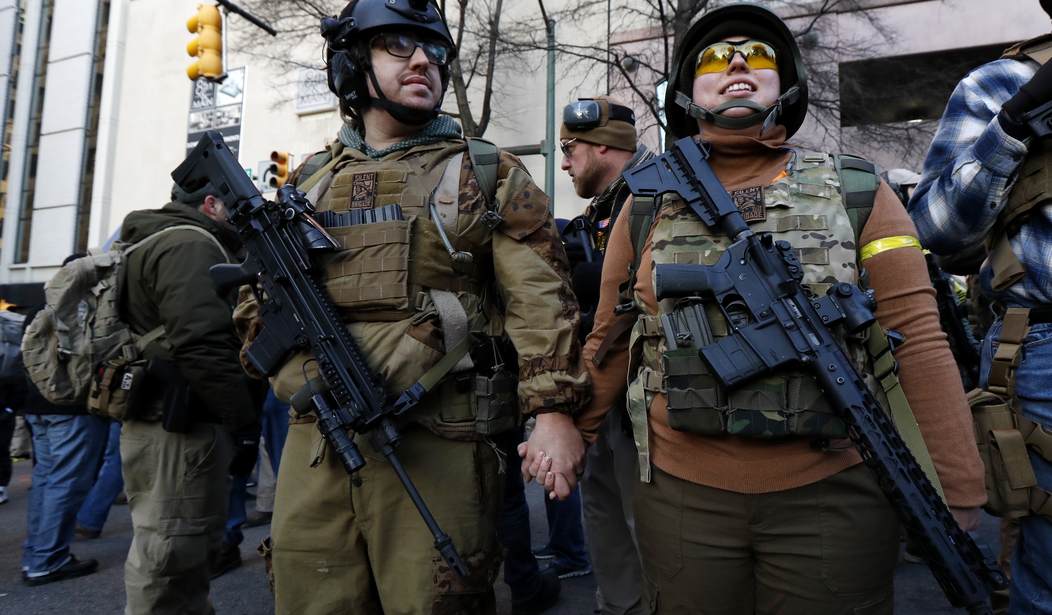
When I read that language I immediately thought about the Virginia Citizens Defense League's 2020 Lobby Day rally in Richmond, where tens of thousands of Second Amendment supporters showed up to express their opposition to the Democrats' gun ban agenda. Many of them were armed, and I'm sure that the majority of Democrat legislators felt intimidated by their presence. Does that mean that VCDL could be a domestic terror organization under HB 1471?
Maybe, but it's doubtful. According to the text of the bill, the Chief of Domestic Security has the authority to label a group a domestic terror organization if it meets any of the criteria listed above, but the Florida cabinet must approve of any designation and any group that's labeled a domestic terror outfit can appeal that description in state court.
There are some guardrails built into the legislation, which is good. I just don't know that those guardrails are enough when a group can be designated as a terror organization based on solely on actions deemed by the Chief of Domestic Security and the governor's cabinet to be intimidating or coercive.
The odds of this bill being abused to deem Florida Open Carry or Gun Owners of America terrorist organizations are slim, but they could increase dramatically if a Democrat ever wins a gubernatorial election in the state again. And if this bill could be abused by Democrats, it could be abused by Republicans as well.
If HB 1471 also required engaging in terrorist activities, I'd be a lot more comfortable with the language, and I believe it would be on much firmer constitutional ground. As is, though, I do think the bill has the potential to be abused, and to turn arguably protected First Amendment activity into domestic terrorism. It seems to me lthat this can and should be a pretty simple fix. I don't know if that would satisfy CAIR and the Muslim Student Union, but I'm pretty sure it would satisfy any judge hearing a challenge to the bill if it's signed into law.