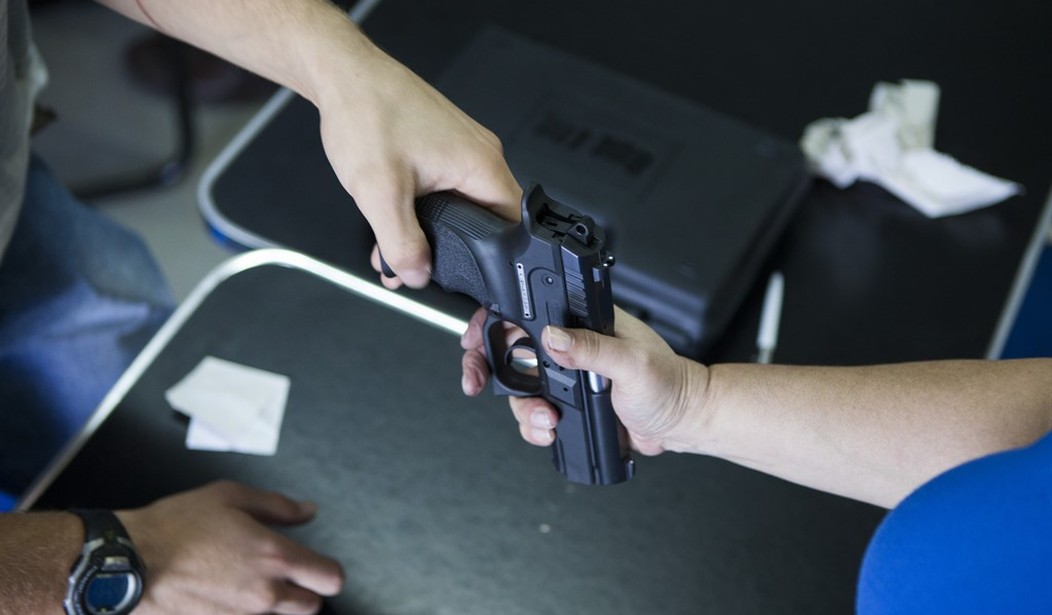
A new law meant to reduce gun-involved suicides is set to take effect in Colorado later this year, but will it truly have an impact?
Last session lawmakers approved a bill known as "Donna's Law", which sets up a voluntary "Do Not Sell" list allows residents to block themselves from purchasing a firearm. Colorado is the fifth state in the country to enact such the law, which is named after a woman named Donna Nathan, who took her own life eight years ago. Nathan's daughter has been a vocal advocate of these "Do Not Sell" registries, which are already in place in Delaware, Utah, Washington, and Virginia.
Supporters of the law call it "self defense against suicide", and while the website in support of the law takes pains to stay out of the broader debate over gun control, I couldn't help but notice that in the website's shop the book "Weapon of Choice: Fighting Gun Violence While Respecting Gun Rights" is available alongside two books on grief authored by Nathan's daughter Katrina Brees.
"Weapon of Choice" is authored by Ian Ayers and Frederick Vars, who are supporters of Donna's Law. But the pair, both law professors, are also big fans of far more restrictive gun laws. Ayers, for instance, was the academic who came up with the "vampire rule" banning concealed carry by default on all private property. In a 2020 article, Ayers and co-author Spurthi Jonnalagadda argued that such a rule would "radically expand the private spaces where guns could not be carried."
Reducing the number of places available for gun carriers to travel freely with their firearms might have knock-on effects, reducing preferences to carry and possess firearms more generally, as it becomes increasingly inconvenient to do so.
In my opinion, if Brees really wants to separate Donna's Law from the broader gun control debate, she should put as much distance as possible between herself and gun control advocates like Ayers and Vars.
Vars, in particular, has argued that the reason why the NRA and other Second Amendment groups generally oppose the law is because "reduces gun sales," arguing that the firearms industry "seems to think that every gun sale is a good gun sale, even if the buyer is actively suicidal."
That's a ridiculous smear against both the NRA and the firearms industry. The NRA's chief objection to the law is that while it may be easy to place yourself on the list, it's fairly difficult to remove yourself. As for the idea that the firearms industry is worried that Donna's Law will put a dent in sales, the truth is that the law is used so infrequently that it has virtually no impact on sales.
In August 2022, I asked the Virginia State Police how many people had placed themselves on the "Do Not Sell" list. At that point the law had been in place for a little more than a year, but there were just 24 names on the registry.
I followed up with the VSP last June, and as of June 17, 2025 there were a total of 56 names on the list, out of an adult population of about 6.7 million people. As I wrote at the time:
There's also evidence that even with Donna's Law on the books, suicides have increased in Virginia. In fact, a report from the Virginia Department of Behavioral Health and Developmental Services last December says suicide rates have been climbing since 1999. Donna's Law has been in effect since July, 2021, but there's no evidence whatsoever that it's been effective in lowering the suicide rate.
I can't speak for the NRA, but my main objection to Donna's Law is simple: it's a way for politicians to avoid taking more substantive (and expensive) steps to improve access to mental health care by focusing on guns. The same is true of "red flag" laws, which have no mental health component to them whatsoever.
Colorado's mental health crisis is well documented. There aren't enough inpatient beds for those in acute crisis, and access to mental health care in rural parts of the state is almost non-existent, at least if you want to see someone in person. Donna's Law is a cheap way for lawmakers to say they're doing something to address suicide (the Colorado Bureau of Investigation's registry is expected to cost about $200,000, with that money coming from grants and donations), but there is no evidence whatsoever that it is of any real benefit.
As of 2024, at least 130 people across three states suspended their ability to purchase a gun. Fredrick Vars, a University of Alabama law professor who developed the idea for Donna’s Law, told The Trace that he expects that number to increase as awareness grows.
But Brees doesn’t measure the legislation’s success by how many people use the registry. Instead, she thinks about how many people across the country now have the opportunity to do so.
“Something like 20 million people now have that tool and they get to use it how they want when they want, totally confidentially,” she said.
I don't like raining on Brees' parade, but how many people use the registry absolutely matters, especially if suicide rates continue to climb after its in place. The goal of Donna's Law is noble: saving lives. I'm absolutely on board with that objective. I just believe that, like the more intrusive "red flag" laws, Donna's Law goes after the gun instead of addressing the underlying issues, while allowing legislators to proclaim their addressing a problem when they're putting a Band-Aid on a gaping wound.
Editor’s Note: The radical left will stop at nothing to enact their radical gun control agenda and strip us of our Second Amendment rights.
Help us continue to report on and expose the Democrats’ gun control policies and schemes. Join Bearing Arms VIP and use promo code FIGHT to get 60% off your VIP membership.









Join the conversation as a VIP Member