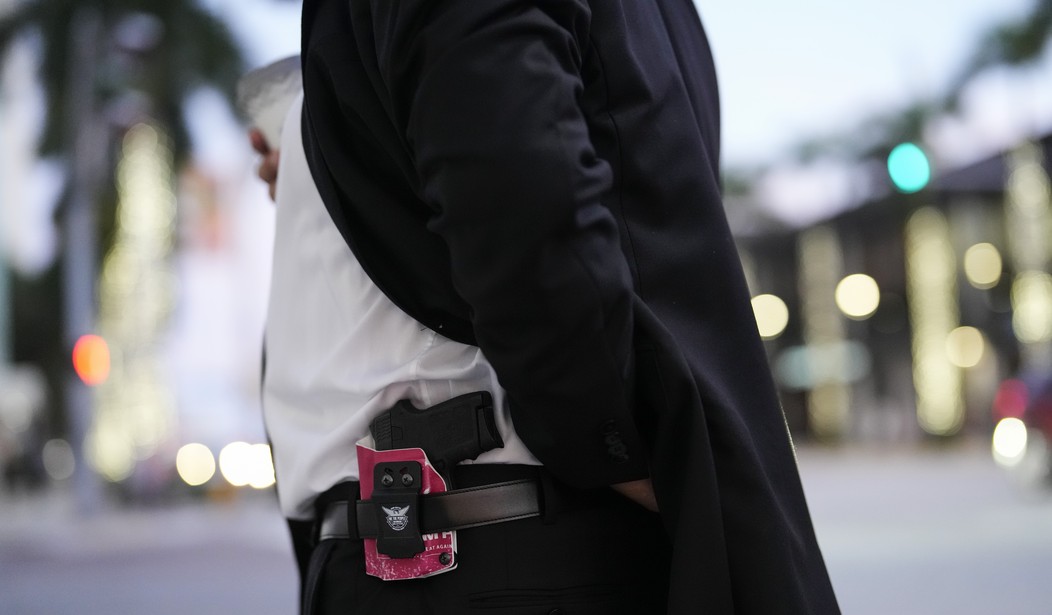
The Seventh Circuit Court of Appeals is no friend to gun owners, especially when Judge Frank Easterbrook is involved in a decision. Easterbrook infamously concluded in NRA v. Chicago that the Second Amendment did not apply to states, which were free to implement whatever gun controls lawmakers wanted; a decision that was overturned by the Supreme Court in McDonald v. Chicago.
Since then, Easterbrook has repeatedly held that "assault weapons" aren't protected by the Second Amendment, and has rejected all challenges to the federal ban on possession of firearms by those convicted of a crime punishable by more than a year in prison, unlawlul drug use, and other statutory prohbiitions.
So, the mere fact that Easterbrook was on the panel hearing the appeal of Kenneth Karwacki does not bode well for the plaintiff, who is seeking to renew his Wisconsin concealed carry permit but was denied because of a court-martial for peyote delivery. That's essentially a misdemeanor punishable by discharge for bad conduct, at least in the state where the court-martial took place, but because Wisconsin classifies that crime as a felony, Karwaki's application was denied by the Wisconsin Department of Justice was denied.
Karwaki sued, but a district court dismissed his complaint, and after oral arguments before a three-judge panel of the Seventh Circuit on Thursday, I'd say he shouldn't expect his case to be reinstated anytime soon... if at all.
Karwacki’s attorney William Sulton got off to a rocky start by arguing the charges weren’t violent, and that the context of the crime should be considered.
“You seem to be saying this wasn’t that bad of a crime, he was just handing out peyote at a party or something,” U.S. Circuit Judge Michael Scudder Jr., a Donald Trump appointee, said. “But we can’t draw lines like that. It’s drug distribution, which in Wisconsin is a felony.”
Sulton also suggested the law was arbitrarily applied to his client because he was convicted out of state, and that the Justice Department’s denial of his concealed carry application lacked explanation.
However, the panel pointed out that the denial was based on a clearly written statute. Assistant Attorney General Aaron Bibb returned to this point during his response to add that there is no misdemeanor delivery of peyote in the dairy state.
“It’s a felony. Full stop,” Bibb said.
U.S. Circuit Judge Frank Easterbrook, a Ronald Reagan appointee, was surprised to hear that Wisconsin classified peyote as a narcotic, exclaiming loudly that it’s a hallucinogen.
“Lacking personal experience in this area, I’ll defer to your experience — or your knowledge, sir,” Sulton said in reply, earning laughter from the panel.
The context of Karwacki’s conviction was not included in the appellate record, but it was suggested during Thursday’s oral arguments that he was distributing the drug to fellow service members at a party.
Sulton argued that this should be treated less severely than if he had distributed another drug, even positing to Scudder that drug distribution should not come with a permanent ban on gun ownership.
“A Wisconsin resident charged with drug delivery could plead down to a misdemeanor and walk out with a loaded gun, no questions asked,” Sulton said.
That's true, but that's also not how the prohibited persons statutes are written in either federal or Wisconsin law. The actual sentence doesn't matter. What counts is the potential sentence, which is why Bryan Range, Melynda Vincent, and many others have been prohibited from possessing a firearm after receiving probation for a non-violent crime.
Courthouse News says Karwaki's attorney raised another argument in his briefs but failed to include it in his presentation on Thursday, which is a shame because I think it's a decent one.
U.S. Circuit Judge Amy St. Eve, a George W. Bush appointee, questioned Sulton’s focus on the word “misdemeanor” in his argument when the law isn’t all that different from the federal law’s focus on jail time.
Sulton didn’t have a clear answer, except to reiterate that the context of the crime should matter. He also failed to develop an argument he made in his briefs about the full faith and credit clause of the U.S. Constitution.
The clause requires states to give full faith to the public acts, records and judicial proceedings of other states, which Sulton argued in his brief Wisconsin does not do. In his view, a misdemeanor in Illinois should be a misdemeanor in Wisconsin.
But as Bibb pointed out Thursday, the clause doesn’t require Wisconsin to adopt the laws of other states or the penalties. The panel didn’t disagree.
It's not that a misdemeanor in Illinois should be a misdemeanor in Wisconsin. It's that a misdemeanor conviction in Illinois shouldn't be seen as a felony conviction once the person who was convicted crosses the state line.
Sulton could also have tried to argue that, even if Karwaki's crime was punishable by more than a year in prison in Wisconsin, the law still rests outside the national tradition of gun ownership, in which blanket bans for all felonies are outliers. But while multiple appellate courts have adopted that view, the Seventh Circuit has unfortunately adhered to statements in Heller and Bruen about "longstanding laws" regarding felons in possession of firearms being presumptively lawful. The court has been content in presuming that to be true instead of conducting the statute to a serious historical analysis, which means that even if Sulton had raised this argument he almost certainly would have been shot down by Easterbrook and his colleagues.
To make things even more convoluted, if Karwaki lived in almost any other state and had a valid concealed carry permit issued by his home-state government, he could carry in Wisconsin. The Badger State lacks reciprocity with only Maine, New Hampshire, Vermont, Oregon, and New Jersey (though they do place conditions on permits from several other states). Wisconsin residents, though, are required to have a Wisconsin license to carry in-state.
I don't think there's much chance of the Seventh Circuit siding with him, and the odds of the Supreme Court taking any given case are about 1 in 10,000. If Karwaki wants to bear arms, his best bet is to move to a state that doesn't consider his misdemeanor conviction a felony, where he would be free and clear to resume exercising his Second Amendment rights.
Editor’s Note: The radical left will stop at nothing to enact their radical gun control agenda and strip us of our Second Amendment rights.
Help us continue to report on and expose the Democrats’ gun control policies and schemes. Join Bearing Arms VIP and use promo code FIGHT to get 60% off your VIP membership.







Join the conversation as a VIP Member