Minnesota Democrats didn't get the gun and magazine ban they were demanding this session, and since they refused to go along with bills that would have offered tens of millions of dollars in school security grants without any gun control attached, some K-12 campuses across the state are still going to be dealing with some major security issues like having to use curtains instead of classroom doors.
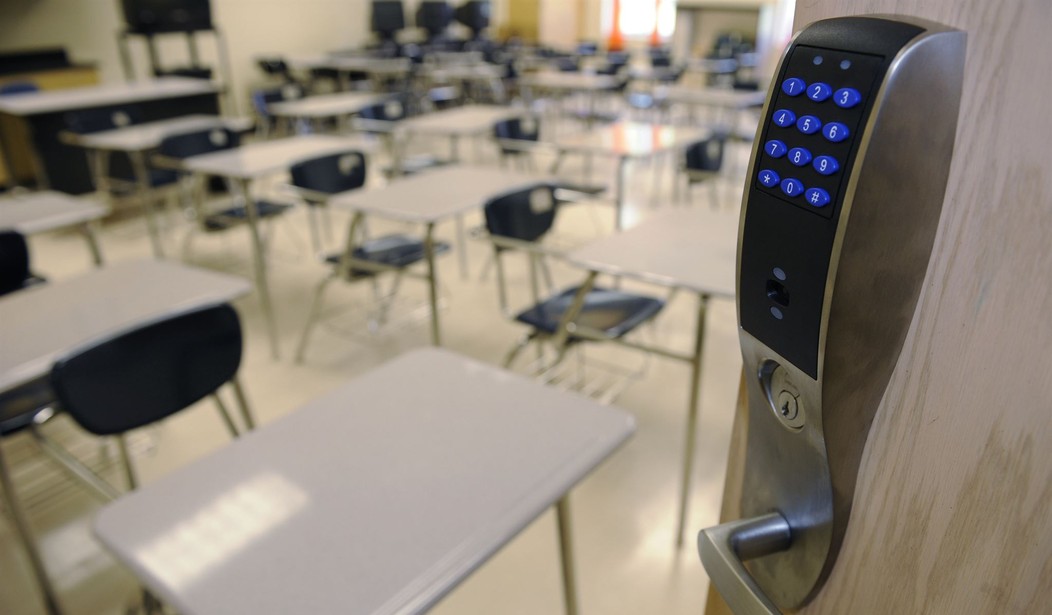
A new study from Texas State University's Advanced Law Enforcement Rapid Response Training (ALERRT) Center reveals just how critically important a simple, secured door can be when it comes to protecting students.
According to the report, almost half (47.8%) of casualties in the 54 school-based active shooter incidents between 2000 and 2025 took place in classrooms. Hallways were the next most common location, accounting for 17.6% of victims. When the perpetrators of these attacks can't get inside a classroom, lives are saved. On the other hand, when doors aren't locked, or aren't even present, it can have tragic results.
The October 2007 attack at SuccessTech Academy illustrates how building design can eliminate doors as a protective factor entirely. A current student entered the school carrying two revolvers and went to a bathroom to change clothes and load the weapons. He then moved rapidly through hallways and several classrooms over the course of approximately two minutes before entering an empty classroom and fatally shooting himself. Four people were wounded. The perpetrator was able to move freely between spaces in part because most of the school's rooms did not have doors — only open doorways. In a building without doors to secure, lockdown protocols that rely on closing and locking cannot be executed.
The perpetrator in that attack could easily have killed or injured more students and faculty, but authorities believe that this was more of a targeted attack in response to the perpetrator's suspension from school.
According to the report, "the majority of perpetrator entries occurred through unsecured doors and that locked doors were rarely breached through mechanical means."
The study notes, however, that in high schools and middle schools, "perpetrators are overwhelmingly current students who already have routine access to the building." In these settings, researches say, exterior door locks are relatively less important since the students aren't generally prohibited from coming inside. Locking classroom doors, however, do make a significant impact in terms of the student being able to carry out an attack.
In elementary schools, on the other hand, the majority of active assailants are not students, and about half have no prior relationship to the school. Active shooting incidents in these schools were primarily in classroom settings, highlighting the importance of both secured exterior doors and classroom doors that can be locked from the inside.
A separate section of the study took a closer look at incidents where school shooters were unable to gain access to the school building because of secured doors. The study's authors note that they only found three such incidents in the 2000-2025 time frame, but say that the "small sample size should not be interpreted as reflecting the true frequency of averted school shooting incidents.
Rather, it reflects the limitations inherent in identifying these events through available sources. Unlike completed school-based active shooter events that often generate sustained national media coverage, some averted incidents only receive local news attention, or limited national attention, and may not be systematically cataloged in accessible databases. The four cases documented here represent only those incidents that could be identified through comprehensive searches of open-source materials and publicly available databases. It is likely that additional averted incidents occurred during the study period but remained beyond the reach of systematic identification efforts.
That makes sense. There are hundreds of thousands, if not millions of defensive gun uses every year, but the vast majority of them will never receive media coverage because a trigger was never pulled. If someone intent on carrying out a school shooting is thwarted before they can ever enter the building, that too is likely to generate far less media attention.
One of the incidents the report discusses happened in Memphis, Tennessee a couple of years ago, when a former student at Margolin Hebrew Academy-Feinstone Yeshiva of the South showed up at the school armed with a handgun and murder on his mind.
The attacker attempted to gain entry but was unsuccessful due to the school's security measures, including locked exterior doors. When he could not gain access, he had a brief confrontation with a contract worker outside the building and fired two shots from his handgun while retreating from the worker. He then returned to his vehicle and fired an additional two shots while leaving the property. The attacker was shot by police shortly after during a traffic stop.The school's security features played a central role in preventing the attacker's entry. According to school leaders and media reports, Margolin Hebrew Academy had recently upgraded its security measures, including the installation of metal doors with electronic fob access, security cameras, and an emergency response system designed to quickly notify law enforcement of an active shooter.
Although the focus of the study was on the effectiveness of locked doors and not gun control, the report does note that a majority of school shooting incidents involved handguns, not the semi-automatic rifles that are the targets of Democrats in states like Minnesota. That too provides more weight to the argument that banning so-called assault weapons isn't the solution to preventing shootings on campus. Instead, simple yet effective security measures like classroom doors that can lock from the inside and using metal doors instead of wooden ones can pay huge dividends in keeping students and staff safe from harm.
I'd say it's a shame that this report didn't come out until after Minnesota's legislative session was gaveled to a close, but I doubt it would have made a difference with any of the anti-gunners intent on using the Annunciation shooting last August to demand a gun ban. Still, if Democrats in Minnesota want to make gun control an issue on the campaign trail this year, I hope their Republican opponents will point to this study and the Democrats' sheer unwillingness to make these security upgrades unless a gun and magazine ban was included.