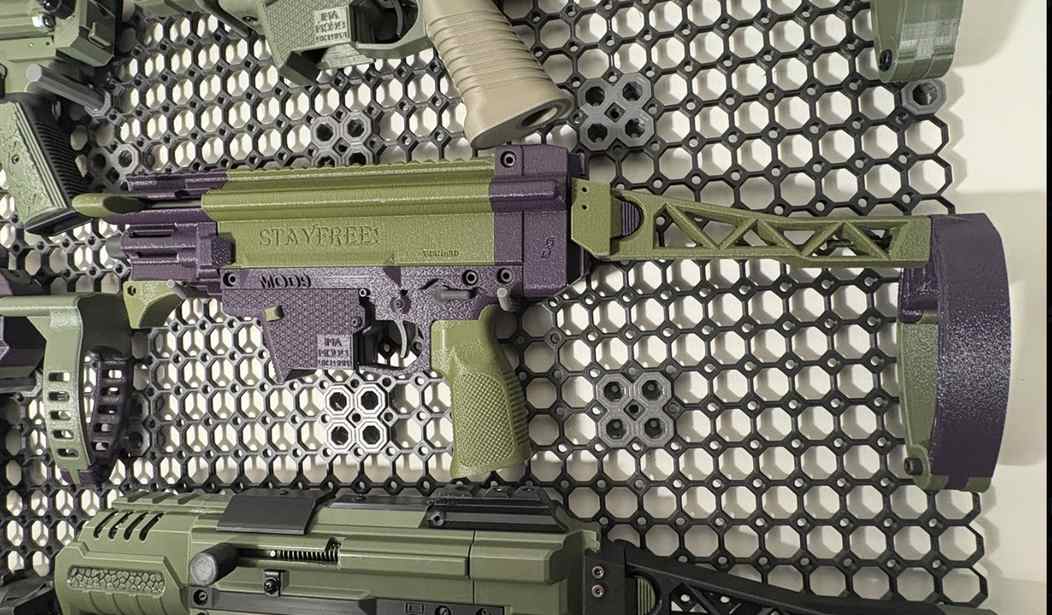
New York Gov. Kathy Hochul and her fellow Empire State Democrats have been patting themselves on the back for going after 3D printers in an attempt to crack down on "ghost guns," but even some supporters of a new law that could lead to restrictions on 3D printers say their efforts won't pan out.
Anti-gunners are hoping the new law in New York will lead to a requirement that every 3D printer sold in the state has the ability to block the printing of gun parts, but as Fortune reports, the plan is getting pushback from gun owners and 3D printer owners, even those who don't build guns. And even some supporters of the law say it won't make a difference to criminals.
The Association of 3D Printing supports the legislation in New York and California, but “it’s not going to work,” [Executive Chairman Bill] Decker said. “It’s more of a political statement than anything else.”
Criminals still will come up with ways to make guns from 3D printers, either by altering their designs or taking their printing projects elsewhere, Decker said.
The more aggressive the technology becomes, the more likely that it also blocks unintended items, said Rory Mir, director of open access and technology community engagement at the Electronic Frontier Foundation, a nonprofit digital rights group. Some harmless pipes might look like gun parts, or an S-shaped wall hanger might resemble an auto sear trigger used to modify a semiautomatic weapon into a machine gun.
“These sort of censorship algorithms don’t work, and they wind up capturing and blocking a lot of lawful speech,” Mir said.
If print instructions are submitted for a cloud-based artificial intelligence search, it also risks the privacy of people’s artistic and proprietary creations, Mir said.
So why support something if you don't believe it will work? I went to the association's website hoping to find an explanation or a statement of some kind, but beyond a couple of blog posts about 3D printed firearms, there was nothing there.
My guess is that Decker and the association are hoping that going along to get along will spare them from further regulation in the future, but if that really is the mindset I think they're sorely mistaken. Today it's anything that could be used to assemble a firearm, but once lawmaker start regulating the industry it won't stop there.
And as Mir points out, even if someone isn't thrilled about 3D-printed firearms, the new laws could easily result in mistakes that block printing of items that have nothing to do with guns. A line in the sand needs to be drawn now, and it's a real shame that Decker and the Association of 3D Printing is unwilling to take a stand in defense of freedom.
The only bright spot about the bill in New York is that it doesn't automatically impose new restrictions on 3D printers. Instead, it essentially creates a task force to develop standards for algorithms that can spot files used to make gun parts.
The technology would analyze every design submitted for 3D printing, compare it to a digital library of firearm parts, and reject those that are similar.
Though the study process would start now, the mandate that 3D printers come equipped with firearm blocking technology wouldn’t begin until 2029 — or later, in New York’s case, if the study group determines it’s not yet feasible.
It's entirely possible that the panel will conclude that it's not feasible to block the printing of gun parts without blocking the printing of other items that aren't meant for gun-making. If not, any concrete step to impose these kinds of controls will face a slew of lawsuits.
Let's assume for the sake of argument that these controls survive a legal challenge. Will that stop the signal, so to speak? Absolutely not. There are already kits out there that allow people to build their own 3D printers, as well as open source designs for those who want to go that route. Even if commercial 3D printer manufacturers abide by the mandates anti-gun lawmakers are hoping to put into effect, people will still be able to build their own machines.
The answer to all of this is ludicrously simple. Punish those who misuse firearms in violent crimes, regardless of how those guns are made. We live in a nation with more than 400 million firearms and the technology that allows them to be built on demand. Trying to prevent violent crime through supply-side measures is never going to work. Criminals will find a way. The best strategy is to disincentivize the criminal use of firearms, and the best way to do that is to ensure that there are consequences for using a gun to commit a crime; arrests, prosecutions, and stiff sentences.
Reducing demand can also involve violence intervention strategies that disincentivize gunplay by helping to put those most at-risk on a better path in life and deescalating disputes that might lead to shots fired. All of these strategies have the bonus of not infringing on a fundamental civil right, but that seems to be the sticking point for anti-gun politicians. They can combat violent crime without going after gun ownership, but time and again they reject that course of action in favor of imposing new restrictions on the right to keep and bear arms. The current debate over 3D printing is just more evidence that gun control isn't about fighting crime. It's not even about controlling guns. It's about controlling We the People.
Editor’s Note: The radical Left will stop at nothing to enact their radical gun control agenda and strip us of our Second Amendment rights.
Help us continue to report on and expose the Democrats’ gun control policies and schemes. Join Bearing Arms VIP and use promo code FIGHT to receive 60% off your membership.







Join the conversation as a VIP Member