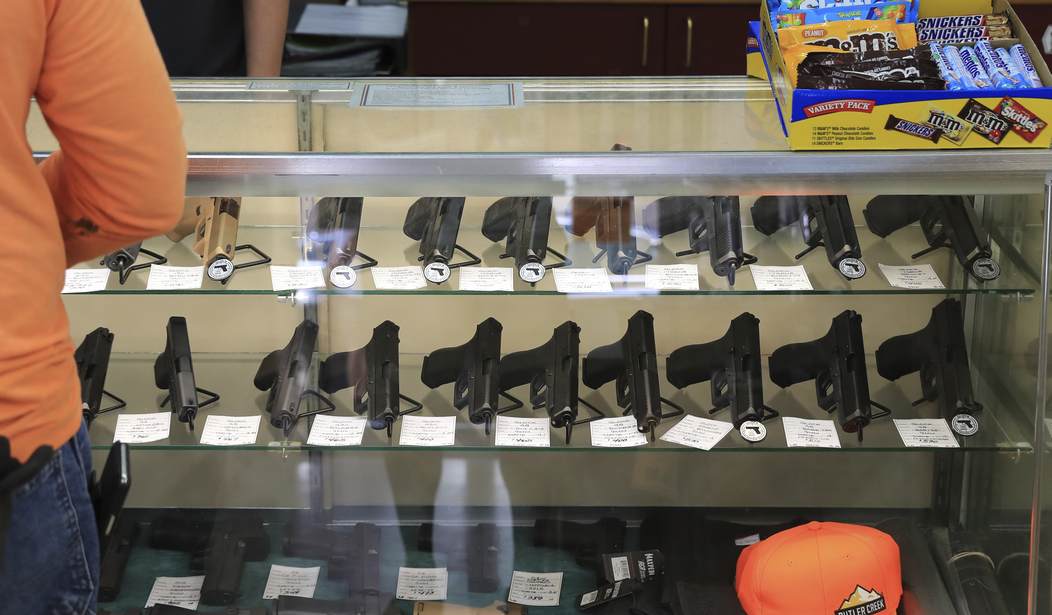
On the surface, the Supreme Court's decision striking down Hawaii's "vampire rule" prohibiting concealed carry by default on all private property open to the public isn't that big a deal. Hawaii's law was never actively enforced thanks to an injunction, and there are only three other states (New York, California, and Maryland) that had adopted similar laws after the Supreme Court struck down "may issue" concealed carry four years ago. None of those states were ever able to enforce those laws either, thanks to legal challenges. So why are law professors like Jake Charles and Megan Walsh crashing out over the ruling?
Second Amendment Foundation attorney Kostos Moros captured some of the angst they've been unleashing on their Bluesky followers, and it's clear that both of the anti-gun academics believe Wolford will have an impact far beyond "vampire rules." Moros began by responding to meltdown of Megan Walsh, who runs a pro-gun-control clinic at the University of Minnesota Law School that works hand-in-hand with the state's anti-gun Attorney General Keith Ellison.
This is misleading because the DC law at issue in Heller made *all* guns useless for self-defense, because of the strict storage requirements. pic.twitter.com/rZHmoKurJU
— Kostas Moros (@MorosKostas) June 25, 2026
Both Walsh and Charles mischaracterized the D.C. storage regulation struck down in Heller, claiming it allowed for long guns to be used in self-defense even though the law required "any lawful firearm in the home be disassembled or bound by a trigger lock at all times, rendering it inoperable," as Justice Antonin Scalia put it.
That's not Walsh's biggest beef with Wolford, though.
Bruen asks for "representative" analogues, and rejected outliers.
— Kostas Moros (@MorosKostas) June 25, 2026
What do you think that meant, Megan? Certainly not that you could cite one Black Code from 1865 and have your Vampire Rule upheld. pic.twitter.com/reuN51J8R5
Walsh recoils at Alito's statement (and Justice Amy Coney Barrett's concurrence) that the first step judges must take in determining whether a gun control law is constitutional is to decide if the law in question implicates the plain text of the Second Amendment. If it does, then the judge must assume that that law is unconstitutional, and it's up to the government to prove that it is not; that instead, it is part of the "national tradition" of gun ownership and regulation by pointing to historical analogues that were in place around the time of the Founding or the ratification of the Fourteenth Amendment.
That infuriates the anti-gunners, who've cheered on judges that have dismissed challenges to things like "assault weapon" bans by claiming they're not even protected by the Second Amendment, and therefore there is no need to conduct any kind of historical investigation. Wolford makes it clear that if a law prohibits the keeping of arms, it's presumptively unconstitutional, and the burden is on the defendants to prove otherwise.
Wolford also says that for those analogues to be accepted, they need to be "widespread, well-known, and widely accepted." A handful of laws doesn't suffice, nor do laws that were established in one geographic region of the country, or those that were only in place for a short period of time.
While Walsh is clearly upset about Wolford (she said in a subsequent post on Bluesky that she wasn't sure she could "handle this Wolford opinion on the same day that the Wolves traded Naz Reid," adding, "The arc of the moral universe is not bending toward justice at the moment."), she's downright levelheaded compared to Pepperdine law professor and former head of the Duke Center for Firearms Law Jake Charles.
"Dangerous and unusual" is a HISTORICAL principle. It has no bearing on whether something is an "arm" or not. pic.twitter.com/QcO8DPSC1x
— Kostas Moros (@MorosKostas) June 25, 2026
Charles (and Walsh) are well aware that the Wolford decision calls out the rationale used by courts like the Fourth Circuit to uphold bans on "assault weapons," and that it likely to have a big impact on gun and magazine ban cases going forward. But Charles is also incensed at what the Court had to say about Hawaii's "vampire rule," to the point that he's now calling for the state of Hawaii (and perhaps others as well) to compel private property owners to speak on the subject of concealed carry even if they prefer to remain silent.
Remember the failed Hawaii bill that would have replaced the vampire rule with one forcing every private property owner to put up a sign saying whether or not they allow guns? You'll never guess what Jake is now advocating for! pic.twitter.com/hzNu3omgyY
— Rob Romano (@2Aupdates) June 26, 2026
Charles is even claiming that the Supreme Court's Second Amendment jurisprudence is unconstitutionally violating the Tenth Amendment.
Jake is still going: "The Court’s implementation of Bruen is violating the Constitution." pic.twitter.com/w6phYMrdCU
— Rob Romano (@2Aupdates) June 26, 2026
States have the power to legislate. They do not have the power to do so in a way that violates our individual rights. That's pretty simple, but I guess when you don't have any good arguments to make, you work with what you have.
Wolford ended up being a more consequential opinion than I expected, and so long as the lower courts don't ignore it or abuse it then it will be helpful to plaintiffs challenging other gun control laws going forward. Of course, we've watched courts across the country disregard cases like Heller and Bruen for well over a decade now, and I suspect that some judges will willfully ignore the Court's guidance in Wolford as well... which makes it all the more critical that the Supreme Court stop letting many of these issues "percolate" in the lower courts and address them head on as soon as possible.
Editor’s Note: The radical Left will stop at nothing to enact their radical gun control agenda and strip us of our Second Amendment rights.
Help us continue to report on and expose the Democrats’ gun control policies and schemes. Join Bearing Arms VIP and use promo code FIGHT to receive 60% off your membership.








Join the conversation as a VIP Member