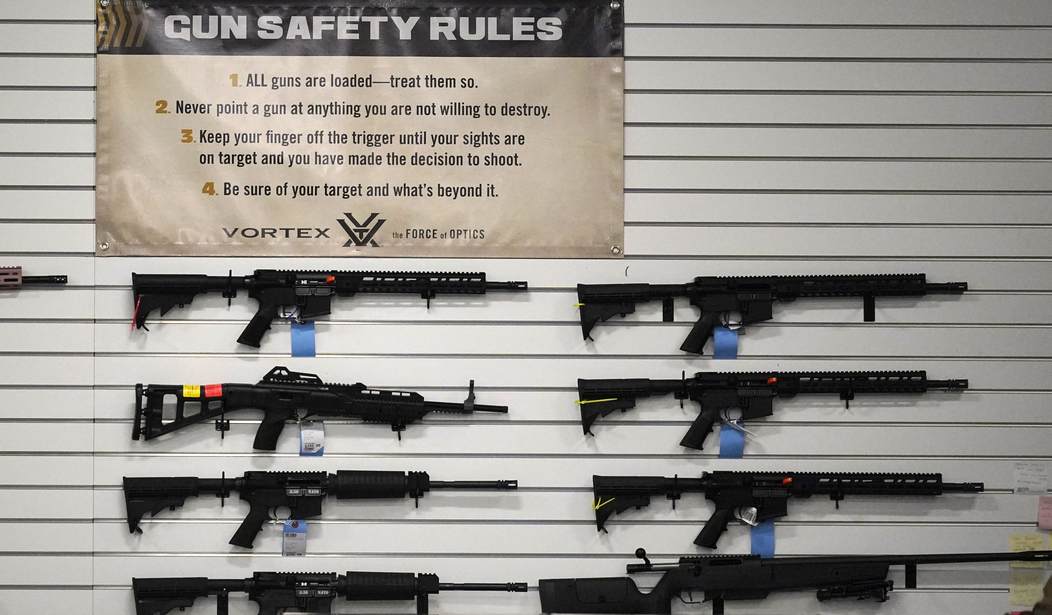
There are now two injunctions blocking enforcement of the ban on so-called assault firearms and large capacity magazines set to take effect on July 1, after a judge in Washington County, Virginia sided with the National Rifle Association, Virginia Shooting Sports Association, and several individual gun owner and gun sellers who'd sued over the law.
Washington Circuit Judge Jeffrey Campbell handed down his ruling on Monday afternoon, delivering a big win to the plaintiffs and a stinging defeat to the defendants, including multiple Commonwealth's Attorneys and Virginia State Police Col. Jeffrey Katz. The head of the VSP is already blocked from enforcing the law thanks to an injunction granted by a Lancaster County judge last week in a GOA/VCDL suit, but today's injunction is broader in its scope... and according to the plaintiffs, applies statewide.
In his ruling, Campbell stated that, given the sweeping nature of the ban and the arms in question, the plaintiffs are likely to win their lawsuit on the merits.
See SB 749 language amending Section 18.2-308.2:2 definition of assault firearm:
2. A semi-automatic center-fire rifle that has the ability to accept a detachable magazine, not including an attached tubular device designed to accept and capable of operating only with .22 caliber rimfire ammunition, and that has one or more ofthe following characteristics: (i) a folding, telescoping, or collapsible stock; (ii) a thumbhole stock or pistol grip that protrudes conspicuously beneath the action of the rifle; (iii) a second handgrip...
The highest court in the land has made a finding that "The AR-15 is the most popular semi-automatic rifle" in America and is therefore undeniably "in common use today." Heller v. District of Columbia, 670 F. 3d 1244, 1287, 399 U.S. App. D.C. 314 (CADC 2011). In the Bruen case, the U.S. Supreme Court held that the Second Amendment protects not only the carrying of weapons that are those "in common use at the time."
The state of Virginia had pointed to several court decisions around the country upholding similar bans, including the federal Fourth Circuit Court of Appeals, which has previously upheld Maryland's "assault weapons" ban and has jurisdiction over federal (but not state) litigation in Virginia. Judge Campbell was unimpressed.
This Court is unpersuaded by these cases because the determination in all matters involved findings that would conflict with this Court's finding that these types of firearms and their component magazines are in common use and presumptively covered by the 2nd Amendment or, in the alternative, they remain pending in various states of unresolved appeals.
In upholding Maryland's ban, the Fourth Circuit also engaged in something SCOTUS just said is a no-no. In Wolford, the majority clearly stated that, when the plain text of the Second Amendment is implicated, courts should start with the presumption that a law is unconstitutional. It's up to the State to justify its law by pointing to "widespread... and well regarded" analogous that have similar "whys" and "hows" to the modern law in question. The Fourth Circuit didn't do that with Maryland's gun ban. Instead, it assumed from the outset that the banned arms aren't even protected by the Second Amendment because they're "unusually dangerous" and to akin to military arms to fall under the text of the Second Amendment.
That language in Wolford re-opens the door to a federal challenge to Virginia's ban (and arguably Maryland's as well), and it's going to be much more difficult to justify an "assault weapon" ban going forward, in my opinion. The closest analogues that states like Virginia can point to are probably bans on the public possession of Bowie knives adopted by some states in the mid-1800s, but I doubt those laws were widespread enough to be accepted by SCOTUS. Even if they were, the vast majority of those restrictions did not impose a complete ban on their sale, manufacture, and transfer, as Virginia's "assault firearm" ban does.
Virginia could try to point to the National Firearms Act, but again, that statute doesn't prohibit the possession of NFA items. It just requires owners to pay a $200 tax and register the payment of that tax with the feds. The "why" may be close to the public safety arguments presented by the gun banners, but the "how" is notably different and less restrictive. It's also far later than either 1791 or 1868, when the Fourteenth Amendment was ratified.
Attorney General Jay Jones is already appealing the Lancaster County injunction, and will surely do the same with the Washington County injunction as well. It is possible that these measures will be stayed by the courts, and I also wouldn't be surprised if Jones tries to argue that FFLs are opening themselves up to civil litigation by his office if they continue to sell the affected magazines and firearms on July 1 and after. While it's still unclear at this point what the practical impact of the injunctions will be, what the effect should be is pretty clear: no enforcement going forward, and a continuation of the status quo as of June 29.
***UPDATE***
In a statement, the National Rifle Association is hailing what it calls a "statewide comprehensive injunction" against enforcement of the gun and magazine ban.
John Commerford, Executive Director of the National Rifle Association Institute for Legislative Action, released the following statement on the win:
“The NRA’s world-class legal team delivered a clear, powerful argument demonstrating that Abigail Spanberger’s gun ban is a blatant constitutional infringement on the rights of law-abiding Virginians. Our strategy has now secured a comprehensive statewide injunction, blocking enforcement of this law until the courts hear our full case. This is a major victory, but our mission is not complete. We will not rest until this unconstitutional measure is struck down in its entirety and added to the long list of gun control laws the NRA has removed from the books for good.”
I truly hope this is as comprehensive as Commerford says, but the judge's injunction (at least today's opinion) says it applies to the defendants, and there are plenty of local law enforcement and Commonwealth's Attorneys who aren't named in the complaint. In fact, the Attorney General isn't a named plaintiff either, and given Jones's animosity towards gun owners, gun sellers, gun makers, and the Second Amendment, I wouldn't be surprised at all if he threatens to bring civil suits against any FFL who continues to sell "large capacity" magazines or "assault firearms" after July 1, as well as any firearms distributor or manufacturer who ships to Virginia.
Commerford may be right, but I would really like a statement from Judge Campbell to the effect that the is enjoined its entirety from being enforced by any law enforcement entity, just to make that crystal clear to every agency in the Commonwealth... including the AG's office.
Editor’s Note: The radical Left will stop at nothing to enact their radical gun control agenda and strip us of our Second Amendment rights.
Help us continue to report on and expose the Democrats’ gun control policies and schemes. Join Bearing Arms VIP and use promo code FIGHT to receive 60% off your membership.







Join the conversation as a VIP Member