








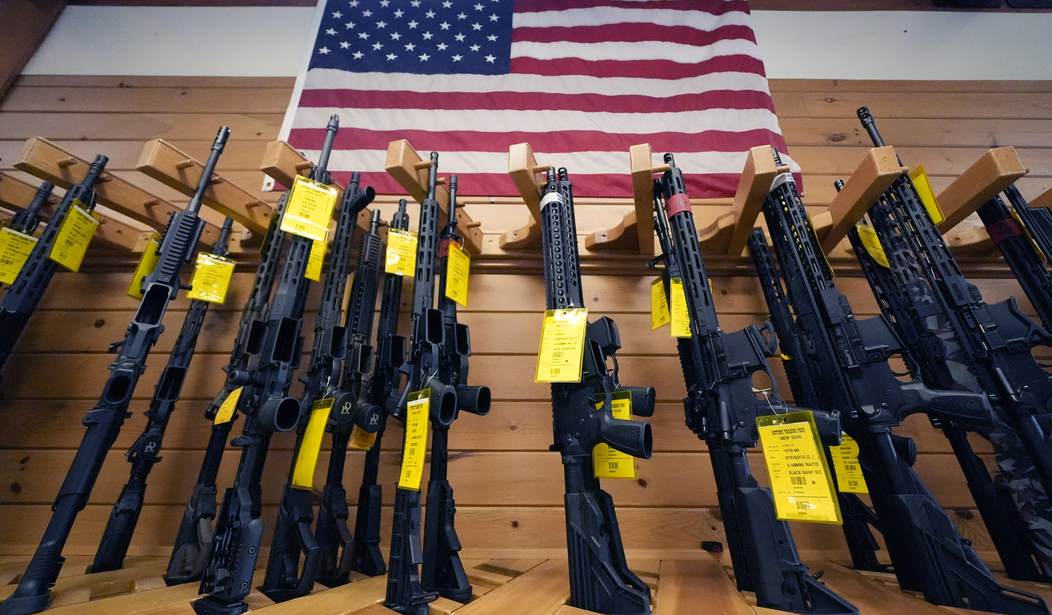
Just days after the Third Circuit Court of Appeals struck down New Jersey's ban on so-called assault weapons and large capacity magazines, a three-judge panel on the First Circuit Court of Appeals has upheld an even broader ban in Massachusetts.
The panel concluded that First Circuit precedent forecloses any challenge to the gun ban. Last year, in a case known as Capen, the First Circuit upheld an earlier version of the state's semi-auto ban using some downright tortured logic. As the panel explained on Tuesday in Recchia v. Campbell:
Specifically, we considered (1) how the predecessor law's burden on the right of armed self-defense compared with the burden imposed by similar historical weapons regulations, and (2) whether the justification for the predecessor law was analogous to the justification for earlier weapon regulations.
As for the first consideration, we "gauge[d] how [the predecessor law] might burden the right of armed self-defense," and then compared that burden "to the burdens imposed by historical regulations." We concluded "that the Massachusetts [b]an's AR-15 restriction d[id] not impose a heavy burden on civilian self-defense." We then compared that burden to theburden arising from historical restrictions on Bowie knives, sawed-off shotguns, and machine guns, concluding that it was "'reasonably clear that our historical tradition of regulating arms used for self-defense has tolerated' burdens similar to those posed by" the law's ban on assault weapons.
And that is not even remotely close to the test that the Supreme Court has laid out for the lower courts. The First Circuit should have asked "is the plain text of the Second Amendment implicated by the challenged statute?" Given that the state is prohibiting the keeping of a class of "arms", the answer is clearly yes.
It's then up to the state to justify that prohibition based on historical analogues. The Court has said nothing about self-defense being the sole aspect of the right to keep and bear arms, and it would be absurd to do so. The Supreme Court has repeatedly stated that the Second Amendment protects arms that are in common use for lawful purposes, including (but not limited to) self-defense.
In looking at sawed-off shotguns and machine guns, the First Circuit clearly went far beyond either 1791 or 1868 in its search for historic analogues. And when it comes to Bowie knives, the Third Circuit correctly held that laws regulating those knives are "too late in time, and none enacted an outright ban on a class of weapons in common use for lawful purposes."
The First Circuit also upheld the previous version of Massachusetts' "assault weapon" ban by concluding that "the justification for the ban was analogous to justifications that have 'underpinned a tradition of weapon regulation throughout American history.'
We noted that when a permanent enactment of the ban was being signed in 2004, then-Governor Mitt Romney stated that the ban was justified because assault weapons are "instruments of destruction with the sole purpose of hunting down and killing people" and that a corresponding press release stated the ban "will help keep the streets and neighborhoods of Massachusetts safe." We found that the ban "reflect[ed] a common concern regarding 'the State's responsibility to protect the public from the danger caused by weapons that create a particular public safety threat.'" And we concluded that similar justifications were employed as a basis for prohibiting sawed-off shotguns and Bowie knives (noting that bans on sawed-off shotguns were spurred by the popularity of the gun "with the mass shooters of their day" and that bans on Bowie knives were spurred by "growing societal concern about violent crime").
Quoting Mitt Romney's justification for signing a gun ban as if it were Gospel is infuriating. If the sole purpose of AR-15s is to hunt down and kill people, we've got tens of millions of Americans who are misusing their rifles. These guns are commonly owned for a variety of lawful purposes, and are rarely used in crimes of any kind.
The First Circuit's rationale that states can ban weapons that lawmakers believe create a "particular public safety threat" could be used to justify bans on handguns, which are the weapon of choice for violent criminals. But the Supreme Court has already taken that option off the table, and it's not up to the First Circuit to put it back.
Recchia's attorneys also raised a Commerce Clause argument, but the First Circuit blithely brushed that aside by asserting that Massachusetts is "merely exercising its sovereign authority to 'exclude from its territory, or prohibit the sale therein of any articles which, in its judgment, fairly exercised, are prejudicial to' the interests of its citizens.'"
Except that these items are protected by the Constitution, at least when judges aren't mangling the Supreme Court's "text, history, and tradition" test.
In my opinion, the Supreme Court's findings in Wolford provided the First Circuit panel with more than enough legal ammunition to revisit its decision in Capen. That the panel declined to do so is an exercise in judicial cowardice, and the only saving grace is that the panel is going to find itself on the losing side of the argument when the Court addresses bans on commonly-owned semi-automatic firearms next term.
Editor’s Note: The radical Left will stop at nothing to enact their radical gun control agenda and strip us of our Second Amendment rights.
Help us continue to report on and expose the Democrats’ gun control policies and schemes. Join Bearing Arms VIP and use promo code FIGHT to receive 60% off your membership.
Join the Conversation
VIP members get the ability to comment on articles.