New York Times investigative reporter Mike McIntire has a new book out this week called "Ricochet: Guns, Greed, and the American Way of Violence." His thesis is that a "witches’ brew of politics, money, and ideology has warped gun culture in the United States, hijacking the Second Amendment and allowing fear and insecurity to drive the reckless marketing of powerful weapons."
McIntire's released an excerpt from his book at TPM, and it is downright bizarre.
The heedless integration of firearms into American life is not solely explainable by historical undercurrents, such as the grand schemes of the NRA and the gun industry to inculcate pro-gun attitudes in young people. Larger cultural and social forces have also become increasingly important.
As I began exploring them more deeply, it quickly became apparent that modern-day gun culture has entered a phase akin to the late-stage Roman Empire, when success and power devolved into selfish extravagance. No longer was it enough to argue that sports shooting, hunting, and self-defense justified an expansive interpretation of the Second Amendment—simply having fun with guns was now a God-given right.
Now? As in, this is some recent development? And how is it "selfish extravagance" to enjoy a day at the range or a couple of hours in a rural backyard plinking at targets with family and friends? When I think of "late stage Roman Empire," the excesses and decadence of emperors like Caligula come to mind, and Roman orgies are a far cry from what you'll find at shooting ranges across the country (though I suppose it's possible that I'm just not getting invites).
So what on earth is McIntire talking about?
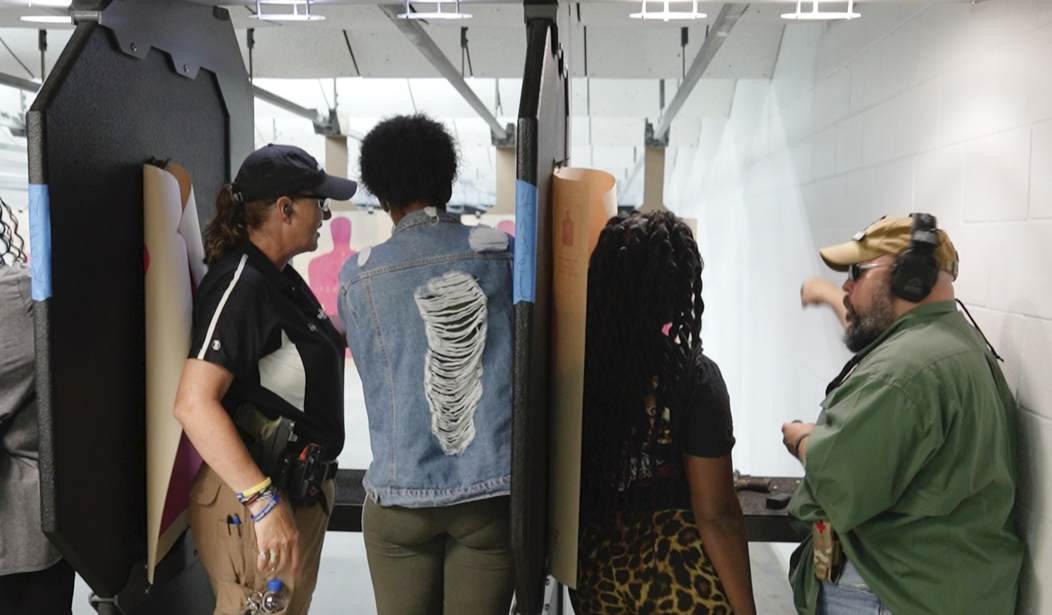
As it turns out, McIntire seems terribly offended by both luxury gun ranges and places like Rolling Thunder in Nevada and Bullets and Burgers in Arizona, where customers can easily spend four figures on memberships or shooting packages. McIntire isn't just bothered by the existence of these facilities. He seems really upset that they're popular.
Well-educated, well-off parents with the freedom to choose any number of healthy, memorable adventures for their children gravitated to ones centered around instruments of lethal violence as entertainment. Some of this was undoubtedly influenced by the gun lobby’s decades-long effort to position firearms as an acceptable way to teach responsibility to kids by making shooting a family-friendly pastime.
But there were deeper societal currents working as well. Legally purchasing and maintaining a decent firearm has never been cheap. One consequence of restricting imports of expensive guns such as so-called Saturday night specials—which in the 1960s and early ’70s could be bought for as little as $10—is that it allowed American-made guns to be sold at even higher prices. Gun control advocates such as Sen. Thomas Dodd were often accused of pushing import bans, in part, to protect homegrown manufacturers, such as Colt, Winchester, and Sturm, Ruger in Dodd’s state of Connecticut.
I assume that McIntire meant to say that restricting imports of inexpensive guns, but even then many of the cheap pistols labeled "Saturday Night Specials" were domestically produced, at least after the import bans of the late 1960s were implemented. Companies like Raven Arms, Lorcin, and Jennings weren't necessarily competing with Colt, Winchester, and Smith & Wesson.
McIntire obliquely mentions that it was gun control advocates like Dodd who were pushing for these import bans, but he ignores the fact that gun control advocates were also trying to put domestic makers of inexpensive handguns out of business. If McIntire has an issue with the price of high-end firearms these days, he should direct his complaints towards those gun control groups that engaged in a quest to eradicate "Saturday Night Specials" and relatively inexpensive firearms; a crusade that today focuses on privately manufactured firearms that are generally cheaper to make than many of the guns in stock at your local gun store.
Import restrictions under the 1968 Gun Control Act required firearms to be for “sporting purposes” and go through licensed dealers. The foreign-made guns that continued to be imported, such as the Beretta, tended to be higher quality and thus more costly. And as the AR-15 took off as a cultural icon, the money required to partake in the fun increased exponentially. Gun industry marketing adjusted to target higher earners, who could more easily afford the advanced weaponry they were selling.
By 2014, households earning more than $90,000 were nearly twice as likely to have guns in the home than those earning less than $50,000. A 2019 study found that “slightly less than half of US guns were owned by persons whose household income was $100,000 a year or more.”
At the same time, the typical education level of the people buying these weapons was also on the rise. In 1994, 29 percent of gun owners had some college education. By 2017, that figure had risen to 34 percent, and by 2022 it was 40 percent. Of course, educational attainment for Americans in general has been trending upward, but the concentration of gun ownership among wealthier households outpaced the extra income that accompanies higher levels of schooling.
Is there anything inherently bad about this? Of course not, at least to most folks. McIntire, though, just can't get over the fact that some Americans with disposable incomes enjoy spending that money on shooting sports.
Or maybe it's just the enjoyment of a day at the range that's made McIntire so prickly. At the end of his book excerpt, he quotes Robert F. Kennedy talking about gun ownership after the assassination of his brother.
"We have a responsibility to the victims of crime and violence. It is a responsibility to think not only of our own convenience but of the tragedy of sudden death. It is a responsibility to put away childish things, to make the possession and use of firearms a matter undertaken only by serious people who will use them with the restraint and maturity that their dangerous nature deserves and demands.”
Paying hundreds or thousands of dollars to shoot machine guns or blow up an old car filled with Tannerite is just too childish for McIntire, who sees danger in everything from machine gun shoots to politicians posing with firearms on their Christmas cards.
Do I cringe at some of the politicians who use guns as props in campaign ads? Yep. But I'd much rather vote for someone who uses that visual to show their support for the Second Amendment than the candidate who holds up an AR-15 and swears they're going to ban "weapons of war."
As for McIntire's complaints about gun owners having too much fun with their firearms, I'd note that the homicide rate today is even lower than it was when JFK was assassinated in 1963 and when RFK was assassinated five years later. The US homicide rate is the lowest ever recorded by the FBI, and estimates are that it's the lowest in a century or more. Violent crime levels have fallen to historic lows as well.
Does McIntire spend any time in his book wrestling with this conundrum? Based on the pitch for his book offered by his publisher, it doesn't sound like it. Instead, McIntire "crafts a gripping narrative of how the imperatives of war, slavery, crime, commerce and politics intertwined with the development of ever-more lethal firearms, leaving the country divided and traumatized."
He shares explosive new revelations about the NRA’s accumulation of power and turn to radicalism; Wall Street's efforts to turbocharge the market for assault weapons and online gun sales; the gun lobby’s secretive campaign to change public attitudes by indoctrinating children; and how dark money, questionable scholarship, and front groups are being used to knock down gun laws. At once a cautionary tale of unfettered liberty, swagger and free markets contributing to our violent undoing, Ricochet also delivers a prescription for how we might yet save ourselves.
With homicides at low levels not seen in McIntire's lifetime, I'd say we're doing a decent job of saving ourselves without his "prescription". And despite his claims of our "violent undoing," the rise in the gun culture McIntire despises has gone hand-in-hand with a decline in violent crime. Unless McIntire is willing to confront that undeniable truth in "Ricochet," I'd say his book is less investigative journalism and more of an anti-gun screed.