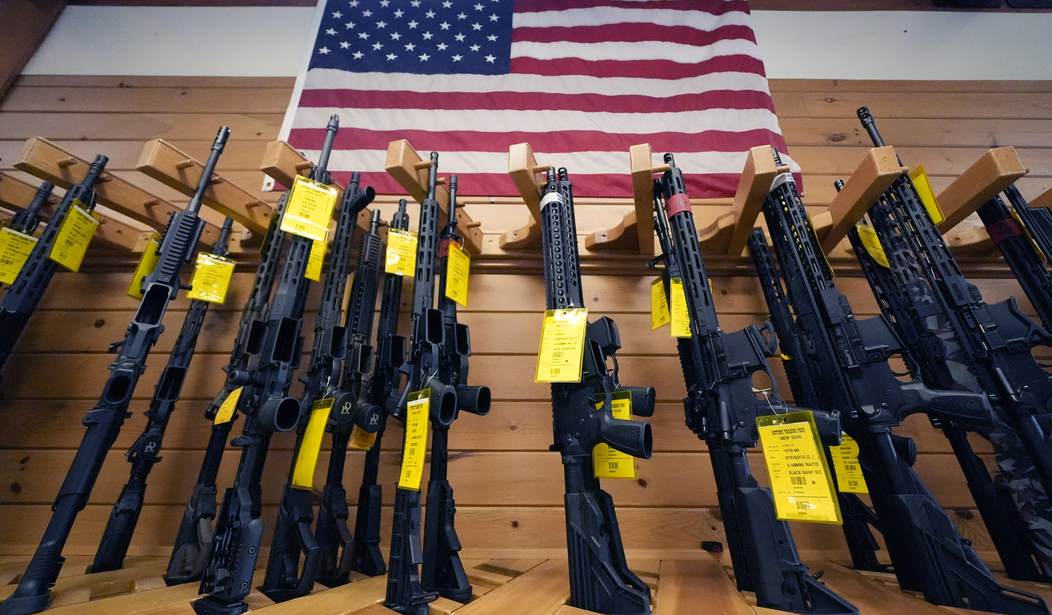

In the month before Colorado's new "permit to purchase" law governing sales of centerfire semi-automatic long guns took effect, the Colorado Bureau of Investigation processed nearly 60,000 background checks on gun sales. That's an almost 300 percent increase from the year before.
Not all of those sales involve the newly regulated firearms, but I think it's safe to say that the massive increase in transfers was driven by the new law.
When the new law came into effect on August 1, though, the sale of those same firearms plunged to almost zero. According to the National Shooting Sports Foundation, the number of NICS checks on long guns dropped 77.5 percent from July to August.
In order to buy an AR-15 or other regulated long gun, Coloradans must now obtain a certificate of eligibility from their local sheriff, and then take either a four- or 12-hour training class before they can make their purchase.
According to a new court filing by the state of Colorado in a lawsuit challenging the new restrictions, the number of residents who've completed their training is dwarfed by the number of transfers that took place before the restrictions took effect.
Over 3,500 people submitted applications for an eligibility card in August. Then, 1,125 of those cards were issued at 39 sheriff's offices and 502 people went to complete a safety course and pass the exam, according to the filing. The number of people who completed the basic four-hour course available for people with hunter education was 409, and 93 people went through the 12-hour extended course.
It's unclear how many people submitted an application but failed to follow up with a sheriff to get an eligibility card. Eligibility cards are valid for five years, so the 623 people who didn't take a course still have plenty of time.
The data came from a declaration from Kirk Teklits, the manager of business operations for CPW. The declaration was part of a response to a request for a preliminary injunction against Colorado's permit-to-purchase scheme.
"That's a 14% completion rate. That does not show that this is a system that's functioning well," Daniel Fenlason, the Colorado State Shooting Association director of operations, said in a video posted to the organization's YouTube account.
According to NSSF data, there were 29,333 NICS checks on long guns in Colorado in July 2026. That number plunged to just 6,600 in August, a decline of 77.5 percent. We don't know exactly how many of those July checks involved centerfire semi-automatic rifles now subject to the new permitting requirements, nor can we equate the 502 people who completed training in August with 502 actual firearm purchases. But the numbers strongly suggest that sales of the newly regulated firearms collapsed once the law took effect.
If roughly 6,000 long gun transfers in each month involved firearms unaffected by the new law, then approximately 23,000 July transfers may have involved newly regulated firearms, compared with only about 600 in August—a decline of more than 97 percent.
It's no wonder why state Sen. Tom Sullivan, who was the primary sponsor of SB 3, has said that the permit-to-purchase scheme is essentially a ban on so-called assault weapons.
The flood of semi-auto long gun sales, which admittedly spiked in July ahead of the new law, has now slowed to a trickle. In the first month that the law was in place, less than half of the folks who applied for an eligibility card received one, and less than half of those who did get approved took part in the training that's required to purchase some of the most popular firearms in the country.
Fenalson says this is proof the system isn't functioning well. I'd say it's evidence that the system is functioning exactly as anti-gunners like Sullivan envisioned. Purchasing one of the affected firearms is now a far more expensive and time-consuming process than it should be, and it's having a chilling effect on the sale of these long guns.
Declarants in that CSSA motion for a preliminary injunction said they experienced an application timeline of less than two weeks and application costs of $82.
Coloradoans interested in going through the (firearm) purchase eligibility process have been able to do so reasonably quickly and in large numbers, particularly given how new this process is.
Teklits wrote in his declaration that the average time in September between a person's completed application and when they got an eligibility card from a sheriff was 10.9 days. The average time between the card issuance and course completion was 11 days.
That $82 is for the application alone, and doesn't include the additional cost of training. As for the assertion that this process is "reasonably" quick, we're still talking about an average of 22 days between submitting an application and completing the required training. That's essentially a three-week waiting period on the purchase of a firearm, which is hardly reasonable. And that's on top of the state's three-day waiting period, which is the subject of an ongoing legal challenge but is still in effect at the moment.
It's downright laughable to claim that Coloradans have been going through the firearm purchase eligibility process in large numbers. Even if each and every one of the more than 3,500 applicants had obtained their eligibility card and completed training, that would still be far less than the number of purchasers in July. But as Daniel Fenalson pointed out, a 14 percent completion rate is hardly a success story... unless you're an anti-gun activist hoping to keep the number of purchases as low as possible.