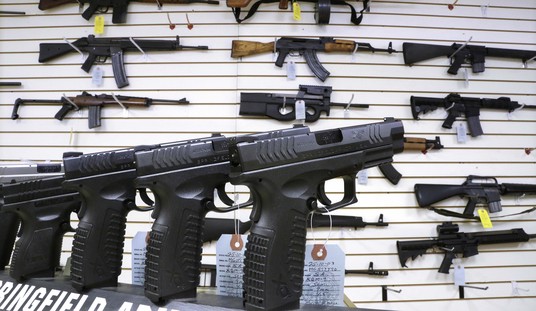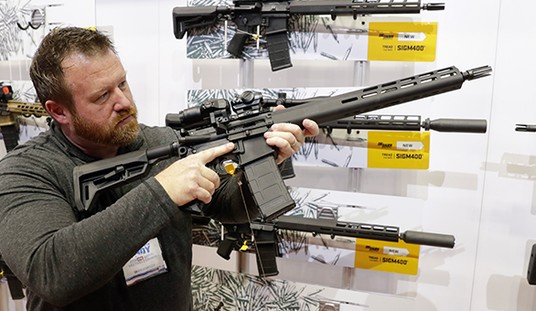

If and when the Supreme Court strikes down bans on so-called assault weapons next year, you know the liberal media and their many pundits are going to lose their collective minds over the decision.
Some folks have apparently decided not to wait, and are already subjecting their readers to takes so hot they'd burn your hand if you touched them. Retired law professor Robert Baron has penned one such column, where ironically, he never once invokes an actual legal principle in defense of bans on commonly-owned semi-automatic firearms. Instead his argument is based on this premise:
Many states impose restrictions on hunters concerning the use of semiautomatic rifles. These reflect public policy considerations involving humane treatment of animals, safety concerns for the hunter and the public, and notions of sportsmanship.
Because some states like South Dakota limit hunters to just six rounds of ammunition in a magazine if they're using a semi-automatic rifle, Baron believes that gives other states license to ban their use altogether.
One of the justifications for imposing cartridge limitations on hunters is that the hunter “could wound an animal without promptly harvesting it.” The counterargument is that “a quick follow-up shot can itself reduce suffering.” When I read this justification, my mind fixated on the hundreds of schoolchildren and police officers who have been killed without the benefit of a similar humane-treatment doctrine offered to waterfowl and game animals.
Many states, including nine now arguing that semiautomatic rifles are protected by the Second Amendment, have established rules designed to prevent unnecessary suffering among animals hunted for sport. They limit the number of rounds a hunter may fire, recognizing the importance of fair chase, public safety and humane treatment.
Surely the lives of schoolchildren and police officers deserve at least as much consideration as the lives of game animals.
There's an enormous difference between telling hunters they can only load six rounds into a semiautomatic rifle while pursuing deer and telling ordinary Americans they're forbidden from owning that rifle in the first place.
Hunting regulations govern a particular activity, generally conducted under a state-issued license, during specified seasons and in designated locations. They don't determine which firearms Americans may possess for self-defense, and they certainly don't establish the constitutional boundaries of the right to keep and bear arms.
The author seems genuinely perplexed that attorneys general from states with hunting restrictions would defend the constitutionality of owning AR-15s, but there's no contradiction here. A state can limit the number of shells a duck hunter loads into a shotgun without claiming the authority to prohibit that shotgun from being kept in someone's home for personal protection.
Then there's the author's discussion of police officers whose soft body armor can be penetrated by rifle ammunition. That's hardly unique to AR-15s. Many ordinary hunting rifles fire ammunition capable of defeating soft body armor, often with substantially greater energy than a typical AR-15 cartridge. If the ability to penetrate a police officer's vest is sufficient justification for prohibition, the author's argument extends well beyond the semiautomatic rifles currently being challenged in court. In fact, the government could ban the very bolt-action rifles that Baron is apparently okay with folks like you and me owning.
What about the law-abiding homeowner confronting multiple armed intruders? Or the woman defending herself against a violent attacker? The very characteristics the author finds so frightening in the hands of a murderer can be valuable when a firearm is used to stop a violent crime. If you can't take down a deer with six rounds, maybe hunting isn't for you. But when it comes to protecting myself and the people I love, I want access to as much ammo as I need and a self-defense weapon I feel comfortable using.
None of this diminishes the horrors of Sandy Hook or the murder of police officers that Baron invokes as justification for his argument. Those tragedies deserve to be taken seriously, unlike Baron's suggestion. But invoking the victims of violent criminals or cowardly mass murderers doesn't relieve the government of its obligation to respect constitutional rights, nor does it establish that prohibiting millions of peaceable Americans from possessing commonly owned firearms would prevent similar atrocities.
The Second Amendment isn't about hunting. It protects the right to keep and bear arms for lawful purposes, including for self-defense. And the Supreme Court has made clear that constitutional protection doesn't disappear simply because a weapon might also be misused by criminals.
The author's closing question is whether schoolchildren and police officers deserve as much consideration as game animals. Of course they do. The real issue before the Supreme Court, though, is whether the government can prohibit Americans from possessing firearms that are commonly owned for lawful purposes.
That's a constitutional question, and one that the retired law professor managed to completely avoid. Invoking the victims of horrific crimes may tug at the heartstrings, but it doesn't make the Second Amendment and the rights it protects null and void.