








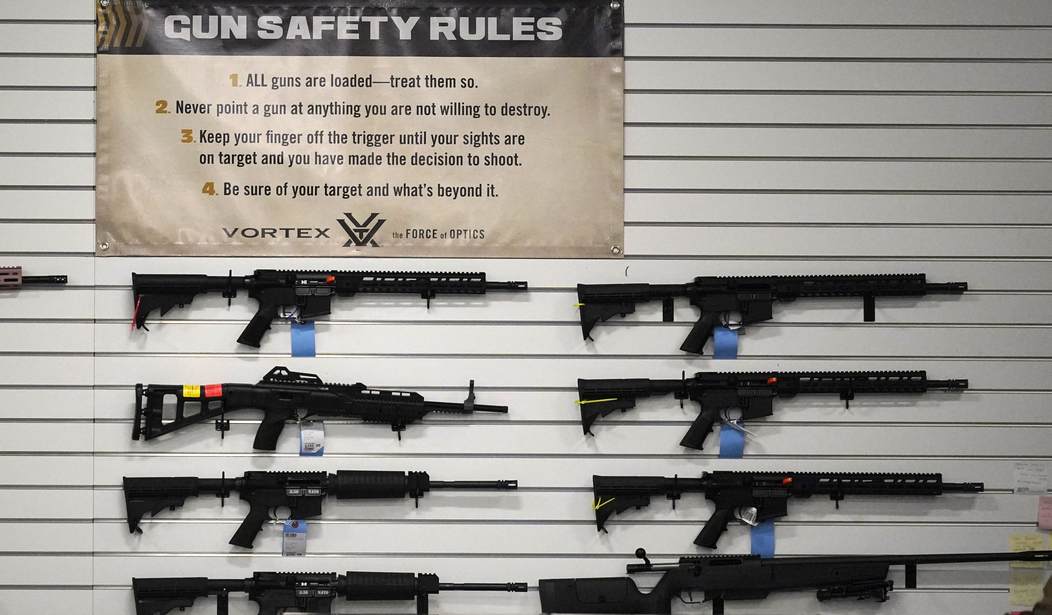
With the Supreme Court hearing oral arguments next week in the challenges to semi-auto bans in Cook County, Illinois and the state of Connecticut, we're about to be inundated with hot takes from supporters of these bans telling us why the justices should keep them in place.
Vox is among those outlets getting a head start on this spin, with writer Ian Millhiser boldly declaring that SCOTUS is going to have to decide between two different Second Amendments.
So what are these two versions of the right to keep and bear arms?
According to Millhiser, the first comes from the Heller decision, which recognized that the Second Amendment protects an individual right to possess firearms for self-defense. The Supreme Court struck down Washington, D.C.'s handgun ban, but Justice Antonin Scalia's majority opinion also acknowledged that the right isn't unlimited. Among other things, Scalia noted the historical tradition of prohibiting the carrying of "dangerous and unusual" weapons.
Millhiser argues that this language was a compromise designed to secure Justice Anthony Kennedy's vote. He argues that gun-rights advocates are now using that compromise to their advantage by pointing out that AR-15s and similar semiautomatic rifles are owned by millions of Americans. If those firearms are commonly possessed for lawful purposes, they cannot reasonably be described as "unusual," and therefore cannot be prohibited under Heller.
The second Second Amendment, according to Millhiser, is predicated on the Court's 2022 decision in New York State Rifle & Pistol Association v. Bruen, which held that modern gun laws must be consistent with the nation's historical tradition of firearm regulation.
Millhiser contends that this test could actually work in favor of gun-control advocates defending bans on semiautomatic rifles. He points to historical restrictions on weapons ranging from crossbows and Bowie knives to concealable handguns and slungshots and argues that governments have long prohibited particular weapons they considered especially dangerous, even after those weapons had become widely used.
Millhiser posits that the states defending their bans are relying more on a historical argument under Bruen, while gun-rights advocates are relying primarily on Heller's language about dangerous and unusual weapons.
But does the Court really have to choose between the two? And are those two readings actually incompatible with one another?
I don't think so, and here's why.
Millhiser treats Heller's "dangerous and unusual" language as though it were separate from the historical analysis required by Bruen.
But Heller didn't invent the dangerous-and-unusual exception as part of some negotiation between Scalia and Kennedy. The opinion grounded that exception in historical legal tradition, including Blackstone's discussion of carrying dangerous or unusual weapons. And as SAF attorney Kostas Moros pointed out on X, the attempt to create a controversy over whether the standard is "dangerous and unusual" or "dangerous or unusual" ignores the fact that most scholars agree both phrases were used interchangeably, and to describe a form of carry, not to a particular firearm.
Instead of focusing on "or" vs "and," maybe the antigun side should instead explain why before 1900, there were zero possession bans on any type of gun, including after the proliferation of repeating arms like revolvers and lever-action rifles. Whether you want to call it "dangerous and unusual," "dangerous or unusual," or even the invented "unusually dangerous," the phrase was never applied to the historical predecessors of the AR15. It was a restriction on a threatening form of carry. That's their biggest problem, not which specific version of the phrase SCOTUS wants to use.
— Kostas Moros (@MorosKostas) November 24, 2026
Besides, Bruen didn't discard the historical legal tradition. It expressly reaffirmed Heller and laid out a test that relies heavily on historic precedent from the time of the Founding to uphold modern restrictions on the right to keep and bear arms.
That means the two approaches aren't in competition with each other at all. The question is whether the historical restrictions cited by Connecticut and Cook County are sufficiently analogous to modern bans on firearms commonly possessed for lawful purposes.
Again, Moros points out that while the respondents claim that restrictions on Bowie knives, billy clubs, and "launcegays" are analogous to a semi-auto ban, the historical record is devoid of any longstanding or widespread attempts to ban the sale and possession of repeating arms, even though they represented a huge increase in the number of shots that could be fired without reloading.
There is also a meaningful difference between historical restrictions on carrying particular weapons in a threatening manner and outright prohibitions on their possession. Outright bans on Bowie knives were few and far between, and most of them were wiped off the books by the early 20th century.
It's entirely possible (and likely, in my opinion) that the Court will reference both Heller and Bruen when striking down these gun bans. AR-15s and other similar semi-automatic rifles are in common use for lawful purposes, and there is no tradition of banning commonly owned firearms simply because of their muzzle velocity, ammo capacity, or their use in crime. It's my opinion that there's only one Second Amendment, but even under Millhiser's two 2A theory, the bans on these semi-automatic firearms cannot be justified by either version of our right to keep and bear arms.
Editor’s Note: The radical Left will stop at nothing to enact their extreme gun control agenda and strip us of our Second Amendment rights.
Help us continue to report on and expose the Democrats’ gun-grabbing schemes. Join Bearing Arms VIP and use promo code FIGHT to receive 60% off your membership.
Join the Conversation
VIP members get the ability to comment on articles.