
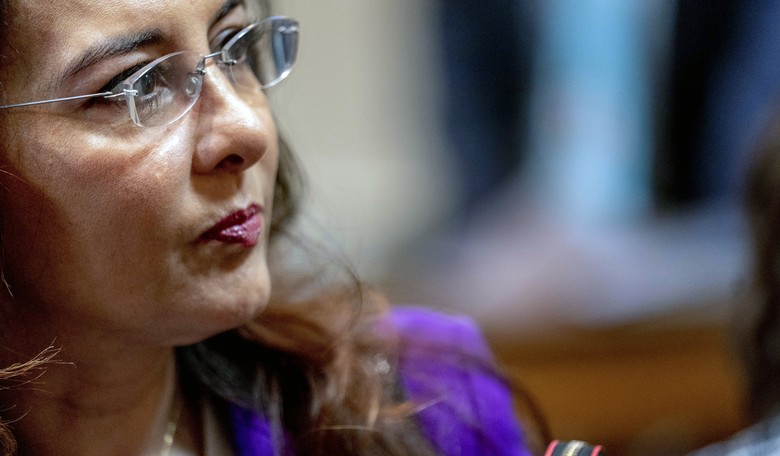
For years, gun owners have heard politicians promise to defend the Second Amendment, only to watch those promises disappear once they take office. Harmeet Dhillon was different. With this week’s announcement that Dhillon is stepping down as Assistant Attorney General for Civil Rights at the Department of Justice, I want to take a moment to recognize something that doesn’t happen nearly often enough in Washington. A public servant who followed through on defending our constitutional rights.
During her tenure, Dhillon didn’t simply issue statements about the importance of the Second Amendment. She helped fundamentally change how the federal government approaches protecting it. Personally, as someone who has spent years advocating for the rights of law-abiding Americans, particularly women who want the ability to protect themselves and their families, I believe her work deserves recognition.
Making the Second Amendment a Civil Rights Priority
Perhaps Dhillon’s most significant accomplishment was overseeing the establishment of a dedicated Second Amendment Section within the DOJ’s Civil Rights Division. Think about the significance of that for a moment. For decades, Americans have watched state and local governments impose increasingly restrictive gun laws, often forcing ordinary citizens to finance expensive legal battles just to exercise rights already guaranteed by the Constitution.
Under Dhillon’s leadership, the federal government began taking an active role in challenging those restrictions. The new section was tasked with investigating constitutional violations, filing lawsuits, intervening in litigation, and holding government agencies accountable when they infringed upon the rights of law-abiding gun owners. It didn’t take long for that commitment to produce results.
Taking the Fight Directly to Gun-Control States
One of the first major actions involved the Los Angeles County Sheriff’s Department, where applicants were experiencing extraordinary delays obtaining concealed carry permits. The DOJ’s investigation revealed more than 8,000 applications, with records initially showing only two approvals and interviews being scheduled as far as two years into the future. Under Dhillon’s leadership, the DOJ sued and by August 2026, the department had secured a settlement, and Los Angeles County had dramatically reduced its processing delays. That wasn’t a symbolic victory. It meant ordinary citizens were no longer being subjected to the same unreasonable delays when seeking permission to defend themselves.
But the DOJ’s fight endured and resulted in:
- Challenging Washington, D.C.’s restrictions on commonly owned semiautomatic firearms, including AR-15-style rifles.
- Suing Denver over its so-called assault weapons ban and Colorado over its restrictions on standard-capacity magazines.
- Going after Virginia's newly enacted restrictions on commonly owned semiautomatic rifles.
- Challenging California's Glock restrictions and handgun roster, which limit the firearms residents can legally purchase.
These lawsuits sent an important message: States cannot simply disregard constitutional protections because their political leadership dislikes firearms.
Challenging the Barriers That Prevent Americans From Defending Themselves
Dhillon also recognized that infringements don’t always come in the form of outright bans. Sometimes they come disguised as administrative procedures, excessive fees, arbitrary waiting periods, and complicated permitting requirements. For example, in San Jose, California, the DOJ challenged concealed carry licensing fees approaching $1,600. In Minnesota, it sued over firearm purchase permitting requirements and waiting periods that could force some residents to wait nearly 60 days. In Montgomery County, Maryland, it challenged sweeping restrictions that made lawful public carry extraordinarily difficult, even for licensed individuals.
Her division is also investigating allegedly unconstitutional permit revocation practices in Philadelphia and permit issue delays in New Jersey and Connecticut. These actions matter because constitutional rights shouldn’t depend on your ZIP code, your income, or whether a government employee decides you’ve waited long enough.
As a firearms instructor, I’ve worked with women who understand firsthand that threats don’t operate on a government timetable. A woman being stalked by a violent former partner doesn’t necessarily have months to wait for permission to protect herself. Neither does a single mother concerned about the safety of her children. The ability to defend yourself should never be treated as a privilege reserved for those who can afford expensive permits or navigate endless bureaucratic obstacles.
A Legacy Worth Recognizing
Not every lawsuit filed under Dhillon’s leadership has reached a final judgment, and there is still considerable work ahead. But the importance of what she accomplished extends beyond individual cases. She helped establish a federal enforcement structure dedicated specifically to protecting the Second Amendment, one that can continue defending Americans long after her departure. That is a meaningful institutional change.
Too often, we measure public officials by their speeches, political affiliations, or willingness to repeat whatever talking points their supporters want to hear. I prefer to measure them by what they accomplish, and on the Second Amendment, Harmeet Dhillon has a record worth acknowledging. She confronted unconstitutional restrictions, challenged government overreach, and demonstrated that protecting civil rights includes protecting the right to keep and bear arms. I don’t believe public officials deserve automatic praise simply for doing the jobs they were appointed to do, but I absolutely believe in recognizing those who make a genuine difference. Harmeet Dhillon did.
So, thank you, Harmeet, for your service, your determination, and your willingness to stand up for Americans whose constitutional rights have too often been treated as negotiable. The Second Amendment is not a second-class right, and because of your work, the federal government has a stronger foundation for defending it. That’s a legacy worth being proud of.