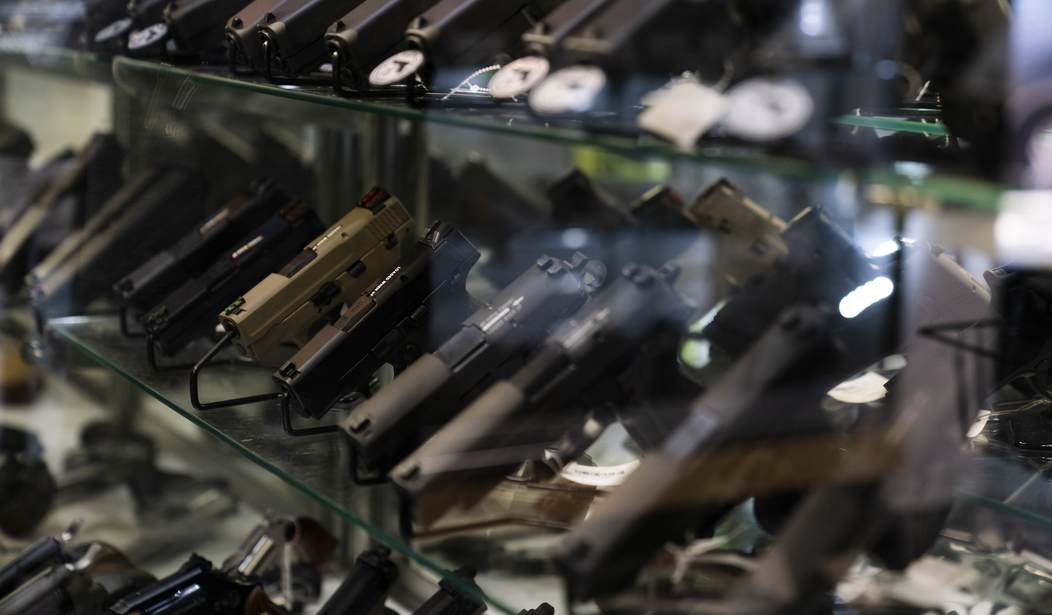
In the aftermath of a mass killing, the rhetoric fires up. This is especially true after something like a Uvalde or Parkland.
Various groups, both pro- and anti-gun, flood the field with money in the next election, all trying to accomplish something. They all say they're trying to accomplish some good, and some people who donate really believe that, but at the end of the day, they're trying to sway an election, and money talks.
But does one side have an advantage when it comes to putting their money to work?
According to a new study, not really.
Polls consistently show overwhelming support for measures like universal background checks and raising the minimum age for gun purchases. But Congress rarely acts. A new study published in Proceedings of the National Academy of Sciences helps explain why.
In "School Shootings and the Strategic Contributions of Gun Policy PACs in U.S. House Elections," three Stanford Law co-authors show that only fatal school shootings—not nonfatal school shootings, and not other mass shootings—trigger significant increases in campaign spending by gun policy political action committees. And those increases are highly targeted to competitive U.S. House districts, where elections are decided by narrow margins and control of the seat is most at stake.
The study also shows that in the wake of a fatal school shooting, both gun rights and gun control PACs rapidly push money into these competitive U.S. House races, often neutralizing each other's influence and blunting the electoral pressure that might otherwise push lawmakers toward reform.
The study was conducted by Donohue III, the C. Wendell and Edith M. Carlsmith Professor of Law and one of the nation's leading empirical scholars of crime and public policy, Eric A. Baldwin, a Stanford Law postdoctoral research fellow; and Takuma Iwasaki, JSM, JSD. Baldwin and Iwasaki served as co-lead authors.
The researchers analyzed 25 years of campaign finance data, linking every fatal K–12 school shooting since 2000 to monthly PAC contributions in U.S. House districts.
Of course, Donohue seems to see this as a bad thing, because polls keep telling him that universal background checks are popular yet there's no political action to implement them. I guess that, for both an economist and a lawyer, it's too complicated to believe that most people interpret those questions not as support for universal background checks, but support for the current system, where background checks are the norm in gun store purchases, which account for the vast majority of lawful gun transfers.
The true impact of this study, at least from our perspective, is that we need to step up our game.
Money shouldn't have the influence on elections that it does, but the truth is that we live in a world where money is essential if anyone wants to get their message out. Various PACs flood the field with money to advance their own agenda, and yeah, no one can galvanize much of a movement when both sides are pretty even.
More money might equate to more problems, but it also means it can create problems for the other side of the debate.
It's unfortunate that we need to spend more just to preserve our right to keep and bear arms, but the reality is that too many people don't value our rights as it is. They see no problem with the loss of one more.
For now, we're holding our own.
We need to do more than that.
Editor’s Note: The radical left will stop at nothing to enact their radical gun control agenda and strip us of our Second Amendment rights.
Help us continue to report on and expose the Democrats’ gun control policies and schemes. Join Bearing Arms VIP and use promo code FIGHT to get 60% off your VIP membership.









Join the conversation as a VIP Member