








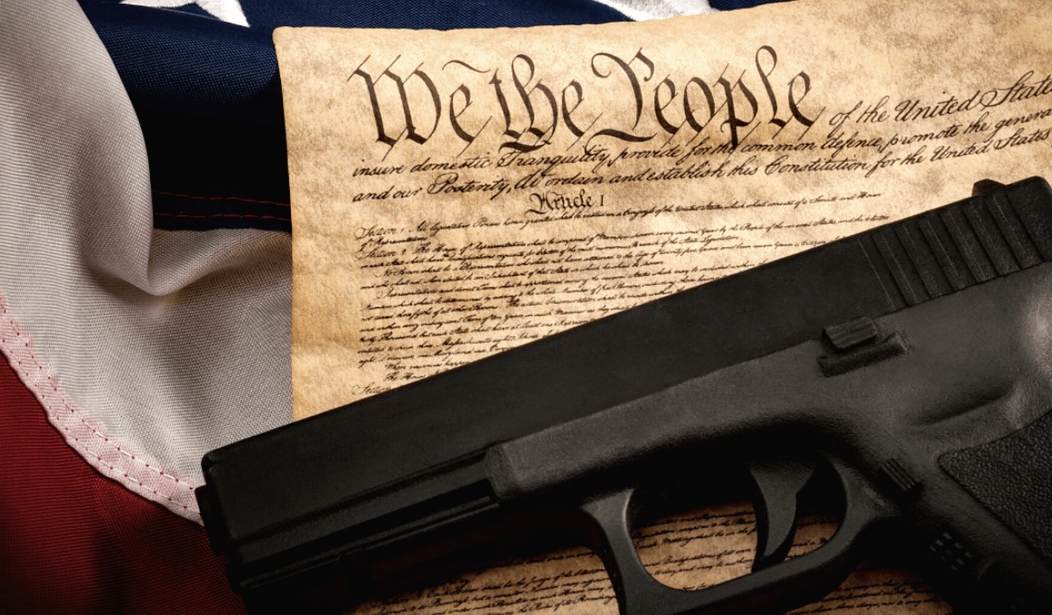
It's been more than three years since the Supreme Court affirmed that the Second Amendment protects the right to bear arms in public, not just to keep them in our homes. While we've seen some tangible improvements to gun laws in the months since, one vexing issue that remains is our ability to lawfully carry beyond the borders of our home state.
The lower courts have largely adopted the stance that, so long as non-residents can apply for a carry license in a particular state, their Second Amendment rights aren't being violated. From a practical perspective, though, that standard doesn't suffice. It would cost thousands of dollars to get a carry permit in all 50 states, and some jurisdictions like Massachusetts even require non-residents to meet in person with licensing authorities before they can be approved; a burden that would be virtually impossible to meet if every state had that same mandate.
The House could vote on H.R. 38, a national reciprocity bill, in the coming weeks, but its prospects in the Senate are pretty dim. That leaves the courts as the most viable path towards a right to bear arms that crosses state lines, and the Supreme Court was set to discuss a case in conference last week that touches on the issue.
***UPDATE***
The Supreme Court denied cert in Marquis v. Massachusetts on Monday morning, sadly, leaving the state's subjective "suitability" requirement for non-residents intact
Another case making its way to SCOTUS involves a truck driver's fight to legally carry in Minnesota without having to get a non-resident permit. Jeffrey Johnson, Sr. is suing the state for not recognizing his permits from Georgia and Florida, though a district court judge dismissed his case last year after ruling that the state's "shall issue" permitting law for both residents and non-residents sufficed under the Second Amendment. Johnson is now appealing that decision to the Eighth Circuit, arguing that the state has failed to demonstrate its law comports with a national tradition of bearing arms.
Minnesota instead defended its approach by pointing to historical surety laws, which could require people accused of posing a danger to post a bond to keep the peace before carrying firearms.
However, surety laws targeted specific individuals deemed dangerous through individualized assessments. Conversely, concealed-carry reciprocity laws apply broadly. Surety laws also presume an individual’s right to carry, whereas Minnesota’s reciprocity law presumes unrecognized permit holders do not have that right.
Thus, Johnson argues that surety laws are not comparable. The appeals court, Johnson states, must send the case back to revisit that issue.
Johnson goes on to argue that Minnesota cannot revoke Second Amendment rights without proving a danger to public safety.
The truck driver contends that Minnesota is essentially deeming unrecognized firearm permit holders as dangerous so that it can ban their Second Amendment rights. He says there is no evidence to back up that claim.
To start, every state Minnesota does not recognize requires concealed-carry permit applicants to pass a criminal background check. Most require education or training courses. Assertions that these permit holders are dangerous are baseless, the brief argues.
Johnson cited court precedent cautioning against sweeping, status-based assumptions of dangerousness. In United States v. Veasley, the court rejected a Second Amendment challenge to the federal ban on gun possession by unlawful drug users, holding the law is not unconstitutional in all applications, while emphasizing that a blanket disarmament of “all” drug users simply because of status is problematic. Later, in United States v. Cooper, the court clarified that the ban can violate the Second Amendment in some as-applied cases and remanded for an individualized determination.
“And if ‘disarming all drug users, simply because of who they are, is inconsistent with the Second Amendment,’ … then disarming all unrecognized firearm license holders is too.”
I don't know if the appellate court will agree, but Johnson does raise an interesting argument. The Eighth Circuit has indeed said that Section 922(g)(3) and its blanket prohibition on gun possession for "unlawful" users of drugs can violate someone's Second Amendment rights if they're not dangerous, so it does stand to reason that states like Minnesota are violating our Second Amendment rights if they treat "unrecognized firearm license holders" as dangerous by default.
The biggest challenge for Johnson is that Minnesota does allow for non-residents to obtain a Minnesota cary permit by applying to any county sheriff that they choose. Like Massachusetts, though, many counties require an in-person visit in order to apply. That might not be much of a burden for someone who has to drive just a few minutes to get to their local sheriff's office, but for Johnson and others, it means traveling hundreds, if not thousands, of miles just to drop off an application.
Johnson also contends that Minnesota's process of recognizing out-of-state permits is arbitrary and capricious, noting that when he filed his lawsuit Minnesota didn't recognize any permits issued by Texas. Now it does, even though there have been no changes to the carry permitting process in the Lone Star State. It's another valid argument, but only if the Eighth Circuit concludes that the fact Minnesota offers non-residents the chance to obtain a carry permit isn't enough to ensure their Second Amendment rights are intact when they visit the state.
Virginia Democrats may be about to open up another front in the fight over reciprocity. A bill introduced for this session would direct the Attorney General to remove reciprocity with states that don't have similar permitting requirements, which would be a major change to the universal reciprocity system that's currently in place.
I hope that the Supreme Court takes up this issue sooner rather than later, but if they decide to pass on Marquis v. Massachusetts there will likely be no shortage of other cases for them to choose from in the next few years.
Editor's Note: President Trump and Republicans across the country are doing everything they can to protect our Second Amendment rights and right to self-defense.
Help us continue to report on their efforts and legislative successes. Join Bearing Arms VIP and use promo code FIGHT to get 60% off your VIP membership.
Join the Conversation
VIP members get the ability to comment on articles.