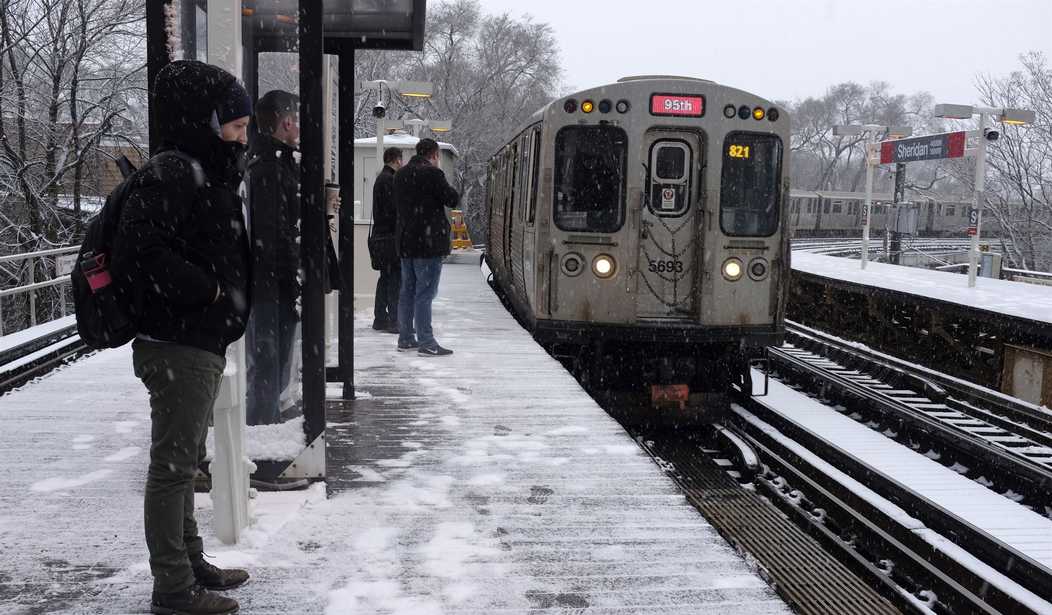
In less than a month, the Supreme Court is slated to consider Schoenthal v. Raoul in conference. The case involves a challenge to the ban on lawfully carried firearms on all public transportation in Illinois, as well as the Chicago Transit Authority's prohibition on lawful carry.
Last week Illinois Attorney General Kwame Raoul submitted his reply brief to the Supreme Court, arguing that the Seventh Circuit Court of Appeals was right to overturn a district court decision that found the prohibitions unconstitutional as they applied to the Schoenthal plaintiffs. The Seventh Circuit (and Raoul) contend that virtually any "crowded and confined" location can be declared a sensitive space where firearms can be banned, and argue that private railroad rules from the 1800s that regulated the possession of firearms are analogous to laws that prohibit carrying altogether.
This Court made clear that crowdedness alone is not sufficient to render a place sensitive, but it did not hold that it is irrelevant to the analysis. Instead, the Court directed lower courts to review modern laws on a location-by-location basis to determine whether they are analogous to historical regulations. The Seventh Circuit followed that direction here. And the tradition of regulation in crowded, confined spaces that it recognized bears no resemblance to a prohibition on carry in an entire borough of New York City in either “how [or] why” it burdens the Second Amendment right. Laws within this tradition limit carry in discrete, confined areas because, when they are also densely populated, such spaces have “unique physical characteristics” that make it difficult to avoid or escape gunfire. That concern does not apply to the entirety of Manhattan.
There are a couple of issues with Raoul's argument. First, there was never a prohibition on bringing firearms onto trains in the 19th century. Firearms may have been required by some railroads to be in checked baggage, and there may even have been rules prohibiting the discharge of a firearm on a train, but those were rules established by private businesses and not governments, and a handful of rules created decades after the Second Amendment was ratified can hardly be evidence of a national tradition.
As for the historical tradition of banning firearms in "crowded, confined spaces," the Seventh Circuit and the state of Illinois point to "at least nine States or territories" that they claim prohibited guns in crowded, confined spaces by 1900. That's hardly a majority, given that there were 45 states and 9 territories at the start of the 20th century. What's more, the actual laws cited generally prohibited firearms at "social gatherings," and none of them were so broad as to encompass all places where you might find a large group of people. These laws are even further in time from the ratification of the Second Amendment, and many of them came decades after the Fourteenth Amendment was ratified as well, which makes them of little use in determining a national tradition.
Neither the Seventh Circuit nor the state of Illinois could point to any Founding-era law prohibiting the carriage of firearms on ferries, stagecoaches, or ships that transported passengers in the late 1700s, because that evidence simply don't exist.
From a constitutional perspective the Illinois law is an outlier. And from a practical standpoint the law is putting people at risk because they can't protect themselves from the violent predators who use CTA property as a hunting ground.
A man who has “terrorized the community over the past 15 years,” according to a Cook County judge, is charged with sexually attacking two women at a CTA bus stop on the West Side.
Deandre Smith, 39, was detained by Judge Luciano Panici Jr., who described him in a detention order as “a violent person who is randomly violent with people he does not know on the street.” Chicago Police Department records show Smith has been arrested 22 times since 2014.
The women were allegedly groped by Smith in two separate incidents, though thankfully they escaped without suffering any injury. That was not the case for another CTA passenger who was allegedly beaten by yet another repeat offender.
A 22-year-old Lansing man, arrested five times since December 30, is accused of attacking and robbing a high school student on a downtown train platform while on pretrial release in three separate cases and wearing an electronic monitoring device. When officers arrested him hours after the mugging, they allegedly found not only the teen’s stolen phone but six additional cell phones that police believe belong to other victims.
Devion Goodman is now detained on charges of robbery and aggravated battery of a transit passenger by order of Judge John Hock.
The victim in this case may not have been old enough to lawfully carry a gun, but Illinois law and CTA policy prevented anyone else on that train platform from defending the teen with a lawfully-possessed firearm.
Chicago's catch-and-release policy towards repeat, violent offenders is already putting residents at risk, and adding in the inability for them to defend themselves on public transportation only makes the city a more dangerous place for peaceable people.
We may not have a circuit court split on the issue of guns on public transit, but prohibitions in Chicago, New York, and other big cities are depriving millions of residents of their Second Amendment rights. SCOTUS should grant cert to Schoenthal v. Raoul next month, and frankly, it shouldn't be a close call.
Editor's Note: The mainstream media continues to lie about gun owners and the Second Amendment.
Help us continue to expose their left-wing bias by reading news you can trust. Join Bearing Arms VIP and use promo code FIGHT to get 60% off your membership.










Join the conversation as a VIP Member