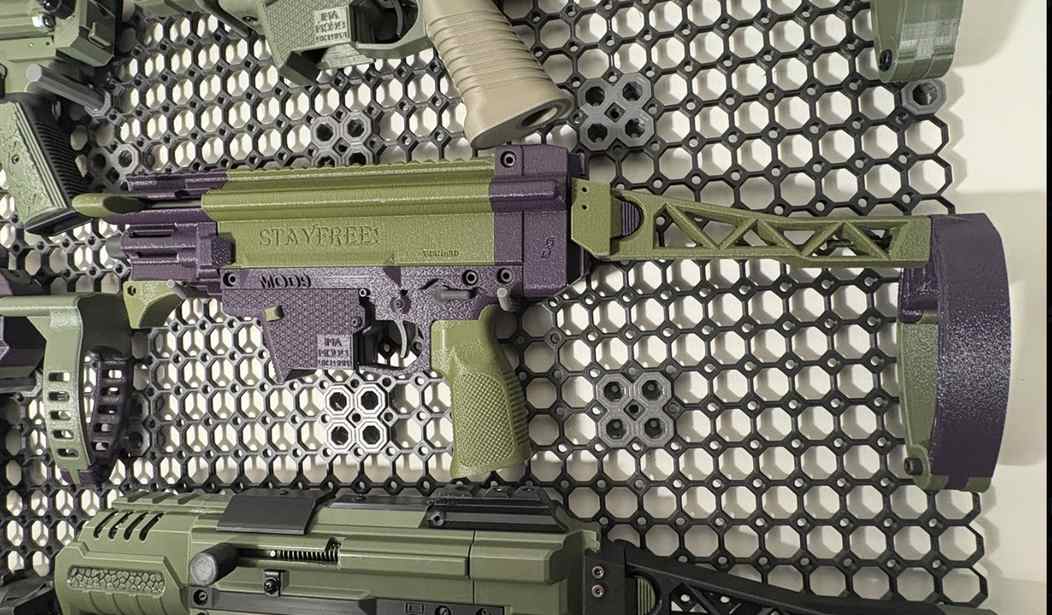
Rolling Stone magazine is hardly known as a hotbed of pro-Second Amendment journalism, and its new report on 3D-printed guns is mostly what you'd expect from an anti-gun outlet that's regularly partnered with Bloomberg-supported The Trace in recent years.
Still, there are a few things in the extensive piece authored by Jack Crosbie that took me by surprise, including a fairly sympathetic portrayal of the man known online as YZY PRINTS, who Crosbie describes as "one of a growing number of amateur gunsmiths dedicated to pushing the limits of 3D-printing technology and America’s gun laws."
I think it helps that Yeezy, as he's called in the article, doesn't quite the fit the average Rolling Stone reader's perception of a stereotypical gun owner. Yes, he's a big-bellied white guy who lives in the backwoods of Appalachia, but he also hosts training events for gun-curious transgender individuals and sells shirts emblazoned with mottos like "The Second Amendment Is for Shooting ICE." As Crosbie writes:
Online, Yeezy hides his identity to protect himself and his family from the threats and abuse he receives regularly from right-wing elements of the gun industry and “the brunch liberals”; he requested a pseudonym for this story for the same reason.
My guess is that if Crosbie showed up to Yeezy's home and found him sporting a Make America Great Again hat, Yeezy wouldn't have seen the same generally positive treatment he received when the story was published. But as a self-described "“far left trantifa extremist," Yeezy may be unusual to the Rolling Stone readership without being as scary as a gun-toting conservative.
Whatever differences I might have with Yeezy politically, I'm in 100% agreement with him that, as he puts it, “the right to bear arms — it’s innate to your humanity.”
Another surprising twist in Rolling Stone's story comes when Crosbie visits Yeezy's workshop. Gun control activists make it sound like assembling a gun from a 3D printer is as easy as punching a couple of keys on a computer. Crosbie, though, makes it clear that is not the case.
Plastic comes out of the printer in an almost unrecognizable state, covered in oddly organic-looking tendrils of plastic called supports. These thin plastic branches are designed to break off after supporting the main architecture of the print while it forms. Yeezy tears into them with pliers, slowly cleaning up the gun’s frame. He pulls up a YouTube video by the gun’s designer, a creator who goes by IvanPrintsGuns, and carefully follows the instructions over the next several hours, slotting metal parts into the frame, and carefully inserting the delicate trigger components into the lower receiver.
...Yeezy works into the evening, hacking at jagged spurs of plastic and tapping away with a special brass gunsmith’s hammer. His fingers are nicked and scarred from pinches and scrapes. “Often, these things demand blood,” he says.
Crosbie goes on to describe the gun-making process as "easy," but it's still a pretty time-consuming process. In the time it takes for Yeezy to print the lower receiver of a firearm and turn in into a fully functional gun, I could drive to my nearest gun store, fill out my 4473, go through a background check, pay for my pistol, drive back home, and spend an hour or two plinking away on my property.
The government, though, would have a record of that transaction, and for builders like Yeezy one of the biggest benefits of printing a 3D gun is the anonymity that comes with it. That's one of the primary reasons why gun control proponents are targeting 3D-printed firearms (and 3D printers too), though most of the law enforcement officials that Crosbie spoke with at least claim to see a difference between hobbyists and criminals.
“This technology isn’t really driven by the street criminal,” says Bonnie Seok, an assistant district attorney for Manhattan who works in the office’s 3D-printed-gun unit. “It’s driven by an ideology — they’re dedicated to the Second Amendment and democratizing the process of being able to access your own guns. It’s driven by incredibly smart people. They’re always trying to defeat regulations. They’re always trying to outsmart law enforcement.”
NYPD Chief Courtney Nilan, who heads up the department's "ghost gun" unit, claims that her targets aren't hobbyists, but those selling weapons and those looking to use them. That was another surprise to me, and I'm skeptical that's really the case given another of her comments.
In the early 2020s, she says, her team was busting mostly hobbyists — people who were printing guns but had no intentions of using them. That describes, she says, the vast majority of the “3D 2A” community — Second Amendment ideologues like Yeezy, in other words.
“Even though they’re loud [online] — they’re not committing any crimes,” Nilan says. “Neither are the beta testers, everyone in the design rooms — it’s once that design is perfected and put out on the open web, that’s where it’s hitting those who have nefarious purposes.”
If you're "busting" hobbyists, then yes, they are your targets. Dexter Taylor is a perfect example of this. The software engineer was never accused of selling the guns that he created, nor was he alleged to have used them in any kind of violent crime. But for merely possessing these unregistered, home-built firearms, Taylor was sentenced to 10-years in prison and is currently serving his sentence in a maximum security facility.
The fact that Taylor isn't mentioned in Crosbie's story is another surprise, especially since he spoke directly to Nilan and Taylor's prosecution directly refutes her claim about not targeting hobbyists. In fact, Nilan acknowledges that, to date, only one homicide in New York City has been proven to be committed with a 3D-printed firearm; the one that was used to murder United Healthcare CEO Brian Thompson.
The key point here is that printed guns are virtually non-existent in crimes.
— ✳️Ⓐ Armed Joy 🔫💣 (@ArmedJ0y) June 17, 2026
Where they do exist, it is for simple possession 99% of the time. Which should hold no moral weight whatsoever. They took something that was absolutely not dangerous to the public, made it illegal… https://t.co/pwd2sqyImK
The war on 3D printers is another bit of evidence that law enforcement isn't solely pursuing violent criminals who may be building their own guns or networks who might be supplying them. Anti-gun lawmakers are taking aim at the technology itself, hoping to impose controls on their use and on users. None of the folks Crosbie spoke to seem all that convinced that this genie can be put back in the bottle, but there are a lot of politicians, police, and prosecutors who are willing to try... starting with putting people in prison for making their own guns.