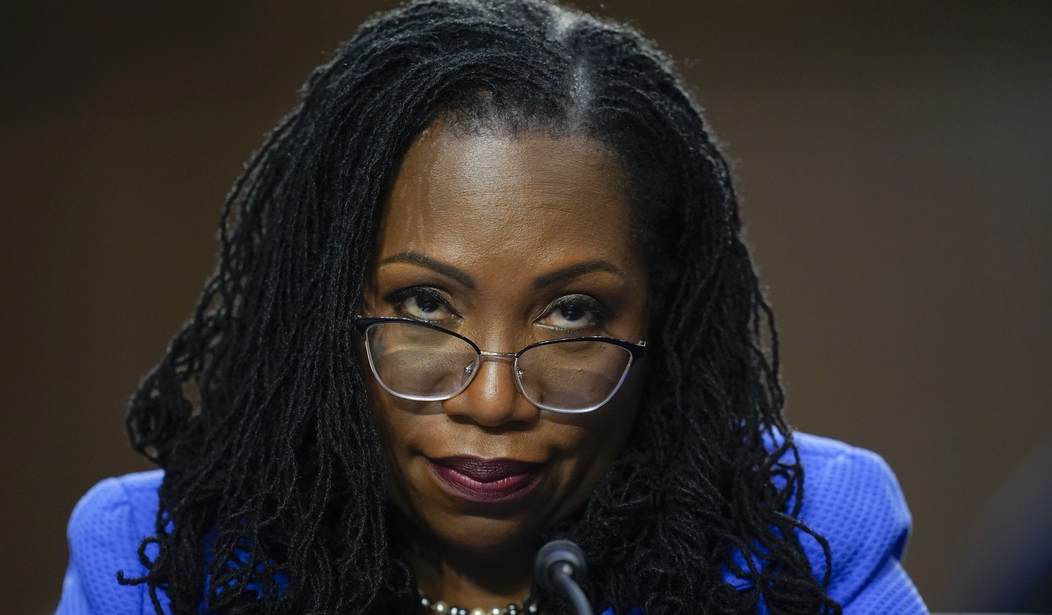
At first glance it seems awfully odd that Justice Ketanji Brown Jackson, the first black woman to serve on the Supreme Court, would take issue with her fellow justices rejecting the use of a racist gun control law from the Civil War ear in attempt to uphold a modern-day prohibition on concealed carry, but there is a reason for Jackson's critique of the majority opinion in Wolford v. Lopez; if racist gun laws aren't deemed to be part of the "national tradition" of gun regulation, then it becomes exponentially harder to justify current gun control laws under the test the Supreme Court laid out in Bruen.
Jackson despises Bruen's test, history, and tradition test anyway, and has repeatedly declared her desire to replace it with a system of tiered scrutiny that would balance the government's professed interest in public safety against our individual right to keep and bear arms; a system in which the government would almost inevitably come out on top.
Her dissent in Wolford doesn't hide her contempt for the test. But her attempt to point out its flaws is deeply flawed in and of itself.
Specifically, Jackson takes issue with the majority rejecting Hawaii's tdefense of its "vampire rule" prohibiting concealed carry on all publicly accessible private property unless the property owner explicitly informs gun owners that they're welcome by pointing to an 1865 Louisiana law that prohibited individuals from carrying firearms onto plantation property without the express consent of the plantation owner.
As the majority points out (and Jackson disputes), the law was part of the infamous Black Codes adopted in the immediate aftermath of the Civil War and before Reconstruction began. While the law was racially neutral on its face, it was part of a larger package that was designed to keep Louisiana's black population in a condition as close to slavery as possible; including denying them the ability to carry firearms for personal protection.
Justice Samuel Alito, writing for the majority, opined that, "[a]s we have said, in considering the probative value of a historical analogue, we must consider whether it was widespread, well-known, and widely accepted. Because this statutewas neither widespread nor widely accepted, it carries no weight."
Alito and company went further though:
We could stop there, but there is another reason for rejecting Hawaii’s reliance on this statute. It was adopted bythe Louisiana Legislature between the end of the Civil War and the beginning of Reconstruction. When the war ended, the legislatures in defeated Confederate States quickly enacted so-called Black Codes that aimed to perpetuate the subjugation of blacks. The statute Hawaii cites was part of Louisiana’s Black Code, and it provided a tool for disarming blacks and thus leaving them defenseless against attacks.
As we laid out in McDonald, the right to keep and bear arms was crucially important for vulnerable blacks during this period. And this was well-understood by the Republicans in Congress who were responsible for drafting, approving, and securing the ratification of the Fourteenth Amendment. The Republican Party Platforms of 1856 and 1860 called for protection of the right to keep and bear arms for self-defense. Unless we put history entirely out of our minds, Hawaii’s claim that this tainted artifact illuminates the original understanding of the right to keep and bear arms cannot be taken seriously.
In her dissent, Jackson largely ignores the initial reasoning for rejecting the Louisiana law as an appropriate analogue to Hawaii's carry ban on private property by default, and instead focuses on the majority's secondary reasoning for rejecting the statute.
If the point of taking the Black Codes out of the equation is that they are not a valid part of our Nation’s historical tradition, then the Court must provide guidelines on how to determine the type of history that can be considered to ensure that this inquiry does not become a free pass to quick invalidation.
Jackson elaborates further in a footnote:
By this I mean that the majority must explain how one is to go about accurately identifying such a verboten law. For facially neutral Black Codes, should courts consult legislative history to understand what the legislature was trying to do? How much racial motivation is too much? What about laws that were facially neutral and passed for seemingly neutral reasons, but were enforced discriminatorily? And finally, does only racial animus matter? What do we do about other types of animus? For example, consider the use of statutes that were prejudiced against Catholics. Does it offend history to use those?
To me, the answer is simple enough. If the gun laws in question were adopted or enforced due to animosity towards any characteristic of an American citizen, be it the color of their skin, their religion, or their standing in polite society, then they are repugnant to the Constitution and by default should not be considered a part of the national tradition.
Jackson (and Sotomayor), though, appear ready to accept any gun control law at face value and as evidence of a national tradition, no matter why it was put in place or how it was enforced.
Confronting the origins of these laws is certainly uncomfortable. The Black Codes were ugly. And racist. And deplorable. Even now, long after their abolishment and thend of the Jim Crow era, Black Americans are still saddledwith the ramifications of centuries of legally authorized exclusion, notwithstanding the much-heralded arrival of“colorblindness.”
But the characteristics that make the Black Codes detestable do not automatically render these laws irrelevant to a fair assessment of the right to carry firearms, especially given how the Court assesses that right. The Court has decided to use history as the metric, and these laws are part of our Nation’s history. So the Court must make an actual assessment of the relevance of what the historical record reveals. To be sure, it would certainly be most convenient for all concerned to skip past the nuance and ignore these painful realities. But choices have consequences: Where the Court has opted to tether its Second Amendment analysis to facts about America’s past, it must contend with our Nation’s entire history, warts and all.
Despite that language, Jackson hedges her statement by adding that "it might well be that the Black Codes are invalid inputs for Bruen’s test, but only if they violated the Second Amendment—which mayor may not be the case." She argues that in some cases, racist gun laws might run afoul of the Fourteenth Amendment's Equal Protection Clause without violating the right to keep and bear arms, but does that really matter when looking at a law to see if it's a part of a national tradition?
A gun law that is repugnant to the Fourteenth Amendment is equally unconstitutional as one that's repugnant to the Second Amendment, and should not be considered "widespread" or "widely accepted." In fact, I'd argue that most of the laws Jackson talks about would fail the "text, history, and tradition" test for those reasons too, and not just because of their discriminatory enforcement.
Given Jackson's opposition to the "text, history, and tradition" test, I can understand why she felt like she had to attack the majority for rejecting the Louisiana statute as an appropriate analogue to the Hawaii law in question, but I think it was ultimately both unnecessary and unhelpful to her cause. There are perfectly valid reasons why the Louisiana law doesn't fit within the national tradition of gun ownership or gun regulation, and her insistence that this short-lived law that was neither widespread nor much appreciated outside of the former Confederate states could plausibly be used to defend current gun control laws just exposes how deeply set her animosity towards the Second Amendment really is.