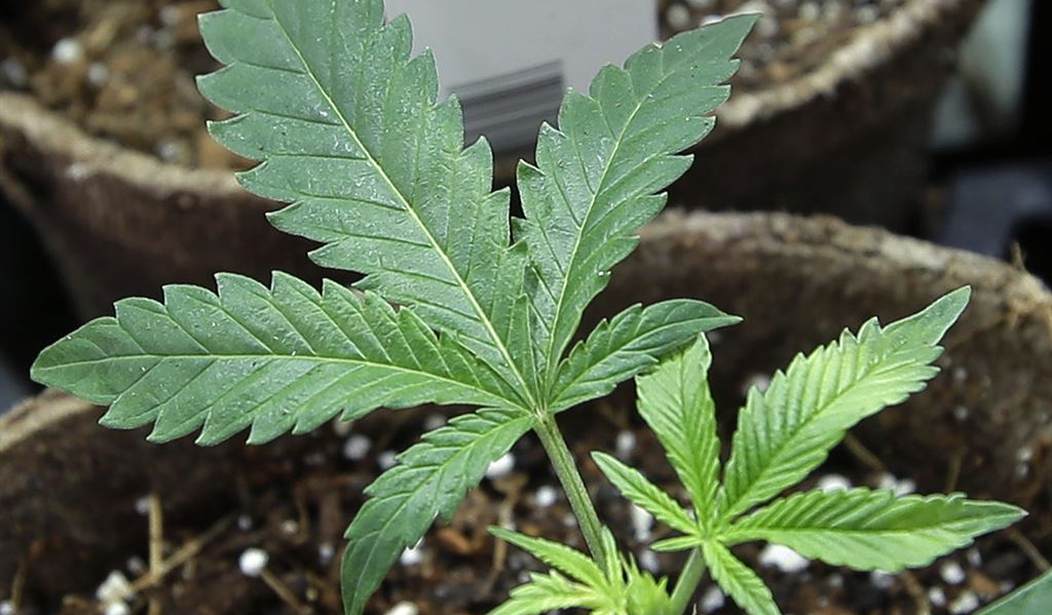
When the Supreme Court ruled that Ali Danial Hemani could not be prosecuted under Section 922(g)(3) simply because he owned a gun while regularly using marijuana, the justices went out of their way to state that the Hemani decision wasn't invalidating the statute as a whole.
The decision, wrote Justice Neil Gorsuch, "does not address efforts to ban addicts or those presently intoxicated from possessing a firearm; other prophylactic laws Congress might adopt after determining that users of a particular drug pose a special risk of misusing firearms; §922(g)(1)’s provision disarming individuals convicted of felonies; or whether the government could bring a prosecution under §922(g)(3) accompanied by individualized proof that the defendant’s drug use renders him a danger to himself or others, or proof that a certain drug always renders its users dangerous."
The Eighth Circuit Court of Appeals, which even before the Hemani decision had concluded that there needs to be some showing of dangerousness before someone can be convicted under 922(g)(3), has now followed Gorsuch's lead in upholding the conviction of an Iowa man named Keshon Baxter for possessing a gun while an "unlawful" user of marijuana.
Baxter's case has been bopping around the Eighth Circuit for a couple of years now. He originally entered a conditional guilty plea that allowed him to appeal on Second Amendment grounds, and the appellate court determined that the district court had erred in not assessing his “individual circumstances.” Baxter's case was remanded back to the district court, where he was once again found guilty, and on Monday the Eighth Circuit upheld Baxter's conviction after agreeing with the lower court that Baxter's drug use made him a danger to himself and others while he was armed.
We have held that § 922(g)(3) is consistent with the Second Amendment when a drug user's conduct is analogous to conduct falling within the "criminal prohibition on taking up arms to terrify the people." We explained that Founding-era laws authorized imprisonment and forfeiture of arms when an individual offensively used a firearm to terrorize others….
To determine if Baxter's conduct is relevantly similar to the conduct sanctioned by the Terror of the People laws, we ask if Baxter's marijuana use "would or did make him 'induce terror, or pose a credible threat to the physical safety of others with a firearm.'" U.S. v. Perez (8th Cir. 2025). The answer is undoubtedly yes. Baxter began using marijuana when he was 13 years old; he used marijuana on a regular basis; and a sample of his urine taken following his arrest tested positive for marijuana metabolites.
At the evidentiary hearing, Dr. Huestis [a toxicology expert] explained that there is a strong connection between chronic cannabis use and aggression and violence and that individuals can experience the cognitive effects of withdrawal—including irritability and aggressiveness—for several days after their last use. Baxter's behavior on the night of his arrest mirrored Dr. Heustis's findings: he acted aggressively and combatively in his interactions with law enforcement and civilians. Baxter—accompanied by fellow gang members—twice engaged in altercations with a rival gang while displaying or otherwise indicating his possession of a firearm. His behavior caused a bystander to report to law enforcement his suspicion that Baxter had a firearm, and Baxter ran from an officer when asked what was in his pocket.
Based on this conduct, the district court did not err in concluding by a preponderance of the evidence that Baxter's conduct on the night of the arrest was sufficiently analogous to prohibited behavior under Founding-era going-armed laws. As the district court pointed out, even if Baxter did not openly brandish his firearm, Baxter's possession of a firearm was obvious enough that an innocent bystander reported it to the police. And when officers attempted to talk to Baxter, he fled. As such, we agree with the district court's assessment that Baxter "absolutely presented a credible threat to the safety of others" as he "engaged in a sustained public confrontation while acting aggressively with other gang members and in possession of a loaded firearm." …
[T]he district court made an explicit finding that marijuana impaired Baxter's judgment on the night that he was arrested such that it caused him to "threaten[ ] the physical safety of civilians, law enforcement, and his adversaries alike." And the record amply supports this finding. Accordingly, we conclude that the district court did not err in denying Baxter's motion to dismiss as the Government met its burden in demonstrating that Baxter's conduct was sufficiently analogous to the conduct prohibited by the Founding-era Terror of the People laws….
Was it really pot that made Baxter get aggressive with rival gang members and then run from police afterwards? We don't know how high Baxter was that night, or if he even was high that evening. The state's toxicology expert suggested it could have been withdrawal from marijuana that caused his aggressiveness.
A concurring opinion from Judge David Stras lays out a different rationale for upholding Baxter's conviction. Stras noted that the Eighth Circuit has been wrestling with 922(g)(3) for some time now, and in an earlier case called U.S. v. Cooper the court held the relevant question to be "whether a defendant had 'induce[d] terror … or pose[d] a credible threat to the physical safety of others with a firearm' while being an unlawful drug user. In a later case known as Perez, though, Stras argued the question had morphed into whether drug use "caused" a defendant "to induce terror or pose a danger to others with a firearm."
Stras believes that was an error.
Just consider a drug user who argues that, high or not, he is flat-out dangerous with guns. Suppose further that the evidence supports the argument: he ordinarily uses them in a terrorizing way. He is so dangerous, in fact, that drug use hardly moves the needle. Rather than just disarming him for terrorizing others, like the historical analogues allow, Perez gives life to the absurd argument that he can have them because drugs did not cause him to be dangerous. Compare Cooper (explaining that historical laws permitted disarmament if "terrorizing behavior … accompan[ied] the possession" (ellipsis in original) (citation omitted)), and U.S. v. Veasley (8th Cir. 2024) (discussing "Terror of the People" laws that allowed disarmament for using weapons "in a way that terrorized others"), with Perez (requiring the court to find that the drug use "would or did make [the defendant] induce terror" (citation omitted)).
Fortunately, our first-in-time rule offers an easy fix. See U.S. v. Johnson (8th Cir. 2012) (recognizing that when two panel opinions conflict, "we are bound to follow the earliest opinion … as it should have controlled the subsequent panels that created the conflict" (ellipsis in original)). Given that U.S. v. Ledvina (8th Cir. 2026) and Perez said they were following Cooper, why not take them at their word? See Perez (remanding "because the district court and the parties lacked Cooper's guidance"); Ledvina (doing the same "[i]n light of th[e] [c]ourt's decisions in [Perez] and [Cooper]"). If we do, all that matters is that Baxter was a drug user who actually "pose[d] a credible threat to the physical safety of others with a firearm." I would start and end the analysis there.
Stras's argument doesn't require a state's witness to go full Reefer Madness in order to uphold a conviction under 922(g)(3). It really doesn't matter if marijuana caused Baxter to get aggressive while he had a gun at all. It was his behavior that posed a threat to the safety of others, and the fact that he admitted to using marijuana on a regular basis makes him eligible to be prosecuted and convicted under the federal statute.
I don't know that I agree with the majority's opinion that it was marijuana that caused Baxter to act as he did, but under both rationales deployed by the panel Baxter's conviction was upheld, and I strongly suspect that if he appeals his conviction the Supreme Court he's not going to get the relief he's looking for. His conviction serves as a reminder that, even with Hemani in place, there's no blanket right for drug users to behave recklessly or dangerously while armed.
Editor’s Note: The radical Left will stop at nothing to enact their radical gun control agenda and strip us of our Second Amendment rights.
Help us continue to report on and expose the Democrats’ gun control policies and schemes. Join Bearing Arms VIP and use promo code FIGHT to receive 60% off your membership.









Join the conversation as a VIP Member