In the aftermath of the Wolford decision last month, anti-gunners tried to go on a tirade and make the decision all about property rights. Never you mind that the Supreme Court said businesses could prohibit guns if they wanted to, it was the state of Hawaii that overstepped.
No, for them, it was about property rights, but why is that a one-way street for them?
See, I didn't think about the fight over 3D printers as a property rights thing until this piece from TheBlaze dropped.
The headline, "California declares war on private property with anti-gun-rights bill," makes it pretty clear what the author, John Mac Ghlionn, thinks, and he makes a valid point.
California Assembly members recently peered into the garage of a suburban hobbyist and experienced a collective panic attack. Their legislative response, Assembly Bill 2047, presents itself as a targeted strike against the DIY firearm industry. This classification completely misrepresents the mechanics of the law. The actual mechanism establishes a permanent legal framework in which consumer hardware operates as an automated, inescapable agent of the state.
The statute mandates that every 3D printer sold in California must run mandatory screening software. This system intercepts every digital file, compares the geometric coordinates against a government-maintained database of banned shapes, and shuts down the machine if it detects a forbidden curve. Property law historically recognized a distinct boundary between an object and its purchaser. Under this new system, the state retains ultimate operational veto power over the physical components sitting on your workshop desk, rendering your financial investment and your purchase receipt completely meaningless.
In 1872, the Colt’s Patent Firearms Manufacturing Company did not include a microscopic state inspector inside the frame of every Single Action Army revolver to ensure the user aimed at a legal target. The legal system punished the homicide after the body was found. Tools were inert objects of wood and iron. If a blacksmith forged a crowbar in 1890, the state did not mandate that the anvil refuse to shape metals exceeding a certain thickness to prevent bank robberies. A.B. 2047 reverses this dynamic by installing a permanent digital warden in the consumer's living room.
I mean, he's not wrong. Not in the least.
And I find this funny because, again, many of the people who were so upset at Wolford and claimed it was an infringement of property rights see absolutely nothing wrong with stepping in and deciding what you should be allowed to make with a product you lawfully purchased. It's not even that they have decided you can't make a gun--plenty of states have already done that--but that they want to mandate technology that makes it so you can't make a component they think might be used in a gun.
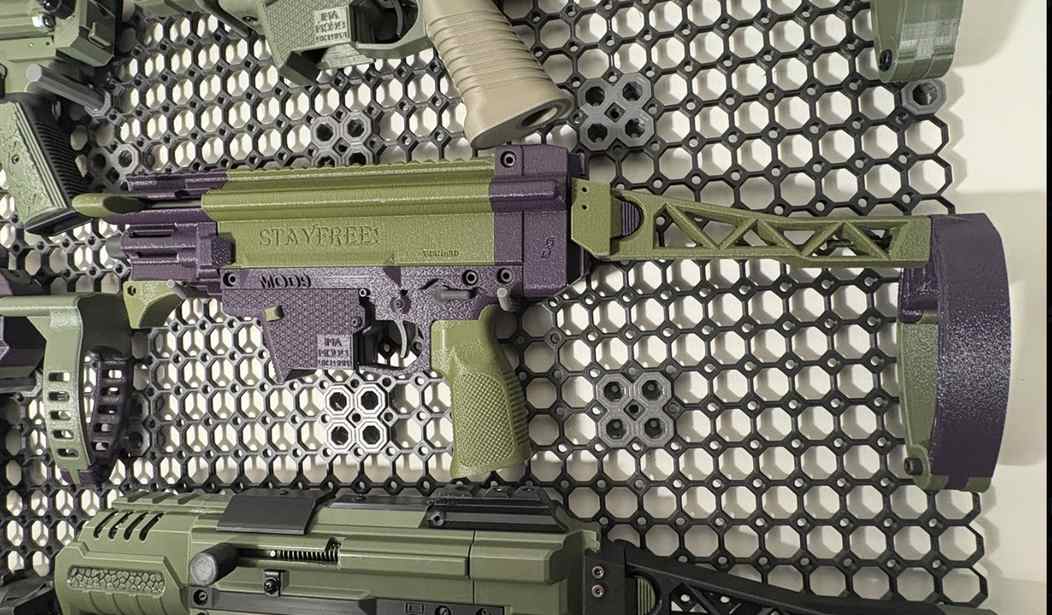
Even in anti-gun states, making things like a pistol grip for an existing firearm shouldn't be an issue, now should it? Making a stock that's compliant with state regulations should be completely within bounds.
But will the technology they're demanding even let you do that?
Regardless of the answer, the truth is that there will be people who will actively want to make things that aren't guns, but look close enough to a gun part that their printer will refuse to do it, and since the law also forbids people from jailbreaking their printers--yes, even if they never print a single gun part on it--that's a problem.
You cannot scream about property rights because the Supreme Court said you overstepped by setting a default for property owners that excludes gun rights while somehow arguing you're justified in telling people that they must have software on their 3D printers that will limit what they can physically print.
So now, we have dueling discussions of property rights while talking about guns, and that's not by accident.
The right to keep and bear arms is the insurance policy for every other right. That includes property rights, which is why many of us have guns in the first place. We want to protect what is ours.
Some of us want to print guns in order to do it.
All rights are connected, and infringements on the Second Amendment will always spawn off to infringe on other rights, even as anti-gunners try to manipulate the public into thinking they're the ones suffering from infringement.
Don't let them get away with it.