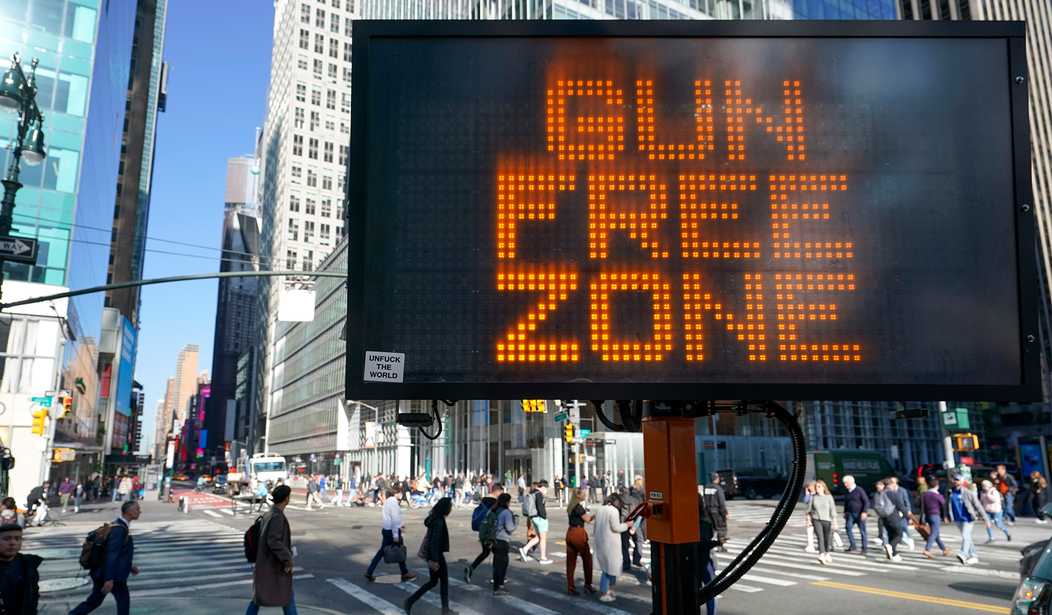
The city of Philadelphia and the state of Maryland are offering up defenses of some of their gun bans, and 's argument is actually even worse than what the headline above implies. If the federal courts accept these arguments, then virtually every Democrat-run city could become off-limits to carry... or at least those cities in states that don't have firearms preemption laws in place. States, meanwhile, could render it illegal to bear arms in almost every location where people gather for almost any purpose, eviscerating the right to carry.
Philly is facing a lawsuit over its ban on concealed carry for young adults 18-to-20-year-olds years of age. As Firearms Policy Coalition highlighted on X, one of the city's defenses of its gun control law is that there is no right to carry in urban areas generally, and Philadelphia specifically.
Not only could young adults be barred from carrying concealed, according to Philadelphia, but everyone else could be prohibited as well. As evidence, the city points to a 1721 law that made it illegal to "fire any gun or other firearms . . . within the city of Philadelphia, without the governor’s special license for the same.”
That law was entitled "An Act for Preventing Accidents that May Happen by Fire," and also banned the sale and use of any "Squibs, Rockets, or other Fireworks." The "why," then, is certainly different than the reason for Philadelphia banning concealed carry for young adults, and the "how" is different as well, since it banned the discharge but not the carriage of firearms.
FPC's Rob Romano noted another problem with the law the city cites.
Pennsylvania's main cite for this argument is a 1721 law that had additional penalties "if such Offender be a Negro or Indian Slave": https://t.co/ZRNzIXm755 https://t.co/61Qmm1oKlm
— Rob Romano (@2Aupdates) August 17, 2026
The city claims that the fact "these laws only prohibit the discharge of firearms in cities does not mean that laws prohibiting the mere carrying of firearms in cities are unconstitutional," adding "this is especially true because, as just noted, firearms are carried so that they may be discharged, if necessary."
Philadelphia also claims that "many" colonial cities had similar prohibitions, but even if every population center had an ordinance like this in place, it is still too far afield of the rationale for prohibiting young adults for carrying a concealed firearm.
Honestly, if this is Philly's best argument, the city attorney's office should be leaning on the mayor and city council to change the law, moot this case, and save the city's taxpayers some money.
The same could be said, though, of Maryland's defense of the multitude of "gun-free zones" being challenged in Novotny v. Moore, a lawsuit involving multiple individual plaintiffs as well as Maryland Shall Issue, Second Amendment Foundation, and Firearms Policy Coalition.
The Fourth Circuit upheld the state's ban on lawful carrying in all government buildings, school grounds, public transit, public demonstrations, state parks, state forests, healthcare facilities, places of amusement, stadiums, amusement parks, racetracks, zoos, museums, bars, and restaurants that serve alcohol. In fact, the only part of Maryland's carry prohibitions the Fourth Circuit took issue with was its version of the "vampire rule" that banned concealed carry by default on all property open to the public.
The case is now pending before the Supreme Court, and the justices could decide to grant or deny cert later this fall. As you can imagine, Maryland's response to the plaintiffs cert petition leans heavily on the Fourth Circuit's justification for these "gun-free zones."
The appellate court went out of its way to give equal weight to gun laws passed in the latter half of the 19th century and the early 20th century to those laws in place at the time the Second Amendment was ratified. It declared a historical tradition could be concluded from just a handful of laws, or extrapolated that a law banning carrying in one place means that a carry ban in a completely separate location can be justified.
The Fourth Circuit also held that there is a national tradition of banning the carrying of firearms in places where "vulnerable populations may be found," with "vulnerable" essentially serving as a synonym for children. The Supreme Court, on the other hand, strongly hinted in Wolford just a few weeks ago that being "barred from entering many places that people routinely visit in the course of their daily routines, such as gas stations, restaurants, and stores" infringes on the Second Amendment.
It's one thing for the owners of amusement parks, stadiums, bars, restaurants, and healthcare facilities to impose prohibitions on lawful carrying on their own. It's something else entirely when the state makes that decision for them.
Even on state-owned property, the restrictions are absurdly broad. Some government buildings may be truly "sensitive places" with the additional security to prove it, but that doesn't mean that they all are. And the right to bear arms doesn't disappear just because some parents make take their kids to state parks and state forests.
Maryland's argument doesn't go as far as Philadelphia's, at least when urban areas are involved, but the result would substantially be the same if the courts were to side with both defendants. It would be virtually impossible to exercise your right to carry anywhere one or more children might be present, but also in places were children are banned, like bars.
The Supreme Court said in Bruen that New York couldn't declare the entire island of Manhattan to be a "sensitive place" just because it's crowded and generally protected by police. That's exactly what Philadelphia is trying to do now. Maryland has taken the position that a "sensitive place" is anything the government says it is, and would still be defending its "vampire rule" if SCOTUS hadn't already declared Hawaii's version unconstitutional.
Here's hoping that the justices are now willing to do the same with Maryland's "gun-free zones." The Court rejected a challenge to the mass transit carry ban in Illinois last term, but maybe they were waiting for a case that deals with multiple "sensitive places." If so, Novotny would be a great case to take, and I'm keeping my fingers crossed that at least four justices agree with me.