








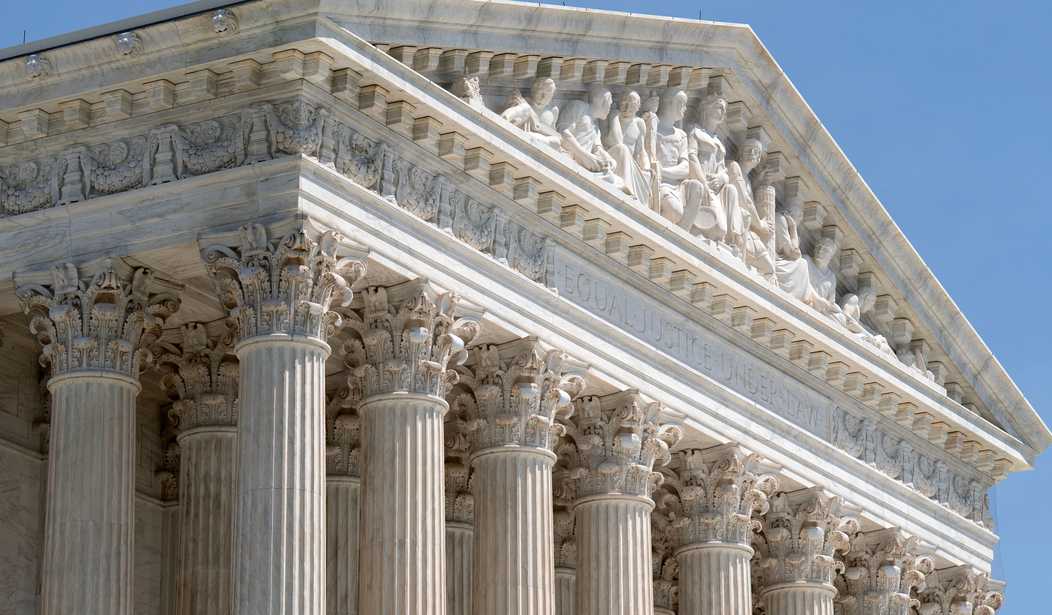
The amicus brief submitted by the United States Conference of Catholic Bishops in the Viramontes case claims to be in support of neither the plaintiffs nor the defenders of "assault weapon" bans, which is an odd take considering what the bishops actually have to say.
There's little doubt that the clergy would like to see the challenged gun bans upheld by the Court. The gist of their argument is that the justices "should reject the view that gun ownership figures alone can place a category of weapons constitutionally and irrevocably beyond all regulation."
Amicus takes no position on the facial constitutionality of the specific state statute and county ordinance at issue here. Amicus urges, however, that the Court decide this case in a manner that preserves the traditional authority of political communities to regulate weapons capable of exceptional violence and that threaten the public peace.
Even if the bishops don't take a position on these specific gun bans, they want to see SCOTUS give broad latitude to governments to adopt all manner of gun control laws... including bans on so-called assault weapons.
The amicus brief was authored in large part by two attorneys with the law firm Wilmer Cutler Pickering Hale and Dorr LLP, which has worked with gun control groups like Everytown and Brady. In fact, Mark Fleming, who was one of the authors of the bishops' brief, also co-wrote a 2018 brief for Everytown arguing in favor of the "may issue" licensing scheme in Massachusetts at the time.
Someone should remind these bishops that lying is a sin. It would have been a simple thing to file their brief in support of the defendants instead of their bogus claims of neutrality. Their entire amicus brief is predicated on the idea that "democratically elected authorities" have the power to impose all kinds of gun control laws, including bans on the possession of commonly-owned arms, so long as they declare they're regulating "exceptionally lethal firearms."
Catholic teaching obviously does not define the scope of the Second Amendment. But it does illuminate why self defense and focused firearm regulation are not inherently contradictory and instead share a common moral foundation: the protection of human dignity and innocent human life. The Church thus recognizes legitimate defense as a right and, in some circumstances, a grave duty. But it also teaches that force must remain orderedt o the protection of life and accompanied by responsibility toward innocent persons. Amicus therefore affirms the right of self-defense while rejecting the premise that protection of that right disables political communities from regulating any weapon capable of defensive use.
In the bishops' view, elected officials have the "responsibility to exercise prudential judgment in safeguarding human life and safety, in the pursuit of the common good." And while the brief states that the "common good is not an interest to be balanced against an enumerated constitutional right," that's essentially what they are asking the Court to do... with their view of the "common good" serving the interests of gun control activists, naturally.
The regulations that form the tradition [of gun ownership] were enacted because political authorities perceived concrete threats to public peace and innocent life. And the “why”/“how” analysis that the Court has established for evaluating modern regulations necessarily considers concrete consequences for public peace and innocent life—not as an unmoored “interest-balancing inquiry” based on public policy preferences, but as part of understanding the principles embodied in the tradition itself.
Unfortunately for the bishops, the Supreme Court has already decided that some policy preferences are out of the question, including an outright ban on the possession of commonly-owned arms. The bishops argue that the principles of federalism require state and local governments to have the power to "devise solutions to social problems that suit local needs and values," which is true enough. The caveat, though, is that those "solutions" can't run afoul of rights that are protected by the Constitution.
The bans on the most popular rifles in the country suffer from the same constitutional issues as a ban on handguns. SCOTUS has already said that though handguns might be the weapon of choice for criminals, they're also the most popular firearm when it comes to self-defense and cannot be banned. The semi-automatic rifles banned in Cook County, Illinois and the state of Connecticut are rarely used in crime and are owned by tens of millions of Americans who'll never use them unlawfully, but the bishops contend that the number of legally-owned firearms doesn't matter.
As an initial matter, the Court’s historical analysis in this case should be nuanced and careful to consider the exceptional capability of violence that the prohibited weapons allow a single person to inflict—a capability unimaginable at the time of the Founding. The Court made clear in Bruen that “when a challenged regulation addresses a general societal problem that has persisted since the 18th century,” then the absence of “a distinctly similar historical regulation addressing that problem” would be “evidence that the challenged regulation is inconsistent with the Second Amendment.” But the Court also recognized that “[t]he regulatory challenges posed by firearms today are not always the same as those that preoccupied the Founders in 1791 or the Reconstruction generation in 1868.” Accordingly, the Court stated that in “cases implicating unprecedented societal concerns or dramatic technological changes,” “a more nuanced approach” may be required.
The bishops argue that "Assault weapons today are fundamentally dissimilar—in terms of their technological, lethal capacity—from any weapon available at the Founding."
That's true of handguns as well, and the bishops never do explain how those can be protected by the Second Amendment while their long-gun counterparts can be banned. They simply assume that so-called assault weapons are "dangerous and unusual" while semi-automatic handguns are not.
The bishops state in their conclusion that they express "no view on the ultimate disposition of these cases or on the facial validity of the challenged provisions." If that's truly the case, then they shouldn't be disappointed when the Court determines these bans are violations of our Second Amendment rights... so long as the Court does so in a way that respects federalism and doesn't just rely on the number of lawfully-owned "assault weapons" to demonstrate they're in common use.
Editor’s Note: The radical Left will stop at nothing to enact their extreme gun control agenda and strip us of our Second Amendment rights.
Help us continue to report on and expose the Democrats’ gun-grabbing schemes. Join Bearing Arms VIP and use promo code FIGHT to receive 60% off your membership.


Join the Conversation
VIP members get the ability to comment on articles.