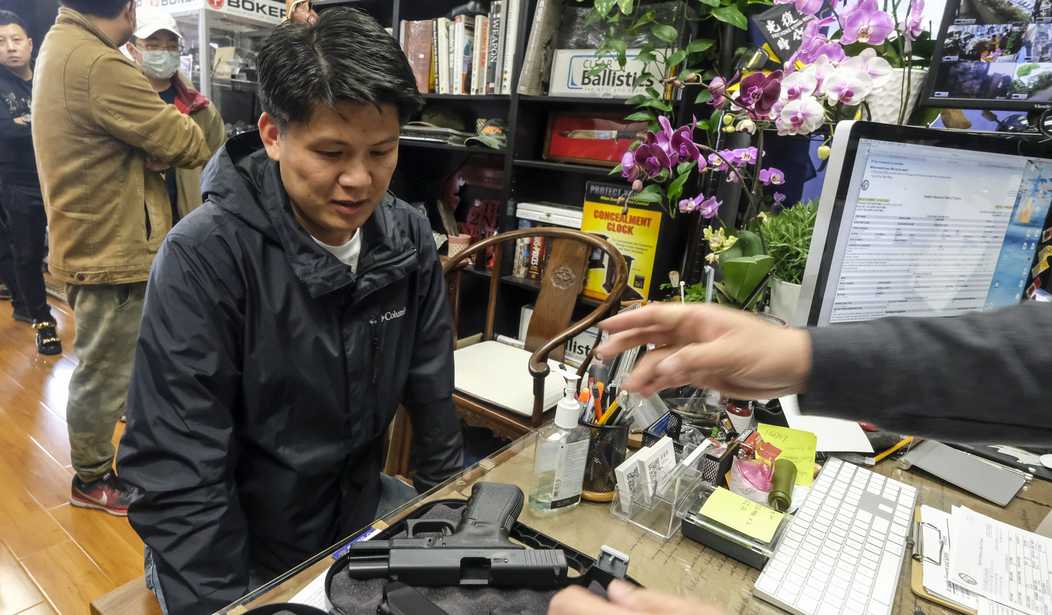
It may be the Fifth Circuit, but it's first in the hearts of many Second Amendment advocates simply because of how many solid victories the appellate court delivers. Today a three-judge panel on the Fifth Circuit sided with Firearms Policy Coalition, Elite Precision Customs LLC, and two individual plaintiffs who had challenged the federal prohibition on interstate handgun sales.
The panel reversed a district court decision in favor of the government, which argued that the ban doesn't violate the Second Amendment because regulations on the sale of firearms presumptively fall outside of the Second Amendment's protections. Even if the Second Amendment were implicated, the district court decreed, the interstate ban on handgun sales imposes only a "modest" burden on the right to keep and bear arms.
The three-judge panel vehemently disagreed. In their view (and in the Fifth Circuit's view), the right to keep and bear necessarily encompasses the right to acquire a firearm, so the Second Amendment is implicated here. That leaves it up to the government to point to historical analogues that justify this modern law.
The DOJ offered up 18 different colonial and state laws dating between 1642 and 1821, which the panel said fall into three broad categories.
First, wartime exigencies and essential provisions for the common defense. Many of the laws were enacted when the colonies were fighting a foreign enemy or at least were subject to circumstances that presented an unusually high risk of physical harm befalling one settlement or another, such that it became necessary to restrict the flow of firearms to avoid becoming defenseless.
So, a different "why" than the modern regulation, which is supposedly aimed at preventing criminals from obtaining firearms.
Second, regulation of commerce with foreign sovereigns. Aside from independent nation states as they are recognized in the modern day, foreign sovereigns before the time of the founding frequently included the other colonies. The further back in history we look, the more independent each colony was, and the less likely that the sale of firearms outside the colony’s borders would have been viewed any differently from the sale of firearms to an entirely distinct country. Additionally, the same goes for the Indian tribes, which were considered as separate sovereigns capable of entering into treaties on par with the government, both at the founding and long thereafter. We need not recount the development and contours of federal Indian law; it is sufficient to say that commerce between American citizens and tribal members was approached quite differently from how the concept of interstate commerce was understood in and around 1791.
Again, the "why" of these laws is not analogous with the government's stated rationale for prohibiting a resident from one state purchasing a pistol in another.
Third, prototypes of consumer protection statutes. While a far cry from modern statutory regimes, the historical laws falling into this category usually sought to inspect the quality of arms and ammunition, to implement minimum mandatory standards for newly manufactured arms and ammunition, to prevent the theft of arms and ammunition held in public trust, and generally to keep abreast of trends in the supply of and market for arms and ammunition. Laws fitting into this category do not aim to prevent sales to any particular class of individual, but rather are exclusively concerned with the nature of the product on offer.
Yet again, the reason for those laws is not the reason for the ban on interstate handgun sales.
The only plausible way to reconcile the government’s view with the historical record is to read early laws restricting cross-border firearms sales at an extremely high level of generality, without regard to the significant differences between state borders and national borders, and also without recognizing that the historical record is devoid of laws meaningfully restricting the trade of firearms between states in the time soon after the United States became established as a single, cohesive entity. That was precisely the Second Circuit’s misdirection in rejecting a challenge to the Ban functionally identical to the one presented here.
The panel refused to make the same mistake the Second Circuit did. As the Supreme Court made clear in Wolford, in order for a law from the past to serve as a modern-day analogue, both the "how" and the "why" must be substantially similar to the law that's being challenged. Those historical laws must also have been widespread and longstanding, but even if a particular statute can be found in a majority of states at the time of the Founding, unless the law was generally meant to serve the same purposes by adopting the same or similar restrictions, it's irrelevant to the State's defense.
So, will the DOJ appeal this decision? The agency has 60 days to file an appeal with the Supreme Court once the panel has issued its order in Elite Precision. And I wouldn't drive to another state tomorrow morning just to test this out. A universal injunction is virtually an impossibility because of the Supreme Court's decision in CASA, so it will take some time to flesh out who is covered by the court's injunction and who is still vulnerable to prosecution.
This is still a very important win, and one that I believe will eventually have a significant real-world impact. Congratulations to FPC, Elite Precision, and the other plaintiffs who took on the ban on interstate handgun sales and who have now come out on the winning side of the legal arguments.
Editor’s Note: The radical Left will stop at nothing to enact their extreme gun control agenda and strip us of our Second Amendment rights.
Help us continue to report on and expose the Democrats’ gun-grabbing schemes. Join Bearing Arms VIP and use promo code FIGHT to receive 60% off your membership.










Join the conversation as a VIP Member