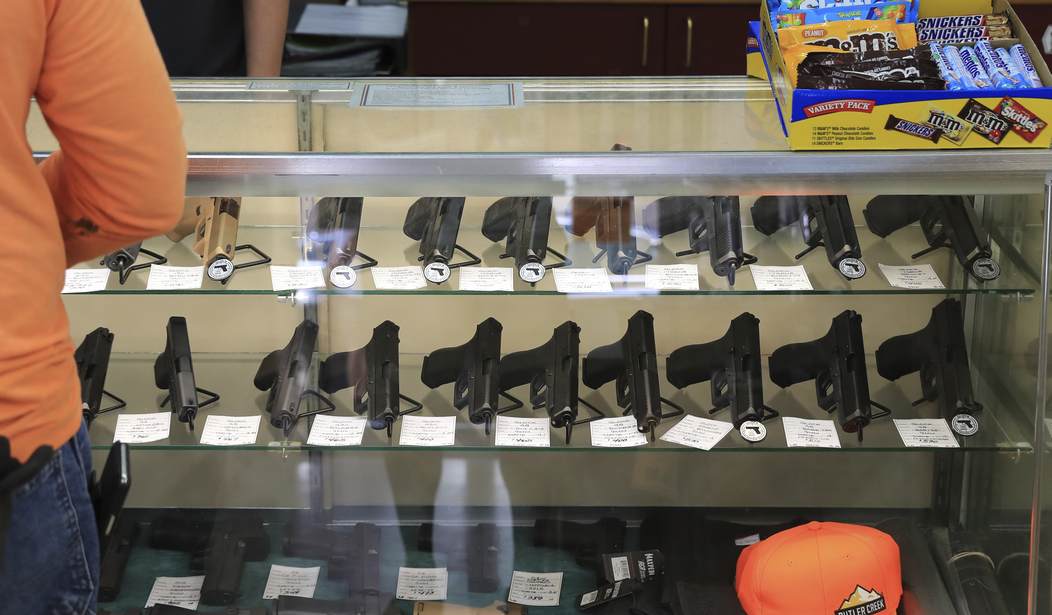
An en banc panel of the Ninth Circuit Court of Appeals has reversed lower court decisions that found a pair of regulations imposed on gun buyers in Hawaii to be facially incompatible with the Second Amendment.
One of the laws in question gives handgun buyers 30 days to purchase a specified handgun after obtaining a state-issued permit, while the other requires purchasers to "register and submit to physical inspection the firearm" in question.
According to the majority of the en banc panel, these bizarre requirements are just part of a "shall issue" licensing system and are therefore presumptively constitutional, with the plaintiffs bearing the burden of showing that the statutes have been "put toward abusive ends that would effectively deny ordinary citizens their Second Amendment rights."
At most, the majority claims, "the provisions impose only modest, procedural burdens, and do not materially impede Plaintiffs from acquiring firearms."
As SAF's Kostas Moros pointed out in a thread on X, the panel ignored what the Supreme Court spelled out in its decision in Wolford that struck down Hawaii's "vampire rule." If the plain text of the Second Amendment is implicated by a particular statute, then the law is presumptively unconstitutional, and the burden is on the state to justify the regulations by pointing to historical analogues.
See how they reverse the burden? Bruen was emphatic that the burden is on the government. The Ninth Circuit uses one footnote to reverse that whenever they can characterize a law as "shall-issue." pic.twitter.com/yO8uksi6GC
— Kostas Moros (@MorosKostas) September 22, 2026
Footnote 9 of the Bruen decision is doing a lot of heavy lifting for the majority of the en banc panel here. That footnote states that "nothing in our analysis should be interpreted to suggest the unconstitutionality of the 43 States’ 'shall-issue' licensing regimes, under which a general desire for self-defense is sufficient to obtain a [permit].'"
Because these licensing regimes do not require applicants to show an atypical need for armed self-defense, they do not necessarily prevent “law-abiding, responsible citizens” from exercising their Second Amendment right to public carry. Rather, it appears that these shall-issue regimes, which often require applicants to undergo a background check or pass a firearms safety course, are designed to ensure only that those bearing arms in the jurisdiction are, in fact, “law-abiding, responsible citizens.” And they likewise appear to contain only “narrow, objective, and definite standards” guiding licensing officials, rather than requiring the “appraisal of facts, the exercise of judgment, and the formation of an opinion,” —features that typify proper-cause standards like New York’s. That said, because any permitting scheme can be put toward abusive ends, we do not rule out constitutional challenges to shall-issue regimes where, for example, lengthy wait times in processing license applications or exorbitant fees deny ordinary citizens their right to public carry.
Bruen dealt with "shall issue" carry permits, not permits to simply possess a firearm in the home, so I don't think that Footnote 9 even applies here. The requirements that were challenged in Yukutake have nothing to do with ensuring those bearing arms are "law-abiding, responsible citizens," after all. And the law requiring gun owners to present their newly-purchased firearm to police for inspection absolutely involves the "exercise of judgment and the formation of an opinion" - the opinion of the police officer inspecting the firearm.
The burden should be on Hawaii to demonstrate that these requirements, which are unique to the state, are part of the historical tradition of gun ownership and regulation. But as Moros discovered, the Ninth Circuit claims that many of Hawaii's ahistorical requirements are "common" among shall issue regimes.
WTF? No, providing SSN and mental health records is certainly NOT the norm in most shall-issue jurisdictions. pic.twitter.com/CT5Z48w5zM
— Kostas Moros (@MorosKostas) September 22, 2026
Licenses to possess are, in and of themselves, uncommon. Providing mental health records and Social Security numbers for those licenses is even more unusual. The narrow majority, though, seems okay with declaring things to be commonplace even when they're not.
Writing in dissent, Judge Ryan D. Nelson correctly pointed out that Footnote 9 only addresses public carry licenses that aren't an issue in Yukutake, and "it does not shift to the citizen the burden to prove that a law governing protected conduct has been 'put toward abusive ends.'"
That interpretation violates Bruen’s clear command that it is the government’s burden to show that restrictions on the right to keep and bear arms are “consistent with the Nation’s historical tradition.”
... Footnote 9 did not create a gaping Second Amendment exemption for states to exploit with new creative restrictions that would otherwise fail Bruen’s test. The majority—like most lower courts—fails to grasp (or even acknowledge) these differences. Never has a single footnote in a Supreme Court opinion been so misread by so many lower courts to deny so many Americans their constitutional rights. The statements in footnote 9 are not the genesis of a different constitutional framework; they show merely how the framework the Court has established might be applied in particular circumstances.
Nelson went on to argue that the challenged laws "appear to be part of Hawaii’s consistent and not-so-subtle attempts to end run around the Second Amendment, which suggests that these laws are abusive under footnote 9." He then cited a litany of court decisions where other Hawaii gun laws have been struck down and declared the state "has only grown more intransigent in its 'blatant defiance' of the Supreme Court’s clear commands on the Second Amendment.
Judge Lawrence VanDyke joined Nelson's dissent, but also penned one of his own in which he argued that the Second Amendment has less protection in the Ninth Circuit now than it did before Heller.
For Exhibit A on how things have changed in the wrong direction, look no further than the majority’s opening paragraph. The majority recalls that the district court “blocked the implementation of [Hawaii’s] firearm licensing regime on Second Amendment grounds” the year before Bruen was decided. The legal basis for reversing that injunction, according to the majority, is the “guidance” that Bruen provided on “how courts should analyze ‘shall-issue’ regimes like Hawaii’s.” I agree thatBruen changed the law. But if our court’s takeaway from Bruen is that Bruen changed the law to make it harder to mount a successful Second Amendment challenge, then somebody has seriously lost the plot.
... It’s hard to imagine how the same court of appeals that gave the government an “undefeated, 50–0 record” in Second Amendment challenges before Bruen could—with the Supreme Court’s subsequent direction in Bruen, Hemani, and Wolford—develop a body of law less sympathetic to firearm-regulation challengers. But we’ve managed to do so. Where there’s a will, there’s a way, I guess. And—when it comes to blessing firearms regulations enacted by the governments of this circuit—our court has never been wanting in will.
... Frankly, our court’s scorched-earth approach to the Second Amendment is getting exhausting. I haven’t even been on the bench for that long, and I’ve lost count of the number of dissents that I’ve written in cases like this one, which is just another verse of the same boring song. I highly suspect that, before too long, the name of this case will have a red flag next to it on Westlaw, just like so many of our court’s other Second Amendment cases do. But hopefully next time, when the Supreme Court plants that flag, it will do so with a little more bite than it has before. Until then, I will assiduously but wearily dissent.
Yukutake will definitely be appealed to the Supreme Court, and while the odds of the Court granting cert to any given case are pretty low, the refusal of the Ninth Circuit to follow the justices' guidance and the blatant hostility that Hawaii still extends to our right to keep and bear arms may help persuade a majority of the Court to issue the "courtslap" that VanDyke has called for in the past.
I certainly hope so, and not just because other anti-gun states in the Ninth Circuit are now free to follow Hawaii's lead and impose similar requirements of their own and subject gun owners to needless red tape and bureaucratic harassment every time they purchase a firearm. The Ninth Circuit's pattern and practice of diminishing our fundamental right to keep and bear arms has an impact far beyond its own jurisdiction, and it's providing aid and comfort to anti-gun activists and politicians who want to turn that right into a privilege doled out by the State in small portions and to a select few.
Editor's Note: Unelected federal judges are obstructing our Second Amendment rights and ignoring the Constitution.
Help us expose out-of-control judges determined to thwart our right to keep and bear arms. Join Bearing Arms VIP and use promo code FIGHT to receive 60% off your membership.








Join the conversation as a VIP Member