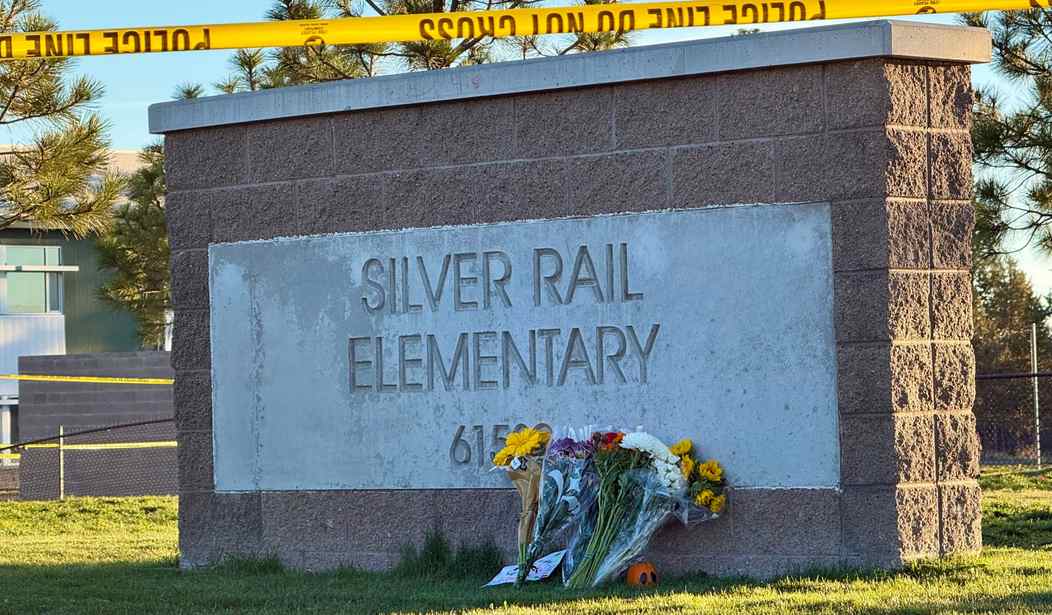
I'll give The Trace a wee amount of credit for even acknowledging that mass shootings happen in places with restrictive gun control laws. In fact, the Bloomberg-backed website admits that "[e]ight of the deadliest school shootings in the past 15 years have occurred in blue states," where there are plenty of restrictive gun laws in place.
But even though The Trace can acknowledge that inconvenient truth, reporter Jennifer Mascia still tries to make the case that this isn't evidence of the ineffectiveness of gun control laws (which, to be fair, is exactly what we'd expect from a writer for The Trace).
Experts and gun violence prevention advocates told The Trace that mass shootings, and gun violence in general, still happen in blue states for a number of reasons: the estimated 400 million guns in civilian hands around the country, laws that vary by state, and weak penalties for unsafely storing firearms. Gun laws also take time to become fully effective, they said, so a zero-sum framing isn’t useful.
“We have a patchwork of gun laws in the United States, and our federal laws are weak,” Emma Brown, the executive director of Giffords, told The Trace. “States with strong gun laws can be neighboring states with weak gun laws, making interstate trafficking easier. We also face emerging technology designed to skirt laws, like 3D-printed guns, that make it possible for people to build guns at home without a background check.”
None of which helps to explain why the strict gun control laws in Oregon failed to prevent the shooting at Silver Rail Elementary School. Nor can Mascia, Brown, or any of the other gun control activists the reporter spoke with offer up a potential law that would have stopped a 16-year-old from using his mother's pump-action shotgun to cowardly target a classroom of special needs students and their teacher.
A few experts pointed to state-by-state variations in gun death rates as proof that strong gun laws can be effective. “If you look at the difference between Massachusetts and Mississippi, gun death is 10 times higher in Mississippi,” said Josh Horwitz, co-director of the Johns Hopkins Center for Gun Violence Solutions at the Bloomberg School of Public Health. “So I’ll argue that gun laws do work. But they can’t stop everything.”
Massachusetts is also estimated to have one of the lowest levels of gun ownership in the country. According to RAND Corporation, about 10 percent of Massachusetts residents own firearms, compared to 50 percent of Mississippi residents. And note that Horwitz is talking about the gun death rate, which is largely driven by gun-involved suicides. When it comes to homicides, Massachusetts is still lower than Mississippi, but higher than neighboring New Hampshire and Vermont.
The Trace and its stable of gun control activists want us to believe that every failure of restrictive gun laws is simply evidence that we need more of them. If a shooting happens in a state with few gun restrictions, it's because the laws are too weak. If it happens in a state with plenty of restrictions, it's because the laws aren't strong enough, haven't been around long enough, or aren't effective because of "weak" gun laws in neighboring states or at the federal level.
That's a convenient argument, but it's not a particularly convincing one. Until these advocates can point to a specific, constitutionally permissible law that would have prevented the murders at Silver Rail Elementary School, they're just using a tragedy to demand more of the same policies that failed to stop it.
Editor’s Note: The radical Left will stop at nothing to enact their extreme gun control agenda and strip us of our Second Amendment rights.
Help us continue to report on and expose the Democrats’ gun-grabbing schemes. Join Bearing Arms VIP and use promo code FIGHT to receive 60% off your membership.









Join the conversation as a VIP Member