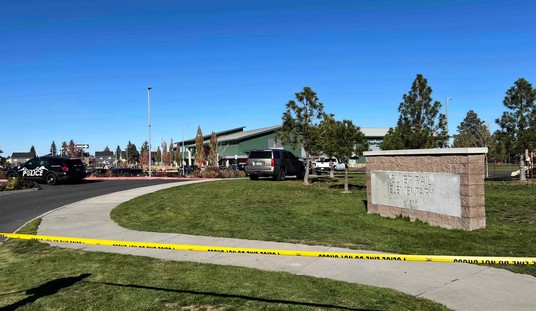

The FBI is reportedly investigating ties between the 16-year-old killer who targeted Silver Rail Elementary School in Bend, Oregon and an online subculture that glorifies and even deifies other spree killers.
Law-enforcement sources who spoke on background to The Oregonian say the teen may have been radicalized by groups operating within this subculture, and reportedly had become obsessed with Nazism.
The FBI, along with state and local police, are focusing on any interactions the killer might have had with the online network known as "764," which has been described as a "loosely connected, transnational set of online groups that engage in sextortion and the glorification of violence." According to the Institute for Strategic Dialogue, in the past five years at least 50 individuals associated with 764 have been arrested for sextortion, possession of child sexual abuse material, or violent attacks.
The FBI field office in Portland actually put out an advisory about the group earlier this year.
Federal officials said 764 members use threats, blackmail and manipulation to pressure young people into producing, sharing or live-streaming acts of self-harm, cruelty, sexually explicit acts and suicide.
In May 2025, Columbia County sheriff’s deputies arrested a teenager after FBI investigators said he had posted plans on 764’s online network to kill people and then himself at the Three Rivers Crossing mall in Kelso, Wash., in an alleged bombing and mass shooting. This past April, the 14-year-old Clatskanie boy was sentenced to probation for first-degree disorderly conduct after the teen admitted making a “false threat.” In that case, evidence revealed an undercover FBI agent had chatted with the boy on the extremist online network 764.
In a February 2026 press release, the Boston field office of the FBI said the agency was investigating over "350 subjects nationwide who are tied to violent online networks commonly referred to as '764,'” but noted that there are other offshoot networks operating under different names as well.
The term Nihilistic Violent Extremism (NVE) refers to what is motivating most of these subjects to commit criminal acts. They want to sow chaos and facilitate the destruction of society. These extremists often emerge from decentralized online networks and subcultures that glorify violence, mass killers, and self-harm. However, not all participants in these violent online networks are motivated by NVE. These subjects may be engaging in criminal activity for sexual gratification, social status, a sense of belonging, or for a mix of other reasons. Each case is evaluated individually to determine if Nihilistic Violent Extremism is involved. Regardless of motivation, the FBI takes each case seriously and works with its domestic and foreign law enforcement partners to ensure offenders are held accountable.
Victims are typically underage females between the ages of 10 and 17 years old, but anyone can be targeted. They often lack a stable support network and may suffer from mental health issues, such as depression, eating disorders, or suicidal ideation. They typically have unfettered access to the Internet, are disconnected, and believe they are communicating with someone their own age. Threat actors often groom victims by first establishing a trusting or romantic relationship before eventually manipulating and coercing them into engaging in escalating harmful behavior designed to shame and isolate them.
In the case of the Oregon teen, it doesn't sound like any evidence of sextortion or sexual grooming has emerged, but an obsession with Nazism could be one indication that Nihilistic Violent Extremism may have been a motivating factor in his targeting of the elementary school.
Whether the FBI ultimately finds a connection between the Bend killer and 764 remains to be seen, but the broader threat posed by these online networks is already well established. And unlike some of the gun control proposals that inevitably follow a mass shooting, there are things we can do to address that threat without infringing on anyone's constitutional rights.
First, parents need to know these groups exist. That's easier said than done when the networks operate on platforms that many of us have never heard of, and members use language and symbols that mean nothing to outsiders.
We don't have to monitor every conversation our children have, but we should know who they're talking to and what they're being exposed to. We also need to be cognizant of any changes in their behavior; isolation, depression, an obsession with mass killers, or talk of hurting themselves or others. Those things need to be taken seriously and not just shrugged off as teen angst.
Schools have a role to play as well. We need to make sure that teachers and counselors understand the tactics these networks use to recruit and exploit young people, and students need to know they can report threats without automatically being treated as suspects themselves.
Law enforcement has the difficult job of pursuing the individuals who recruit, threaten, exploit, and encourage vulnerable teenagers to commit acts of violence. Disrupting a disparate network like 764 is challenging, but there needs to be serious consequences for the leaders of these groups.
A ban on AR-15s won't stop a teenager from being groomed into glorifying or committing mass murder. A magazine ban won't prevent an online extremist from encouraging a vulnerable kid to kill himself or others. Making it harder for peaceable adults to exercise their Second Amendment rights does nothing to dismantle the networks spreading this poison.
Not every troubled teenager who encounters this trash online is destined to become violent. The vast majority of them will never pose a threat to themselves or others. We need to recognize genuine threats and get vulnerable kids help before they're sucked deep into these communities, but that doesn't mean we should treat every teen who has a hard time making friends as a school shooter waiting to happen.
Most importantly, if we want to prevent the next tragedy, we need to quit looking for ways to disarm the law-abiding and spend more time and energy figuring out how to stop the people who are teaching kids to kill.