



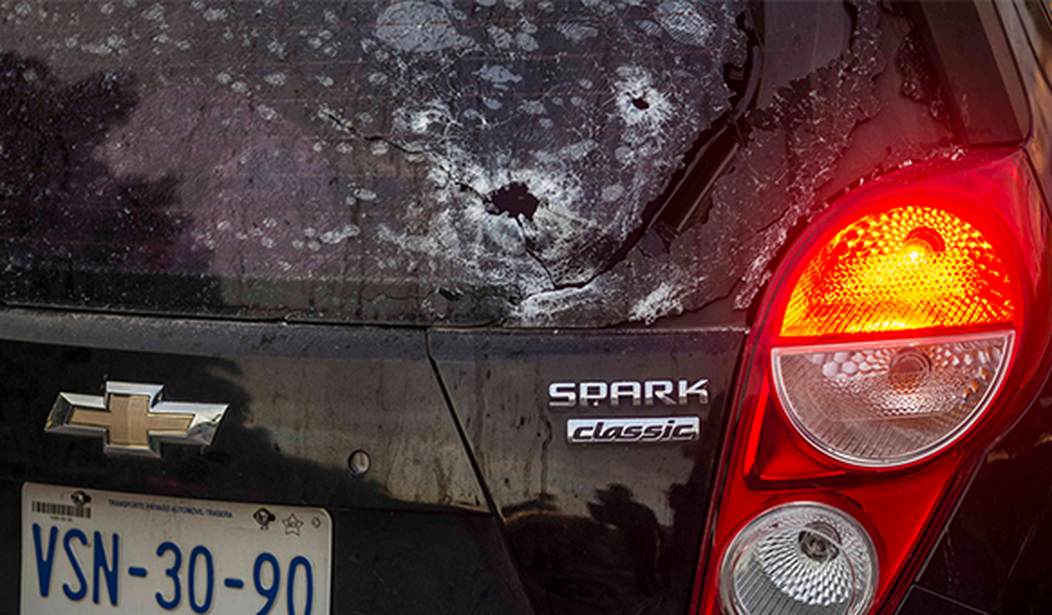
If Mexican drug cartels started using Toyota pickup trucks to transport fentanyl across the border, would that somehow undermine your constitutional right to travel? Of course not. But according to gun control attorney Jonathan Lowy, the fact that Mexican cartels use some AR-15s purchased in the United States and smuggled across the border should count against the Second Amendment rights of millions of Americans who own the same type of rifle.
Lowy has apparently discovered a new way to interpret the Constitution: the more criminals like something, the fewer rights the rest of us should have.
The longtime gun control activist, who helped represent the Mexican government in its doomed lawsuit against the U.S. firearms industry trying to hold it responsible for cartel violence south of the border, recently presented his novel argument to the Supreme Court in an amicus brief for his group Global Action on Gun Violence in defense of "assault weapon bans." Now Lowy has elaborated in a column at Substack, where he contends that "Mexican crime guns shouldn't create a constitutional right."
GAGV’s brief highlights a largely overlooked issue relevant to the case: a significant portion of the demand for U.S.-sold assault weapons comes from Mexican drug cartels and other foreign criminal organizations.
That matters because Petitioners’ constitutional argument rests heavily on production and sales figures. They contend that weapons “in common use” are protected by the Second Amendment, that millions of assault weapons have been sold in the United States, and therefore there is a Constitutional right to AR-15s.
There’s a few problems with this argument, as GAGV’s brief points out. First, sales are not the same as possession by law-abiding Americans for lawful purposes. Hundreds of thousands of assault rifles are purchased in the United States by straw purchasers for foreign criminal organizations, including Mexican cartels. A rifle bought in Texas or Arizona and trafficked to Mexico or elsewhere (or interdicted by law enforcement before making it across the border) remains part of the U.S. manufacturing and sales total cited by Petitioners to argue that assault weapons are in “common use.” Yet that rifle may be used in Mexico to protect a drug shipment, enforce cartel control, commit a kidnapping, attack a rival organization, or confront police or military forces. These weapons are highly prized by cartels, often selling “for double the purchase price or more in Mexico.” Estimates suggest that “between 250,000 to 1 million firearms [are] trafficked from the U.S. to Mexico each year.”
And how many of those are legal purchases by the Mexican government that are diverted to cartel members? As Shayl Attkisson reported last October, "the Mexican government was the top buyer of U.S. guns later traced to crime scenes in Mexico" from 2016 to 2023.
Keep in mind that not all of those firearms are AR-15s. Lowy's figure includes all kinds of firearms, not just the semi-automatic centerfire rifles in question in the Viramontes case. I can understand why the gun control activist would want to make it seem like a large portion of legal sales of these firearms end up in the hands of the Mexican drug cartels, but there's simply no evidence that's the case.
Lowy also takes issue with the idea that widespread ownership of a firearm can help establish its constitutional protection. In his view, that's a dangerous road to travel. If popularity can establish protection under the Second Amendment, he argues, then declining popularity could presumably strip a firearm of that protection.
That's a clever-sounding argument, so long as you don't think about it too much.
The Supreme Court hasn't said that the Second Amendment protects whatever happens to be selling well at our local gun stores. The relevant question is whether a particular type of arm is commonly possessed by law-abiding Americans for lawful purposes. That doesn't mean constitutional protection disappears the moment sales start slipping or gun owners develop a preference for something newer.
Take revolvers, for instance. Semiautomatic pistols have dominated the handgun market for decades, but millions of Americans still own revolvers, and nobody seriously believes their constitutional protection is gradually evaporating as their market share declines. A firearm's popularity can change without transforming it into a dangerous and unusual weapon.
Lowy's argument also ignores the importance of historical lawful ownership. A firearm that has been widely possessed by ordinary Americans doesn't suddenly become constitutionally suspect because a newer design catches on. The Heller decision didn't create a constitutional popularity contest where yesterday's protected arms become tomorrow's contraband if enough people stop buying them.
There's another problem with Lowy's critique, and it's one that will be familiar to those who've been following the legal fights over the Second Amendment over the past couple of decades.
He wants courts to weigh the burden imposed on lawful gun owners against the government's interest in preventing violence. In other words, judges should decide whether restricting a particular firearm is worth the supposed public-safety benefits.
The Supreme Court has explicitly rejected that interest balancing approach. In Bruen, the justices held that the government must justify firearm regulations by demonstrating their consistency with the nation's historical tradition of firearm regulation. Courts aren't supposed to decide whether a restriction is constitutional by balancing its impact on individual rights against whatever public-safety benefits the government claims it will produce.
Lowy's contention that criminal demand for a particular firearm counts against its constitutional protection would mean that criminals effectively acquire some influence over the rights of law-abiding Americans. The more popular a firearm becomes among drug traffickers, gang members, or other violent offenders, the stronger the argument for prohibiting ordinary citizens from possessing it.
The Supreme Court has already rejected that theory, way back in Heller, when it acknowledged that handguns are by far the most popular choice for criminals as well as peaceable gun owners looking for a self-defense firearm. Their widespread criminal misuse didn't cancel out their constitutional protection as arms commonly chosen for lawful self-defense.
Lowy presumably doesn't intend to give Mexican cartels a voice in determining the scope of Americans' constitutional rights, though his group is registered as an agent for the governments of Mexico and the Bahamas, so he very well might want those governments to have a voice. Fortunately, the Constitution doesn't give Mexican drug cartels or foreign governments a seat at the table when deciding which rights Americans get to exercise.
Editor’s Note: The radical Left will stop at nothing to enact their extreme gun control agenda and strip us of our Second Amendment rights.
Help us continue to report on and expose the Democrats’ gun-grabbing schemes. Join Bearing Arms VIP and use promo code FIGHT to receive 60% off your membership.

Join the Conversation
VIP members get the ability to comment on articles.