



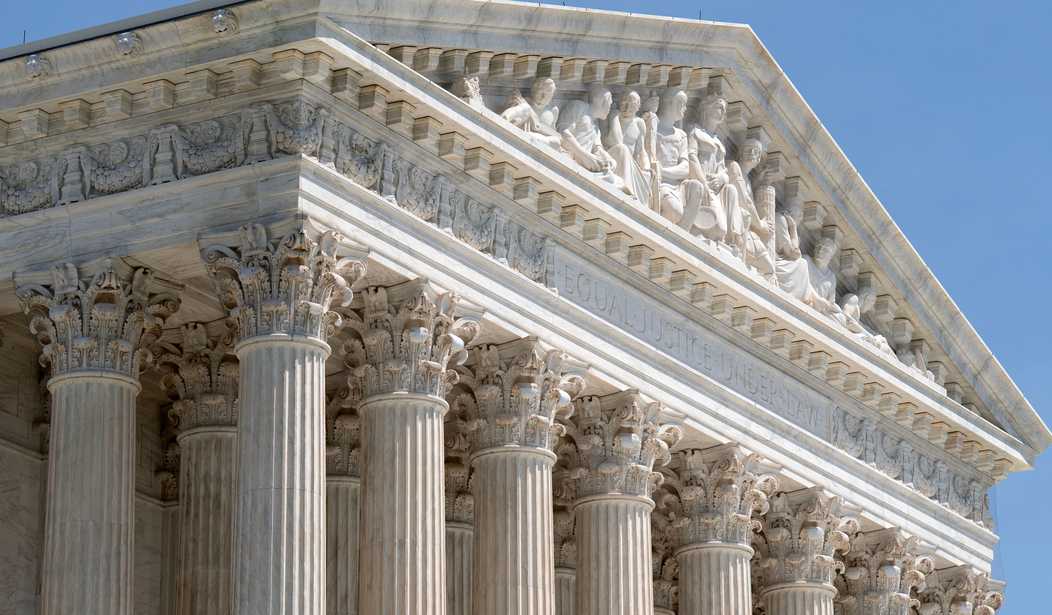
After striking down Hawaii's "vampire rule" that prohibited lawful carry by default in all private property open to the public, it seems logical that the Supreme Court would turn its attention to some of the specific "gun-free zones" that many blue states have adopted in the wake of the Bruen decision.
The Court could have done just that by granting cert to Novotny v. Moore, which challenges a variety of Maryland's new "sensitive places," but on Monday SCOTUS denied cert to the case and will leave the Fourth Circuit's decision upholding most of these "gun-free zones" in place.
The move drew a written statement from Justice Clarence Thomas, who declared that though he's skeptical that "each of these laws 'is consistent with this Nation’s historical tradition of firearm regulation' in 'sensitive places,' he's still in agreement with the decision not to grant cert.
Because each Maryland statute implicates a distinct historical tradition of firearm regulation, the breadth of petitioners’ challenge would complicate our review. In an appropriate and more narrowly focused case, however, we should consider the scope of States’ authority to ban firearms in “sensitive places.”
I respect Justice Thomas, but I think he's wrong here. The Supreme Court only grants cert to a handful of cases every term, and while accepting a narrow challenge to a particular "gun-free zone" would be better than turning it away, a narrow ruling would still leave a host of unconstitutional restrictions in place. As Justice Thomas noted, "States have seized on the idea of 'sensitive places' to prohibit the peaceable carry of firearms in locations that bear little resemblance to legislatures, pollingplaces, or courthouses."
New Jersey, for example, prohibits firearms in at least 25 locations, including zoos, public libraries, casinos, and state-owned beaches. New York has designated 20 locations as “sensitive,” ranging from “any place of worship” to “residential settings licensed... by the department of health.” California’s 29 gun-free spaces include “athletic facilit[ies],” “financial institution[s],” and any government-permitted “public gatheringor special event.” These restrictions stand on questionable historical ground. And, their cumulative effect is to prohibit firearms wherever people gather for eating, drinking, recreation, amusement, and free speech—an affront to the right of “law-abiding citizens” to“carr[y] arms in public for" their “ordinary self-defense.”
If plaintiffs have to challenge each of those restrictions individually, it could take decades to sort out their constitutionality, even if the Supreme Court occasionally issues a ruling broad enough to resolve more than one category of "sensitive places."
There's a reason why plaintiffs are challenging so many of these "gun-free zones" at once. The constitutional problem isn't limited to whether Maryland can prohibit carry in a particular park, restaurant, or healthcare facility. It's that these restrictions, taken together, can make it virtually impossible for someone to exercise their right to bear arms throughout the course of an ordinary day.
Thomas recognizes that problem himself. which is why his decision to pass on Novotny is so frustrating. A narrow ruling might resolve the constitutionality of one particular prohibition, but it won't necessarily address the broader question of whether states can effectively nullify the right to bear arms in public by declaring almost everywhere people go a "sensitive place."
Considering multiple "gun-free zones" in one lawsuit may very well complicate the Court's job. The lower courts seem to have handled these cases, though, so I don't see why the Supreme Court can't. And honestly, the Court has had the opportunity to address specific "sensitive places" like the ban on lawful carry in public transportation in Schoenthal v. Raoul, and they turned that case down last term as well.
If the Court is looking for a narrow question that could lead to a broader ruling, then Christian v. James may be the vehicle. The petition challenges New York's prohibition on carrying firearms in public parks, and New York's brief in opposition is due on December 3. Maybe this will be the case that draws the interest of four justices, but Novotny really should have been the vehicle the Court used to strike down a host of "sensitive places." A piecemeal approach doesn't offer gun owners the relief they deserve, and will allow for far too many unconstitutional "gun-free zones" to remain in place for far too long.
By the way, the Court also rejected cert to Colie v. Commonwealth of Virginia today, leaving in place a bizarre verdict where a concealed carry holder was acquitted on all charges related to the shooting of a YouTube prankster who accosted him, except for a single charge of unlawful discharge in an occupied building. I was anticipating that, since no justice had asked the state to respond to the cert petition, but it's still an incredibly disappointing outcome for those who believe that Alan Colie was unjustly convicted for defending himself in a public setting.
Editor’s Note: The radical Left will stop at nothing to enact their extreme gun control agenda and strip us of our Second Amendment rights.
Help us continue to report on and expose the Democrats’ gun-grabbing schemes. Join Bearing Arms VIP and use promo code FIGHT to receive 60% off your membership.
Join the Conversation
VIP members get the ability to comment on articles.