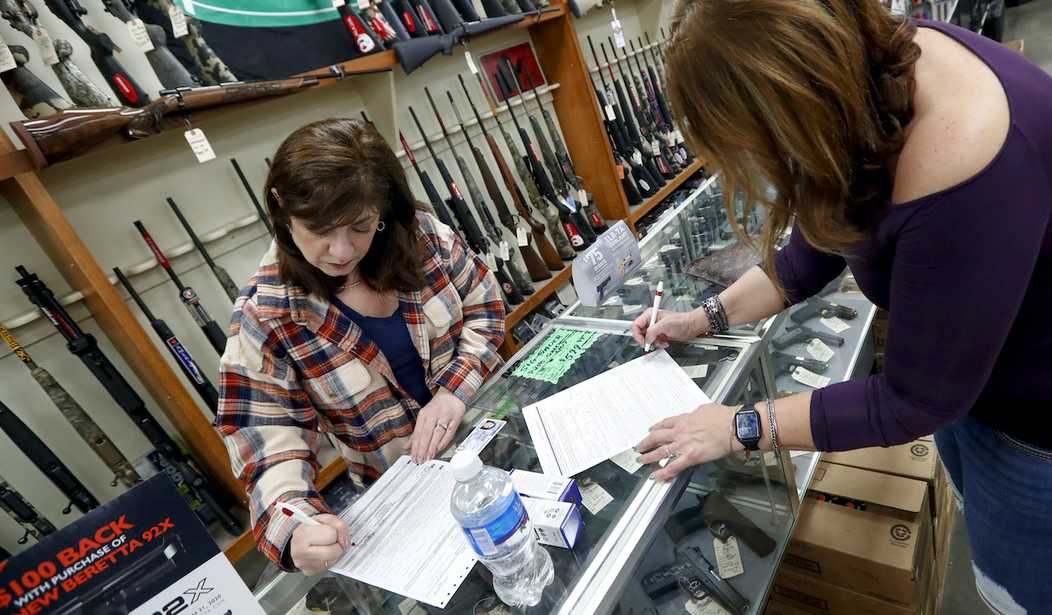
The state of New Jersey has once again shown the problems an anti-gun administration can cause for not only peaceable gun owners, but manufacturers and gun dealers alike. In its most recent attack, the state sued Glock, Inc., under the state’s public nuisance law. As part of that lawsuit, the Attorney General recently sent subpoenas to gun dealers in the state demanding production of customer records regarding sales of Glock pistols to New Jersey residents for the last 10 years.
It is not immediately clear why New Jersey needs these records, given the state already maintains a de facto registry for handguns through its pistol permitting system. It could be the Attorney General wants to make these records public, as under New Jersey law, and in a small nod towards respecting privacy, firearm registration records are exempt from public disclosure under the state's laws.
Regardless of the reasoning for the subpoenas, they are an unconstitutional attack on gun owner privacy. For many people who choose to exercise their Second Amendment rights, their status as a gun owner remains an intensely private matter. Americans have a variety of reasons for wanting to keep their gun ownership to themselves. For some who live in high crime neighborhoods, they may fear the very firearms they own for self-defense could be an enticing target for burglars when they are not home. Others may not want their friends, family, or local community to know they own firearms because they fear the potential social ostracism that may occur in the places where gun ownership remains controversial.
Whatever their reasons for secrecy, our historical tradition supports the idea that Americans have a reasonable expectation of privacy in their status as gun owners. The Second Amendment was crafted both to recognize what the Founders saw as a natural right, but also as a check on potential government tyranny. Given that latter motivation, privacy in gun ownership has always come hand in hand with the right. Today, an assortment of federal and state laws protect gun owner privacy to various degrees and in different ways.
Explaining the intrinsic private nature of the Second Amendment right requires a detour into history, and in particular, an understanding that the Second Amendment was created by people who had just revolted against a tyrannical government. The Founders sought to guarantee the People had a final recourse should the new government they were forming also turn tyrannical. Tench Coxe, a delegate to the Annapolis Convention in 1786 and the Continental Congress in 1788, wrote of Madison’s draft of the Second Amendment that “[w]hereas civil rulers, not having their duty to the people duly before them, may attempt to tyrannize, … the people are confirmed by the article in their right to keep and bear their private arms.”
That understanding persisted throughout the Nineteenth Century as well. In a speech in the House of Representatives, Abolitionist Representative Edward Wade said the “right to ‘keep and bear arms,’ is thus guarantied, in order that if the liberties of the people should be assailed, the means for their defence shall be in their own hands.” Senator Charles Sumner’s “The Crime Against Kansas” speech likewise bristled at the notion that slavery opponents in Kansas should be disarmed of their Sharps rifles by the proslavery government: “Never was this efficient weapon more needed in just self defence, than now in Kansas, and at least one article in our National Constitution must be blotted out, before the complete right to it can in any way be impeached.” Thomas Cooley, a longtime Michigan Supreme Court Justice, similarly wrote that “[t]he right declared was meant to be a strong moral check against the usurpation and arbitrary powers of rulers, and as necessary and efficient means of regaining rights when temporarily overturned by usurpation.”
While more sources exist, there is no need to belabor the point: in addition to enabling personal self-defense, the Second Amendment exists as a last resort check on government power, a failsafe to enable collective defense in the event a tyrant or foreign invader ever usurps our constitutional order. There can be no historical tradition of the government violating the privacy of gun owners when one of the Second Amendment’s main purposes was to be a “doomsday provision” for the People to protect themselves from a tyrannical government.
In the modern era, the federal government itself has recognized gun owner privacy interests. In the 1980s, the Firearms Owners’ Protection Act forbade the federal government from keeping a registry directly linking firearms to their owners, a law still in effect today. Similarly, to prevent the establishment of a de facto registry of gun owners, the FBI is required by federal law to destroy National Instant Criminal Background Check System records of approved firearm purchasers within 24 hours of a "proceed" response. Several states have privacy protections of their own for gun owners, such as Indiana’s “Disclosure of Firearm or Ammunition Information as a Condition of Employment” law, which prohibits both public and private employers from inquiring about or requiring disclosure of employees’ firearm ownership as a condition of employment, unless directly related to job duties.
Those examples, of course, only gently scratch the surface here, and a full examination of the intersection of the right to bear arms, the right to privacy, and to what degree the government’s intrusion on that right is permissible could be the subject of a lengthy law review article. But even this very condensed summation of the relevant historical context shows that Americans have always had the implicit right to keep their status as a gun owner confidential, often even from the federal government itself. That right has been subject only to narrow exceptions. States have increasingly protected this right in the modern era, further entrenching a reasonable expectation of privacy among gun owners. New Jersey's demand for gun store sales records of Glock handguns for the last 10 years is an outrageous attack on privacy in gun ownership, and antithetical to the Second Amendment.
The Second Amendment Foundation is keeping a close eye on the developments in this case to determine what steps might need to be taken to ensure the privacy of New Jersey’s gun owners remains intact.
Editor’s Note: The radical Left will stop at nothing to enact their radical gun control agenda and strip us of our Second Amendment rights.
Help us continue to report on and expose the Democrats’ gun control policies and schemes. Join Bearing Arms VIP and use promo code FIGHT to receive 60% off your membership.










Join the conversation as a VIP Member