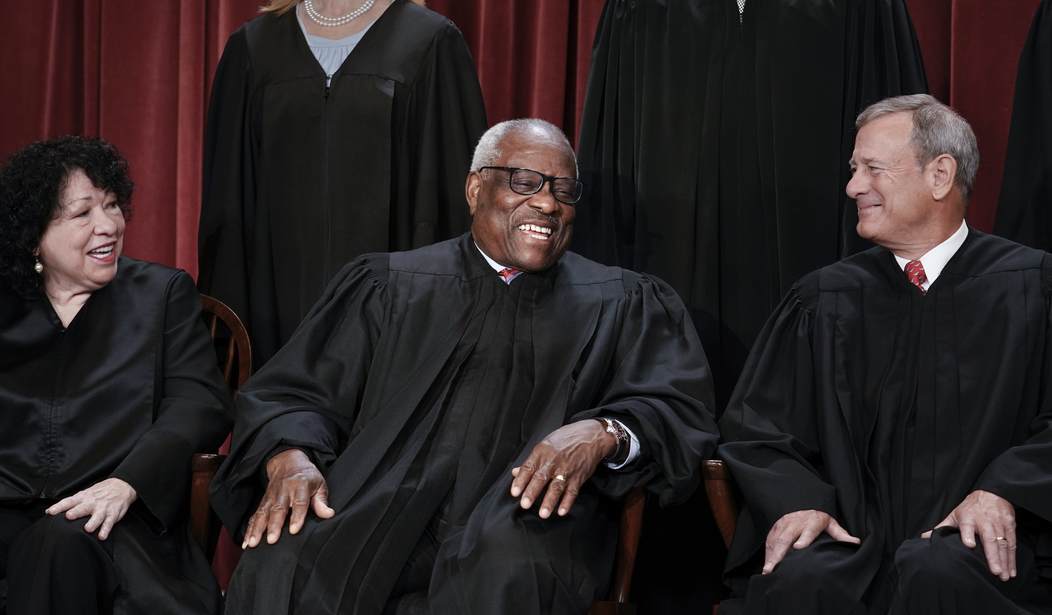
When you think about the heroes of the Second Amendment, I won't debate who you want to put on the top of the heap. If Justice Clarence Thomas isn't up for serious consideration, at a minimum, you're simply wrong. The man who wrote the Bruen decision and was part of the majority on Heller, McDonald, and now Hemani has done more for gun rights than pretty much anyone I can think of.
But his concurrence in Hemani includes a bit that I think is terribly underrated and of vital importance, not just for gun rights, but for freedom in a more general sense.
A shoutout to Ammoland editor Duncan Johnson for pointing this out.
Justice Clarence Thomas used his concurrence in United States v. Hemani to target a constitutional problem even larger than the federal government’s ban on gun possession by marijuana users: Congress may never have had the authority to federalize ordinary, intrastate firearm possession in the first place.
The Supreme Court unanimously ruled that 18 U.S.C. §922(g)(3) could not constitutionally be applied to Ali Hemani merely because he regularly used marijuana. Thomas joined Justice Neil Gorsuch’s opinion for the Court in full. He then wrote separately to question whether the federal statute survives scrutiny under the Commerce Clause.
“As a matter of both original meaning and this Court’s precedents, §922(g)(3) appears to exceed Congress’s enumerated power to regulate interstate commerce,” Thomas wrote. “The statute makes it a federal crime for unlawful drug users to possess any firearm or ammunition ‘in or affecting commerce.’ 18 U. S. C. §922(g)(3).”
The Federal Government’s “Minimal Nexus” Theory
That language sounds like a connection to interstate commerce, but the government’s actual burden is remarkably thin. Under the prevailing interpretation, prosecutors need only prove that the firearm crossed a state line at some point in its history. The accused does not need to have bought it across state lines, transported it interstate, or used it in any commercial transaction.
Hemani allegedly possessed his firearm in his Texas home. The government relied on the fact that the gun had previously traveled in interstate or foreign commerce. For Thomas, that distant historical connection cannot turn local possession into interstate commerce.
“The Commerce Clause does not authorize Congress to ‘regulate or ban possession of any item that has ever been offered for sale or crossed state lines,’” Thomas wrote.
Accepting that theory, he warned, would convert the Commerce Clause into a general federal police power constitutionally reserved to the states.
To some degree, it's already used that way, even as the courts have struck it down over the last couple of decades. The Affordable Care Act's insurance mandate was justified under the Commerce Clause. The Gun-Free School Zones Act tried to ban guns in school zones under the basic idea that, because guns were goods sold via interstate commerce, the Commerce Clause applied.
Before that, Wickard v. Filburn ruled that the Commerce Clause did apply to a farmer growing wheat for personal consumption, simply because other wheat was shipped across state lines, and his lack of need to buy wheat impacted interstate commerce. There's a reason lawmakers figured they could get away with that crap.
The truth is that there are many examples of how the federal government has used the Commerce Clause to regulate activity well beyond what was intended. Thomas is right to point out that no, it doesn't give the federal government the authority to regulate the possession of an item that was once a part of interstate commerce.
The Commerce Clause was intended to keep individual states from pursuing their own economic agendas at the expense of other states. Texas cannot institute a tariff on goods that come from California. Georgia can't stop residents from going to Panama City Beach for their vacations. Utah can't be barred from being Utah.
You know, stuff like that.
It was never intended to be a catch-all that allows the feds to ban every activity they can imagine being remotely linked to interstate commerce.
And while the courts have ruled lately in just that way, let's also be real here, there are a lot of people who want to revamp the Supreme Court in such a way that they'll get the rulings they want from it, and that will likely include a drastic re-interpretation of the Commerce Clause.