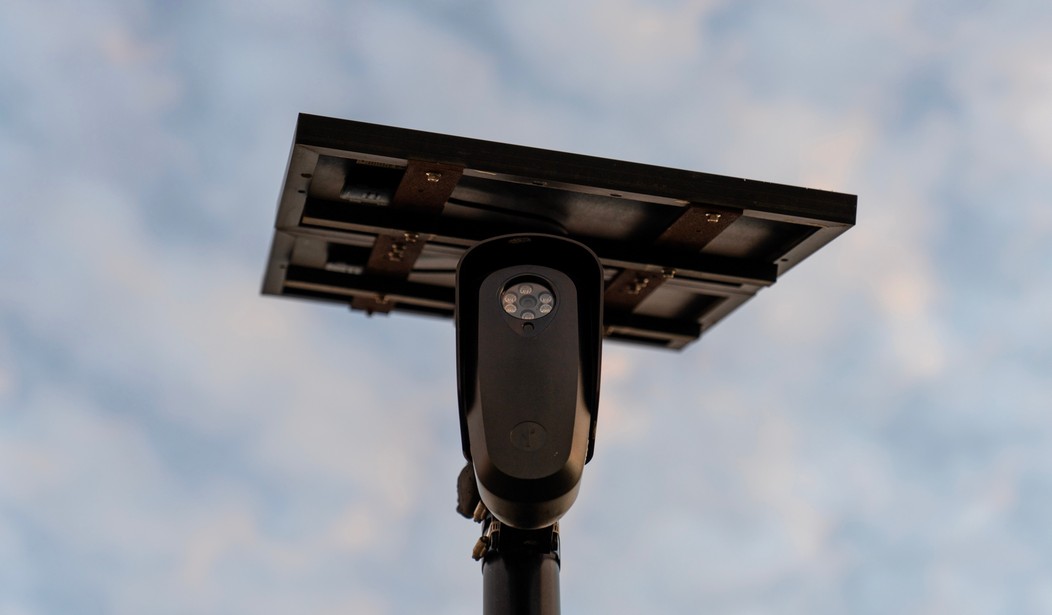
Flock cameras have become big news over the last year, and it's not hard to see why. These cameras are all over the place, and that's a concern. While you don't have an expectation of privacy in public, you do have a right to not expect to be trailed remotely after the fact with digital technologies.
And for gun owners, that's a big concern, as Taylor D. Rhodes recently noted.
While his focus was on Alabama gun owners, you can file the serial numbers off of this, and it works in all 50 states, but it's more terrifying in anti-gun states. Rhodes notes that Flock cameras are basically tracking gun owners, you see.
These cameras came into Alabama the way kudzu did: quietly, then… boom, everywhere.
Birmingham's city council approved a $9.7 million contract last July for more cameras citywide. Huntsville has run more than a hundred since 2019 and shares into a national pool; Madison, Decatur, Moody, Springville, and retail parking lots have them too. The Alabama Gazette reported that Alabama Power was marketing Flock systems to cities, bundled with utility poles and streetlights, some of which I have noticed just outside my neighborhood.
But here is the craziest part: most of it arrived by consent agenda and contract renewal. The Legislature never voted on a statewide surveillance network. Yet ALEA's administrative rules let plate reader data sit for five years, the longest of any state, per a 2026 legislative survey, and require every read to feed a statewide registry once ALEA stands it up.
That should stop every gun owner in their tracks. Alabama law, through Act 2024-232, prohibits the government from keeping a list or registry of privately owned firearms or their owners. Gun owners fought hard to secure that protection. Yet today, Flock has effectively created a searchable, five-year archive showing which vehicles with Second Amendment decals park at gun stores on Fridays, attend gun shows, or regularly visit shooting ranges. It may be built from “license plate photos” instead of firearm records, but for all practical purposes, it’s a hard registry of gun owners.
Nobody in any police department has to sit down and build that list, because Flock's built-in artificial intelligence builds it for them. The software reads every photo, determines what your truck is, tags every sticker and decal, and logs the time and place, 20 billion scans a month, according to the company's own marketing. Its analytics even flag vehicles that keep showing up together as likely associates. By the time an officer pulls up a chair, the sorting is already done. All anybody with a login has to do is check.
As of today, there are a lot of logins. Roughly 5,000 law enforcement agencies use Flock, and most share their feeds into a national pool. A single lookup can sweep nearly every camera in America at once. No warrant. No judge. Just a few words in a reason box and the Enter key.
And that's the concern.
Wired wrote about how Atlanta has joined this database of more than 2,000 individual departments. That's a lot of data in a single place, and those departments span across the country. While it's far from all of them, the truth is that joining the system is trivial, which means that it can happen overnight, leaving millions of law-abiding Americans suddenly sitting in a law enforcement database.
For gun owners, this is a problem because it'll see us at the gun store, at the range, at meetings of gun rights groups, or at pro-gun protests.
The issue with Flock isn't that they read license plates. It's that they read them, centrally store them, and provide for them to be shareable across thousands of agencies. In aggregate, this public data collection becomes an invasion of our privacy, a digital stalking that we'd arrest any individual for trying, but somehow pay for the "privilege" of having our local governments do it for us.
Orwell's 1984 was a warning, not an instruction manual. I've said this before, and I'll keep on saying it. Why? Because this is damn horrifying. The idea that there basically is a gun registration taking place, but it's happening on a digital plane that can be called upon in an instant. Until then, there's no registry. It exists merely as a potentiality, but with no safeguards to prevent it from becoming reality.
There's a reason there's a rash of officers abusing their access to the system. It's because the system is capable of doing more than just reading the license plates of people driving by.
And for gun owners, that means it knows what we've been doing, which no government should be able to find out.