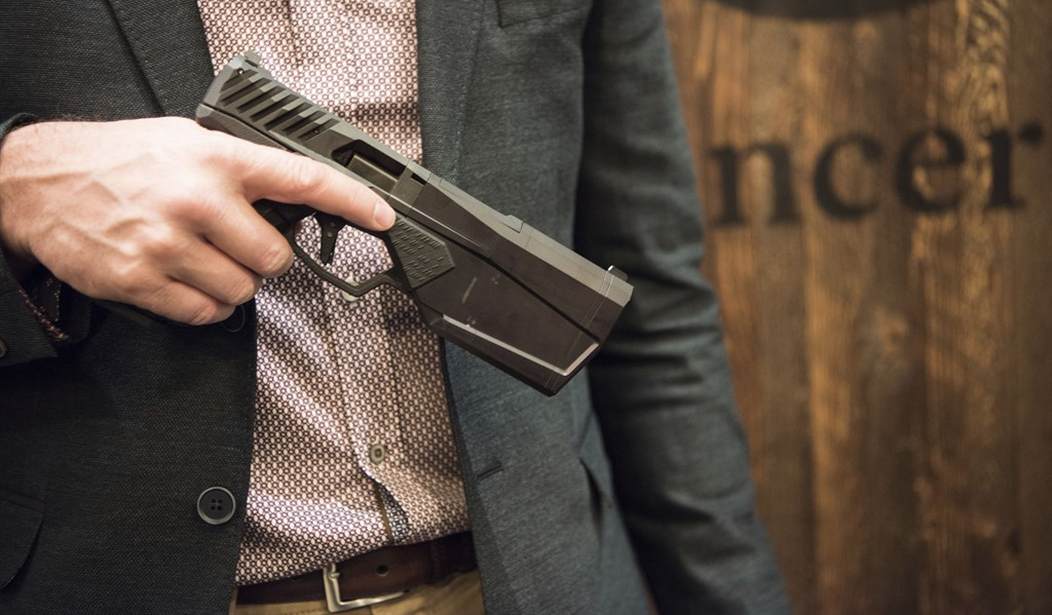
There is only one industry that might be more heavily regulated than the gun industry, and that's pharmaceuticals. It's a close race, in a lot of ways, and while most people are fine with the status quo, for the most part, in pharmaceuticals, there are a buttload of people who want to make the gun industry so regulated that it ceases to exist.
But they can never get everything through all at once. They're playing the long game, though, and a nearly 60-year-old law is one of the tools that went toward that goal.
Now, the Gun Control Act of 1968 is being challenged. In particular, the authority to require manufacturers to have government-issued licenses.
After nearly two years of federal investigations and property seizures, Texas suppressor manufacturers Jared Gee and David Abt are taking the fight directly to Washington — challenging whether Congress has the constitutional authority to license a business operating entirely within Texas.
Two Texas Gun Rights members whose suppressor business was targeted in a sweeping federal ATF investigation have filed a new constitutional lawsuit against the Department of Justice, challenging the federal government’s authority to regulate firearm suppressors manufactured and sold entirely within Texas.
Jared Gee and David Abt, owners of Texas-based suppressor manufacturer 1836 LLC, filed their lawsuit on October 9 in the U.S. District Court for the Northern District of Texas.
The case, 1836 LLC v. Bureau of Alcohol, Tobacco, Firearms and Explosives, Case No. 3:26-cv-03535, has been assigned to U.S. District Judge Brantley Starr.
Unlike recent litigation challenging the National Firearms Act’s taxation and registration requirements, this lawsuit goes after a separate federal gun-control law: the Gun Control Act of 1968 and its requirement that commercial firearms manufacturers obtain federal licenses.
At the center of the case is a straightforward constitutional question:
If a suppressor is manufactured in Texas, sold to a Texan, and never leaves Texas, what constitutional authority does Congress have to require the manufacturer to obtain a federal license?
In theory, it shouldn't.
Basically, the authority for this is derived from the constitutional authority for Congress to regulate interstate commerce. Yes, this goes beyond what the Founding Fathers intended, and I'm not disagreeing with it, I'm just explaining where the so-called thinking on this comes from.
So, if it never leaves the state, it shouldn't matter.
However, the trick here is that there's no way to ensure that the suppressor won't leave the state. They can't tether it to Texas, where it can't somehow cross the line, like one of those invisible electric fences that keeps your dog from wandering.
That said, I find the justification for licenses specious in and of itself, especially under the Bruen standard of history, text, and tradition. The right to bear arms implies the right to manufacture guns and engage in the trade of those firearms with others. There's no historical analog for a licensing requirement for making and selling guns. Back at both the time of the nation's founding and at the time when the 14th Amendment was ratified, I know of no law that required a license in order to exercise a constitutionally protected right.
So I think they've got a better shot at winning this than it might seem.
And I sincerely hope they do win it.
Editor’s Note: President Trump and Republicans across the country are doing everything they can to protect our Second Amendment rights and right to self-defense.
Help us continue to report on their efforts and legislative successes. Join Bearing Arms VIP and use promo code FIGHT to receive 60% off your membership.










Join the conversation as a VIP Member