



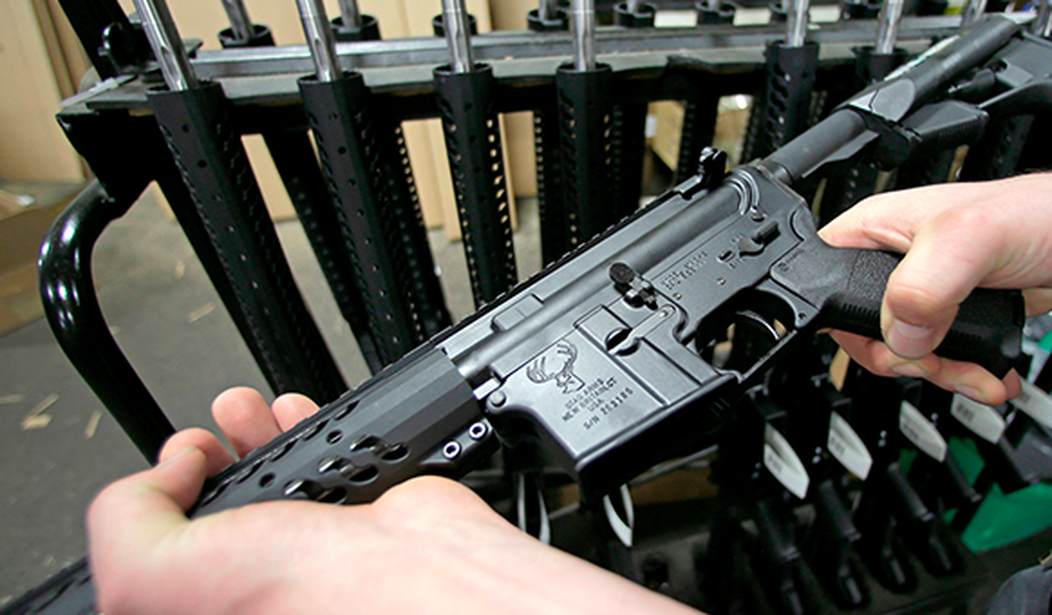
There are a lot of people who want to ban AR-15s. They've tried it before, both at the federal level and in various states. Now, it's going to the Supreme Court, where a lot of anti-gun voices are making a curious claim. They argue that the AR-15, rather than a tool for recreation or self-defense, is a weapon of war that has no place on the streets of the United States.
But there's a big issue with that argument, which comes up in an op-ed that argues the "well regulated militia" aspect of the Second Amendment means that it explicitly protects weapons of war.
The Supreme Court will soon hear arguments in December in Viramontes v. Cook County, a challenge to state and local bans on AR-15 semiautomatic rifles. The challengers say the rifles are “in common use” for lawful purposes such as self-defense. The state governments defending their gun-bans say they are weapons better suited to war than to civilian life.
Neither side recognizes that the Second Amendment’s reference to the “militia” counts in favor of protecting AR-15s either way.
Point of order: we actually do recognize it.
Moving on...
The challengers emphasize self-defense, an individually focused concern, while the governments argue that AR-15s’ military character is a reason to ban them. But AR-15s are the sort of small arms historically suited for a militia. This is actually the heart of the case, as we argued in a friend-of-the-court brief for the Cato Institute.
Small arms that an infantryman would historically have kept and borne are not marginal to the Second Amendment. Rather, they sit at its center. The amendment’s self-professed rationale for protecting the right to keep and bear arms is that a well-regulated militia is necessary to the security of a free state.
Although self-defense is also an important aspect of the right, debates about how useful AR-15s are for that purpose as compared to, say, pistols — or about how useful they are on a modern battlefield versus against a nighttime home intruder — miss the point.
The Second Amendment’s own text says it is protecting an individual right out of a recognition of the militia’s importance. The provision reads: “A well regulated Militia, being necessary to the security of a free State, the right of the people to keep and bear Arms, shall not be infringed.”
In essence, if it is a weapon of war, then it most definitely is covered by the Second Amendment.
And since almost every firearm type available on the market has some relationship to a firearm used in war at some point or another, they're all weapons of war and thus all covered under the Second Amendment. The same with swords, knives, spears, polearms, daggers, and archery equipment, among other things. These are all "arms" under the Second Amendment's text, and are covered.
It's not as novel of an approach as the folks at the Cato Institute might want to believe, but I also think that it's worth repeating as often as possible, if for no other reason than as a reminder that the Second Amendment has nothing to do with hunting season, unless we're hunting tyrants and their lackeys. I pray we don't get to that point, though.
It's not novel, but it's still an important approach.
The truth is that our Founding Fathers saw the militia have superior firearms to the British soldiers, with rifled bores that increased range and accuracy beyond what King George's boys could match. They knew what weapons of war looked like then and did nothing to curtail it.
Why would the AR-15's supposed status as a weapon of war be any different?
Editor’s Note: President Trump and Republicans across the country are doing everything they can to protect our Second Amendment rights and right to self-defense.
Help us continue to report on their efforts and legislative successes. Join Bearing Arms VIP and use promo code FIGHT to receive 60% off your membership.



Join the Conversation
VIP members get the ability to comment on articles.