




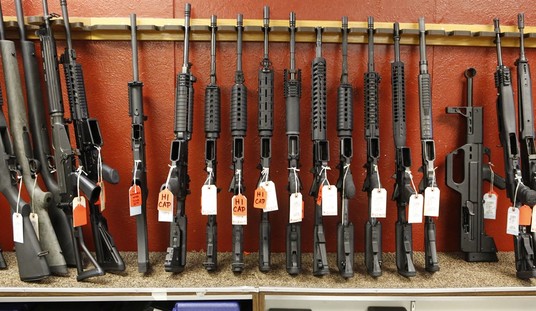
Oral arguments in the Supreme Court case challenging bans on so-called assault weapons won't take place until early December, but the state of Connecticut and Cook County, Illinois have now filed their written defense of the ban with the Court.
Both briefs rely heavily on arguments used by the Second and Seventh Circuits to uphold the bans on commonly owned, centerfire semi-automatic firearms; AR-15s and other popular rifles are "unusually dangerous" and therefore fall beyond the Second Amendment's protections, the bans can fit within the Supreme Court's Second Amendment caselaw because they're a response to "dangers that were created by technological change and unprecedented societal concerns," and because of their "unusually dangerous" nature, it doesn't matter how popular and prevalent these firearms are.
The briefs also rely on a false reading of what the Supreme Court has said about the right to keep and bear arms. While self-defense is a core component of that right, the Court has explicitly held that the right also encompasses "traditionally lawful purposes" (plural). Cook County, though, suggests that self-defense is the only valid reason to own a firearm, and that AR-15s and other semi-automatic rifles are both unsuitable for and rarely used in self-defense.
As expected, Cook County will focus on things like Bowie Knife restrictions even as the real 19th century analogues to the AR15 (colt revolvers, Winchester repeaters) were massive jumps in firepower compared to what came before, but were never banned. https://t.co/whgN60tR8A
— SAF (@2AFDN) October 21, 2026
I don't think either brief truly addresses that conundrum. Instead, they're content to point to restrictions on things like Bowie knives and trap guns as evidence that commonly-owned arms can be prohibited if legislatures determine they are "unusually dangerous." Connecticut's brief leans heavily on this argument, claiming that "American history is replete with examples of governments banning excessively lethal weapons precisely because they had become so popular that they posed immediate dangers to society."
The launcegay and Bowie knife, for example, were both in common use when restricted. And none of the nineteenth-century decisions discussing weapons restrictions held that legislatures lost regulatory authority once a weapon was in common use. Instead, the historical record supports the notion that States have authority to regulate weapons that pose unusual danger to their communities—even if those weapons are lawful, and even commonly owned, elsewhere in the country.
Connecticut argues that the Supreme Court has "made clear that the Second Amendment protects stun guns but not fully automatic machineguns, even though those weapons are owned at comparable rates," reasoning that it follows "that something other than commonality separates stun guns and machineguns—specifically, that machineguns are unusually dangerous."
I don't think the Court has actually categorically ruled that stun gun bans are unconstitutional or that machine gun bans are okay, but even if we accept that flawed premise Connecticut's argument is so open-ended that virtually any arm could be prohibited at any time if a legislature deems them "unusually dangerous." If semi-automatic long guns fire too fast and make it too easy to shoot accurately, then what about semi-automatic handguns? Multi-shot revolvers and repeating rifles fire faster than single shot bolt-action or muzzleloading rifles. Does that make them "unusually dangerous" compared to the muskets that were prevalent in 1791?
For that matter, the Kentucky and Pennsylvania long rifles were far more accurate than muskets. Could they have been banned in 1791 without violating the Second Amendment?
The briefs also seem keen to conflate "regulations" with "prohibitions." While some states adopted laws prohibiting the carry of Bowie knives or imposed high taxes on their purchase, outright bans on possessing them were few and far between. The same goes for the "small, easily concealable handguns" that Connecticut points to. But as SAF pointed out in its thread on the briefs, most of those laws were only in place for a fairly short amount of time anyway, which further undercuts their usefulness as historical analogues.
@davekopel That exorbitant tax was both an outlier, and not long lasting. It was gone by the 1850s, reduced to $2. https://t.co/xFJwLMbMlG
— SAF (@2AFDN) October 21, 2026
There's one other argument worth addressing: Cook County's assertion that AR-15s are "readily convertible" to machineguns. Gun control groups like Brady have been making this assertion in civil suits for several years now, so I guess I shouldn't be surprised to see Cook County borrow that language in defense of its semi-auto ban.
The ATF has never deemed semi-automatic rifles (or semi-automatic handguns) "readily convertible" to full-auto, and they've had nearly 60 years to do so. Adopting that expansive definition would lead to virtually all semi-automatic firearms becoming restricted under the National Firearms Act, and I can't see SCOTUS buying into this argument. Still, it's worth noting, because at the end of the day both Cook County and Connecticut really are taking aim at more than just the AR-15 platform. Their arguments could be used against virtually all semi-automatic firearms, which are by far the most commonly-owned arms in the country.
Editor’s Note: The radical Left will stop at nothing to enact their extreme gun control agenda and strip us of our Second Amendment rights.
Help us continue to report on and expose the Democrats’ gun-grabbing schemes. Join Bearing Arms VIP and use promo code FIGHT to receive 60% off your membership.

Join the Conversation
VIP members get the ability to comment on articles.