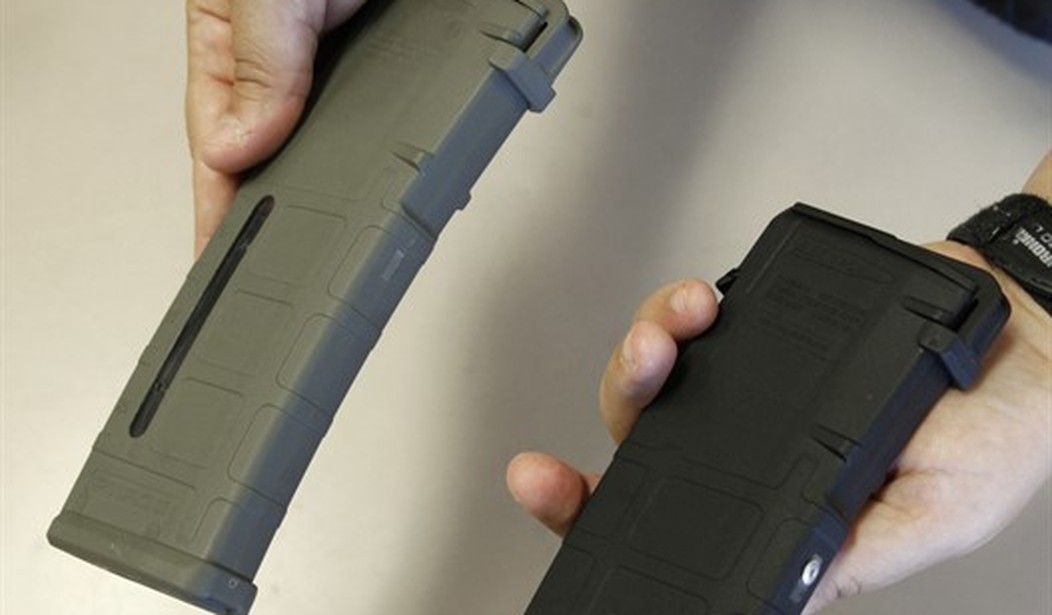
A coalition of 18 Democrat attorneys general have filed a brief with the D.C. Court of Appeals urging the court to grant an en banc request by the District of Columbia in order to reverse a decision that found the District's ban on "large capacity" magazines a violation of the Second Amendment. Though the D.C. Court of Appeals isn't a part of the federal judiciary, anti-gunners are panicking over the possibility that the decision could give the Supreme Court even more reason to take up the issue, and they're doing everything they can to convince the appellate court to reverse course.
The attorneys general of New Jersey, Massachusetts, California, Colorado, Connecticut, Delaware, Hawai’i, Illinois, Maryland, Michigan, Minnesota, Nevada, NewYork, Oregon, Rhode Island, Vermont, Virginia, and Washington make several arguments in defense of the ban, none of which are particularly compelling in my admittedly biased point of view.
First, the AGs argue that en banc is warranted because every other court to consider a mag ban has upheld them. My response: so what? As my mom used to say, if all of your friends jumped off a cliff, would you do it too?
At the first step, even assuming that LCMs qualify as “arms,” but see Duncan v. Bonta, 133 F.4th 852, 867-68 (9th Cir. 2025) (en banc) (holding LCMS are not protected “arms”), they are not in common use for self-defense. Because “self defense is ‘the central component’ of the Second Amendment,” a weapon must be“‘in common use’ today for self-defense” to receive protection at the threshold, Bruen, 597 U.S. at 29, 32; the right “emphatically does not stretch to encompass excessively dangerous weapons ill-suited and disproportionate to such a purpose, ”Bianchi v. Brown, 111 F.4th 438, 452 (4th Cir. 2024) (en banc); see also, e.g., Dist.of Columbia v. Heller, 554 U.S. 570, 627 (2008) (weapons like M-16s “most useful in military service” and not typically possessed for self-defense are unprotected).
I had to include those citations because several of them completely misrepresent the position of the Supreme Court, which has held that arms that are in common use for lawful purposes including self-defense are protected by the Second Amendment. It's unquestionably true that magazines that can hold more than ten rounds are in common use, and millions of gun owners possess those magazines for a variety of lawful purposes including self-defense.
The AG's, though, contend that "LCMs are ill-suited for self-defense since 'civilian self-defense rarely—if ever—calls for the rapid and uninterrupted discharge of many shots,'" adding that "an average case in which a gun is fired in self-defense involves 2 shots, not more than 10."
As I already pointed out once today, the study that claim is based on has already been debunked, but there's also no guarantee that someone using a firearm in self-defense will find themselves in an "average" situation.
Next, the AG's claim the panel "erroneously relied primarily on the notion that LCMs are 'ubiquitous' and 'facilitate armed self-defense.' But the proper inquiry assesses whether a particular weapon is ‘in common use’ today for self-defense."
No, it's not. Again, the Supreme Court has never predicated the idea that a firearm must in common use for self-defense in order to be protected by the Second Amendment. If that was the case, then every bolt-action rifle in the country could be banned tomorrow, even though these same anti-gunners insist that those are the only arms necessary for hunting.
The AG's also try to change what SCOTUS has said by claiming that “dangerous or unusual" is interchangeable with “unusually dangerous." Frankly, that makes no sense whatsoever. An arm that is "dangerous and unusual" means deadly weapons that are not in common use. "Unusually dangerous," on the other hand, has been used by anti-gunners to describe the most popular rifles in the country as well as the hundreds of millions of "large capacity" magazines that are lawfully owned by American gun owners.
The panel insisted that aweapon can only be prohibited based on a conjunctive “dangerous and unusual” test,such that the “inquiry is over” if an arm is “in common and ubiquitous use.” Op. 25. But that simply ignores Blackstone and other commentators who also said weapons could be regulated when they were “dangerous or unusual”—indeed, using it interchangeably with the “dangerous and unusual” construction. Rather than grapple with this evidence, the panel insisted Heller already used the dangerous and unusual formulation. Op. 30 n.11. But more recently, Rahimi utilized the disjunctive phrase, dangerous or unusual, thus undermining the idea that Heller had established some conjunctive rule.
This is some disingenuous B.S. The Court was quoting Blackstone when it used that phrase. It didn't substitute the phrase for its own formulation of "dangerous and unusual." By the way, as much respect as I have for Blackstone, it's not like he was the infallible pope of jurisprudence. What, for example, is a non-dangerous weapon?
The AGs try to buttress this argument by noting that Bowie knives and slung shots were banned by some 19th century legislatures once it became clear that they were being used by criminals. Of course, if that was all that sufficed to outlaw an arm, then SCOTUS would have upheld D.C.'s ban on handguns in Heller, given that they are the weapon of choice for criminals.
They are also, however, the preferred choice of lawful gun owners when it comes to self-defense, just like the hundreds of millions of "large capacity" magazines that are used in conjunction with the tens of millions of semi-automatic firearms in this country.
The AG's make one final case for ignoring what SCOTUS has said about arms in common use: to rely on commonality opens the door for machine gun bump stock possession!
According to the ATF, as of June 2025, there were more than 230,000 registered machineguns that could be transferred between private individuals. That is more than the 200,000 stun guns in lawful circulation that two justices on the U.S. Supreme Court indicated were sufficiently common to receive Second Amendment protection, were a popularity test actually adopted. Of course, that cannot be right: the Supreme Court has held that granting Second Amendment protections to machineguns would be “startling.” And the same concerns apply to bump stocks, where circulation may exceed 500,000. So it cannot be the case that constitutional protections attach to a firearm based only on market circulation.
Bump stocks aren't "arms", and a rifle equipped with a bump stock isn't a machine gun under the federal definition. Cargill v. Garland wasn't a Second Amendment case, and the number of bump stocks in existence had no relevance to the Court's decision that the ATF overstepped its authority by classifying bump stocks as machine guns.
As for the commonality of machine guns themselves, the Sixth Circuit provided a rebuttal to the AGs assertions in U.S. v. Bridges last August. The appellate court accepted the government's contention that there are 175,977 civilian-owned, lawfully registered machineguns in the United States. As Bridges' attorneys argued, that number is larger than the approximately 300,000 Tasers, 200,000 stun guns, and 64,000 nunchucks, all of which at least some courts have ruled are protected by the Second Amendment.
Yet these weapons—stun guns, nunchaku, and tasers on the one hand and machineguns on the other—are not comparable when it comes to whether they are “typically possessed by law-abiding citizens for lawful purposes.”...And machineguns—unlike stun guns, nunchaku, and tasers—are designed for a specific function: to fire as many bullets in as little time as possible. See Cargill, 602 U.S. at 432–33 (Sotomayor, J., dissenting). That function makes this type of weapon exceedingly dangerous and uniquely adapted for unlawful purposes. Although stun guns and tasers, “like handguns, are weapons that can injure or kill,” Avitabile, 368 F. Supp. 3d at 413 (citation omitted); see also Caetano, 577 U.S. at 413 (Alito, J., concurring), they cannot “kill dozens of people within a matter of seconds,” Henry, 688 F.3d at 640. Likewise, people typically possess nunchaku—“a tool from the sphere of martial arts”—“for recreational and other lawful purposes.” Maloney, 351 F. Supp. 3d at 235 (citation omitted). They, unlike machineguns, have “no special propensity for unlawful use.”
As Second Amendment advocates we might not like the Sixth Circuit's rationale, but it does show that the courts aren't going to automatically declare machine guns are protected arms just because the D.C. Court of Appeals says a ban on "large capacity" magazines is unconstitutional. LCMs aren't designed to "fire as many bullets in as little time as possible." Indeed, they don't increase the rate of fire at all. They don't have a special propensity for unlawful use, nor can they kill "dozens of people within a matter of seconds." They are, however, owned for self-defense as well as for recreational and other lawful purposes.
I assume that the D.C. Court of Appeals is going to grant the District's en banc request, and that decision has nothing to do with this particular amicus brief. Whether or not these arguments will persuade any of the judges that will likely rehear the case remains to be seen, but I think it's easy enough to refute and debunk each every one of the points the anti-gun AGs have made.
Editor’s Note: Second Amendment advocates aren't giving up on anti-gun like Washington, D.C., and even small victories can add up to big wins.
Help us continue to report on and these efforts. Join Bearing Arms VIP and use promo code FIGHT to get 60% off your VIP membership.








Join the conversation as a VIP Member