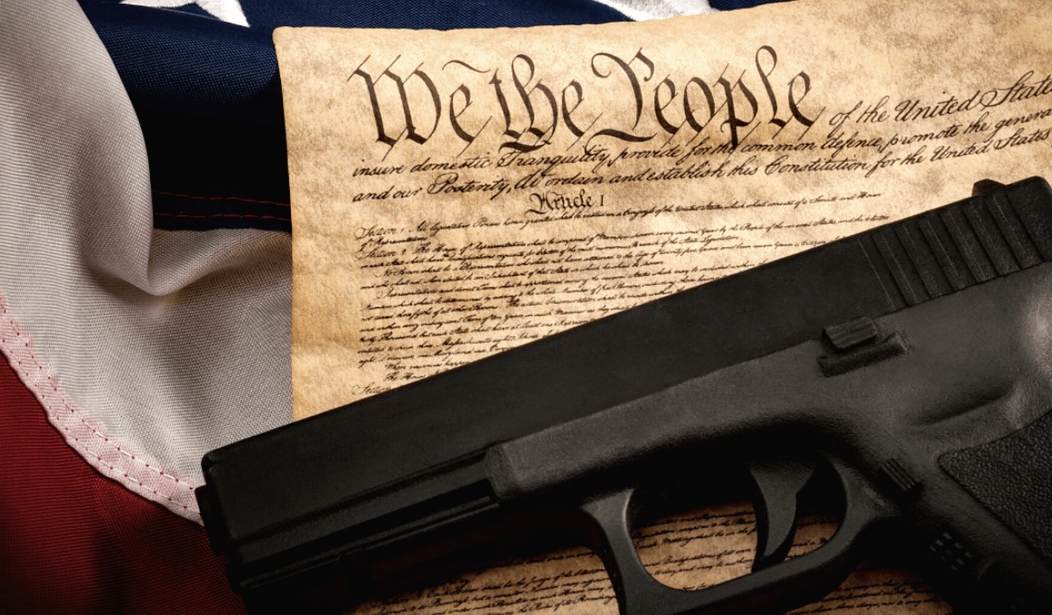
The Duke Center for Firearms Law still has a veneer of academic respectability, but under the leadership of Hayley Lawrence the Center has gone from a somewhat stealthy embrace of the positions of gun control advocates to a more out-and-proud opposition to treating the Second Amendment as the fundamental right that it is.
Lawrence has worked with groups like Brady United, Giffords, and Everytown for Gun Safety, so it's no surprise that Duke Center for Firearms Law has been a more vocal proponent of gun control under her watch. The latest example comes from Lawrence's column on the recent D.C. Court of Appeals decision that struck down Washington, D.C.'s ban on "large capacity" magazines; a decision that, unsurprisingly, Lawrence doesn't agree with.
The District asserted that LCMs are not “in common use” because “it is extremely rare for an individual to fire more than ten rounds in self-defense.” But again looking to Heller, Judge Deahl explained that the Second Amendment is “not concerned with how often arms [a]re actually fired in self-defense”; rather, Heller requires that we ask only whether the arms at issue were “typically possessed by law-abiding citizens for lawful purposes.”
To me, that’s conflating two different principles. Either we ask whether the weapon is in common “use” for self-defense—which is to say, the data shows us that people actually use the arm at issue to defend themselves—or we ask whether the weapon is commonly owned or possessed with the intention of using it for self-defense (which is what Judge Deahl apparently suggests).
Kudos to SAF Director of Legal Research and Education Kostas Moros for flagging this and pointing out that Lawrence has it all wrong.
No, we ask neither of these. We ask, as the Supreme Court said, whether the arms are typically POSSESSED for LAWFUL PURPOSES.
— Kostas Moros (@MorosKostas) April 14, 2026
Personal self-defense is but one of those purposes.
Also, that comes at the historical analysis anyway, not at the plain text, which is concerned… https://t.co/F93HkPbSMk pic.twitter.com/Hj5TYzcMff
Lawrence also took issue with Judge Deahl's argument that most guns possessed for self-defense will never be fired in self-defense at all, but that doesn't mean that ammunition could be banned just because most guns aren't "used" in self-defense shootings or because "blanks might suffice to scare most attackers off without live ammunition."
Deal went on to point out that “law-abiding citizens . . . regularly fire more than 10 rounds for lawful purposes like target practice and marksmanship,” which are other lawful purposes protected by the Second Amendment.
Lawrence sniffs that, "[a]t bottom, the technology in use today differs in degree and kind to the arms technology with which our forebears were equipped. If originalists care about anything, it should be understanding the practical realities of the world in which the Founders lived and legislated."
The second overarching issue is the profound intellectual dishonesty of the “common use” doctrine. Defining the bounds of a constitutional right by metrics of what is in common use today is necessarily an unoriginalist—and indeed living constitutionalist—principle. Allowing consumers and gun manufacturers define the scope of the Second Amendment before legislatures can act is no way to do constitutional law. Indeed, in no other constitutional context would we even countenance such a thought. And as a recent paper by Andrew Nell explains, even setting aside the merits of the common use test, it has proved unadministrable at best, and “hopelessly subjective” at worst.
You don't have to be a gun control activist to have concerns about how the "common use" test can be used and abused. As we just saw in the Second Circuit decision upholding NYC's ban on stun guns, some judges are improperly putting the onus on plaintiffs to prove that some bearable arms are in common use in order to have standing to sue, instead of following the Supreme Court's guidance in Heller and Caetano that all bearable arms are prima facie protected by the Second Amendment, which puts the burden on the defendants to prove that the arm in question is actually "dangerous and unusual."
But Lawrence should be careful what she wishes for. A truly originalist reading of the Second Amendment would encompass virtually every bearable arm suitable for self-defense and other lawful purposes; not just 20-round magazines and stun guns, but things like machine guns as well. I know that SCOTUS isn't ready to go that far yet, but the right to keep and bear arms that shall not be infringed didn't come with an asterisk or fine print.
Editor’s Note: The radical left will stop at nothing to enact their radical gun control agenda and strip us of our Second Amendment rights.
Help us continue to report on and expose the Democrats’ gun control policies and schemes. Join Bearing Arms VIP and use promo code FIGHT to get 60% off your VIP membership.










Join the conversation as a VIP Member