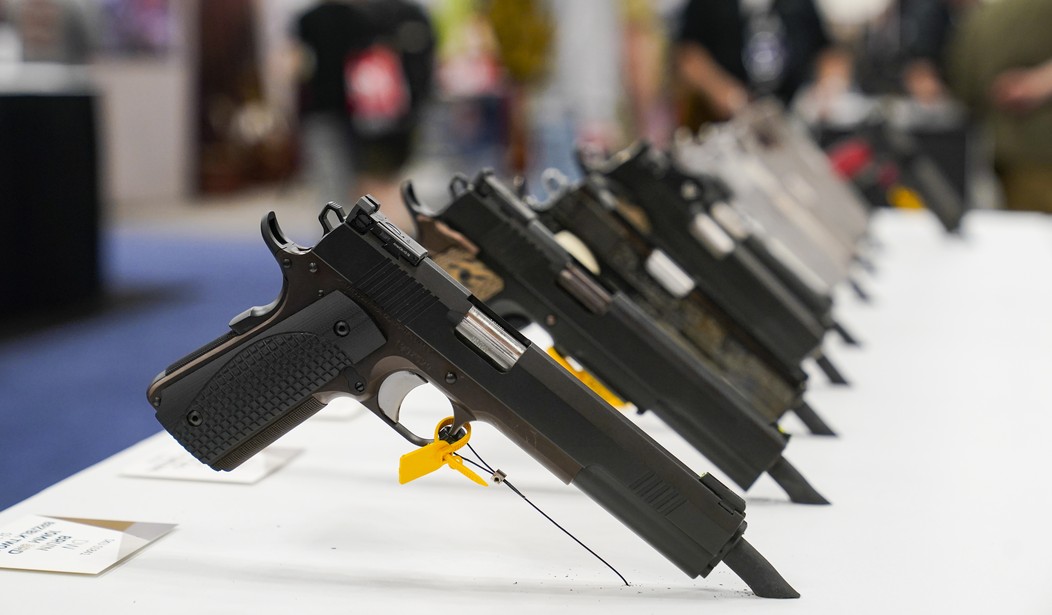
At the moment, the answer to that question is "yes." Massachusetts gives broad discretion to police chiefs to approve or deny licenses to carry, which are also required for anyone wanting to keep a handgun in their home. Even though the Supreme Court said in Bruen that "may issue" licensing schemes violate the Second Amendment, the state continues to let chiefs use their own discretion in determining whether someone is "suitable" to possess a handgun, even if they can pass a NICS check and have submitted proof of the training the state requires for a license.
Randy Westbrook is challenging this policy. Three years ago, the chief of the Holyoke Police Department rejected Westbrook's application based on two criminal cases involving Westbrook more than a decade earlier. One was a case where Westbrook was charged with domestic assault and battery and aggravated assault and battery that ended up not being prosecuted. The other incident involved charges of Conspiracy to Violate the Controlled Substances Act and Possession with the Intent to Distribute. In that case, Westbrook took a "Continuance Without a Finding," which meant he did not admit guilt but conceded prosecutors had enough evidence to find him guilty. Westbrook was sentenced to and successfully completed probation, at which point the charges were dismissed.
In other words, Westbrook was never convicted on any of the charges he'd faced more than a decade before he applied for his license to carry, but then-Chief David Pratt still found him "not suitable" to possess a handgun. Westbrook sued, and a district court agreed that the state's licensing laws are unconstitutional. A Superior Court judge, however, overturned that decision and kept the denial in place.
On Wednesday, the Supreme Judicial Court in Massachusetts heard oral arguments in Westbrook's case. The audio of the oral arguments isn't online yet, and the only news coverage that I've seen is behind a paywall. The headline "Mass. justices look to Shays’ Rebellion in deciding gun licensing question" from MassLive, though, suggests that at least some members of the SJC were more interested in finding a way to get around Bruen than adhering to its edict.
Sitting in a courtroom mere blocks from where Daniel Shays and his rebels clashed with troops outside the Springfield Arsenal, the state’s highest court explored how that incident at the dawn of the country’s founding informs gun laws today.In a special Hampden County session Wednesday, the Supreme Judicial Court considered a case that could change the role police chiefs have in deciding who can receive permits to carry guns.
My guess is that the SJC was pointing to a law passed in the state after Shays' Rebellion was over. The Disqualification Act of 1787 established conditions for participants in the rebellion to receive pardons. Among those conditions was turning over their guns to authorities.
The SJC has previously cited the Disqualification Act in a 2012 case called Commonwealth v. McGowan. In the court's view, the 1787 law demonstrated that there were laws banning gun possession by certain categories of people at the time of the Founding.
I'll be listening to the oral arguments as soon as they're available, but my guess is that one or more members of the SJC pondered whether the Disqualification Act was an example of disarming individuals based on their "suitability" and not an outright conviction.
The argument could have gone in the opposite direction too, though. The Disarmament Act only required participants in the rebellion to give up their guns for three years, and there's evidence that firearms were returned much earlier. An amicus brief co-authored by Second Amendment scholar Steve Halbrook in the Rahimi case also argued that while participants in Shays' Rebellion had to turn over the guns they owned, they were not prohibited from purchasing firearms, even during that three-year period.
The counter-argument, then, is that even if Massachusetts historically required people who had participated in an armed rebellion to surrender their weapons, it was only for a limited period, which suggests there were limits on the government's authority to impose indefinite disarmament based on past misconduct.
I think the Disqualification Act is a bit of a red herring anyway, but even if the SJC wants to consider it important, I don't believe it really helps Pratt's argument.
The bottom line is that the Supreme Court has said that licensing schemes that are based on objective criteria are presumptively constitutional, while those that are based on subjective criteria violate the Second Amendment. It should be relatively easy for the court to find in Westbrook's favor, but this is Massachusetts we're talking about, and things are rarely easy for those trying to exercise their Second Amendment rights there.
Editor’s Note: The radical Left will stop at nothing to enact their extreme gun control agenda and strip us of our Second Amendment rights.
Help us continue to report on and expose the Democrats’ gun-grabbing schemes. Join Bearing Arms VIP and use promo code FIGHT to receive 60% off your membership.







Join the conversation as a VIP Member