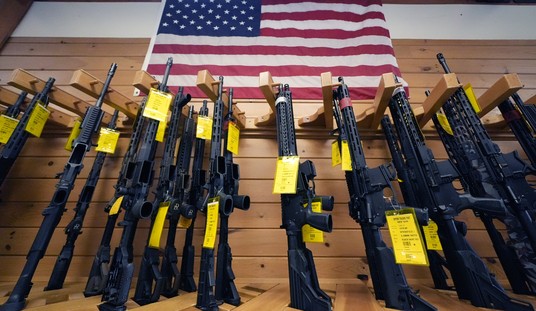

A group of historians has weighed in on the Supreme Court's upcoming review of bans on so-called assault weapons, and unlike some of the other amicus briefs filed in Viramontes v. Cook County and Grant v. Higgins, this one offers more than an argument that AR-15s are basically machine guns with a different trigger mechanism.
The historians contend that restrictions on semiautomatic rifles and ammunition magazines fit comfortably within a longstanding American tradition of regulating weapons that lawmakers considered particularly dangerous. Their evidence ranges from colonial restrictions on carrying weapons to nineteenth-century bans on Bowie knife sales, Reconstruction-era confiscations of Winchester rifles, and the machine gun laws adopted during the 1920s and 1930s.
There's some interesting history here, and I'll give the historians credit for making a more sophisticated argument than simply declaring that modern rifles are too dangerous to be constitutionally protected. But the more closely you examine their examples, the harder it becomes to see how they justify banning millions of Americans from possessing firearms that are commonly owned for lawful purposes.
The brief begins by arguing that the Founding generation's relative lack of restrictions on repeating firearms doesn't tell us much about the Second Amendment's scope. The historians acknowledge that repeating guns existed in the eighteenth century, but say those weapons were expensive, unreliable, and exceedingly rare.
They specifically discuss the Cookson repeater, Joseph Belton's experimental firearm, and the Girardoni air rifle carried by Lewis and Clark. None of them, they argue, were sufficiently common to justify any kind of legislative response to their use. Of course, the fact that the Founders didn't regulate repeating firearms because they were uncommon doesn't establish that they would have prohibited them if they'd become popular either.
And that's where the historians' argument begins to get slippery.
They contend that the development of more powerful and widely available weapons during the nineteenth century prompted a wave of new restrictions, particularly on Bowie knives.
Oh it's going to be another bowie knife brief that ignores or downplays the ACTUAL 19th century analogue to AR15s (revolvers and repeating rifles) https://t.co/S0AwxpF7lt
— SAF (@2AFDN) October 28, 2026
This is probably the strongest part of their brief, but that's not saying much.
Bowie knives were widely owned, used for lawful purposes including self-defense, and notorious for their use in violent confrontations. States responded with everything from restrictions on concealed carry to heavy taxes on sales and, in a couple of outlier cases, outright prohibitions on selling the knives.
Tennessee's law was particularly severe. As the historians point out, the Tennessee Supreme Court interpreted the legislature's intention as essentially eliminating Bowie knives from use. Georgia also prohibited their sale, while Alabama imposed a $100 tax on transactions involving the weapons, a substantial amount of money in the 1830s. But as Kostas Moros noted on X, that $100 tax wasn't long-lived.
Also, note how they say "other jurisdictions," plural, as if there were a lot of these punitive taxes. No, it was just Alabama. The other taxes on possession were $1-$2, and only a few of those existed. There were some taxes on dealers in the $50+ range, but that was an annual tax, not per-sale.
— SAF (@2AFDN) October 28, 2026
The historians argue that these restrictions demonstrate that widespread lawful ownership doesn't necessarily prevent lawmakers from banning a particular weapon, but they can only point to three states, all of them in one geographic region of the country, that implemented what amounted to a ban on the sale of those knives. Otherwise, the historians treat a variety of different restrictions as though they're all interchangeable.
A prohibition on concealed carry isn't the same thing as a prohibition on possession. Neither is a tax on sales, however burdensome. And while Tennessee's restrictions were unusually broad, one state's treatment of Bowie knives doesn't automatically establish a national tradition of prohibiting commonly owned weapons.
The historians recognize that distinction, but their explanation for why outright possession bans were uncommon is that nineteenth-century governments lacked the resources to enforce them. In other words, we're supposed to believe that the absence of widespread possession bans doesn't reflect any constitutional limitations on government power. Lawmakers just didn't have the bureaucratic machinery to take people's weapons away.
However, that argument is weakened by the historians' reference to restrictions on repeating rifles during the Reconstruction Era.
During Reconstruction, South Carolina's Republican governor, Robert K. Scott, armed members of the state militia with Winchester repeating rifles to help combat violent white supremacist organizations. Members of the Ku Klux Klan and their allies subsequently acquired Winchesters of their own.
According to the brief, Scott's administration confiscated rifles from Klansmen and directed militiamen to return their weapons to state arsenals.
The historians also cite an 1878 South Carolina law requiring civilians to return Winchesters that had been intended for state use, but they present no evidence that South Carolina (or any other state) banned the commercial sale of Winchester rifles to ordinary civilians. Nor does the brief identify a general prohibition on possessing privately owned Winchesters. Instead, they offer up one state confiscating weapons from violent insurrectionists and recovering firearms belonging to the state as an analogue to the gun bans in question, which prohibit a law-abiding citizen from purchasing a semiautomatic rifle.
The historians offer another example from Louisiana, where Adjutant General James Longstreet issued orders in 1870 restricting how Winchester rifles in the New Orleans armory could be handled or used during military drills. Again, that's an example of government control over military equipment, not a prohibition on private gun ownership.
Finally, the brief turns to the twentieth century and the rise of automatic and semiautomatic firearms.
The historians describe the technological advances that made modern repeating firearms possible, including smokeless powder, self-loading mechanisms, and detachable magazines. They then discuss the criminal misuse of Thompson submachine guns and the resulting wave of machine gun legislation during the 1920s and 1930s.
They acknowledge that most of these laws targeted automatic firearms, though some statutes also restricted certain semiautomatic weapons based on ammunition capacity. That distinction is crucial.
The fact that states regulated machine guns doesn't establish a historical tradition of banning ordinary semiautomatic rifles. And the existence of some twentieth-century restrictions on semiautomatic firearms doesn't necessarily establish a tradition stretching back to the Founding or Reconstruction.
The historians also rely on the argument that modern firearms possess vastly greater killing power than their eighteenth-century predecessors. They cite research claiming that an AR-15 can deliver more kinetic energy in a minute than 25 Brown Bess muskets (an argument echoing another brief we covered earlier today).
The Supreme Court has repeatedly rejected the notion that the Second Amendment protects only weapons that existed when the Bill of Rights was ratified. Modern firearms are plainly different from eighteenth-century muskets. So are modern methods of communication from the printing presses of 1791, but that doesn't mean the First Amendment's protection extends only to quill pens, parchment paper, and printing presses.
Restrictions on concealed carry, outlier taxes on knife sales, orders governing militia arsenals, confiscations from violent insurgents, and prohibitions on fully automatic weapons don't collectively establish a tradition of banning commonly owned semiautomatic rifles.
The historians have demonstrated that Americans have regulated weapons throughout our history. They haven't demonstrated that those regulations gave the government unlimited authority to decide which commonly owned arms ordinary citizens may possess.
The existence of historical gun laws isn't in dispute. Whether those laws justify today's sweeping prohibitions on AR-15s and other semiautomatic firearms is another matter entirely, and I don't think the historians have made a compelling argument at all.